Boat Fender Size Calculator
Estimate fender diameter, fender length, quantity, and protection score from boat length, beam, loaded displacement, dock face, freeboard, wind exposure, rafting risk, fender shape, and unit system.
🛟Named fender sizing presets
⚙Boat, dock, and fender inputs
Model: the calculator builds a base fender size from length, beam, and displacement, then adjusts for dock hardness, freeboard coverage, wind exposure, rafting or contact risk, and fender shape.
Fender sizing results
Calculation breakdown
📊Fender shape data grid
Cylindrical Side
Center-Hole Cylinder
Round Ball
Flat Panel
🚤Fender, boat, and dock comparison grid
Small Boat Day Dock
Light hulls at floating docks usually need enough diameter for rub-rail spacing and enough count to protect bow, beam, and stern.
Center Console Slip
Moderate beam and higher topsides make side coverage important, especially where the dock edge sits below the rub rail.
Cruiser or Sailboat
Displacement, freeboard, and spring-line movement can push the recommendation toward longer cylinders or center-hole fenders.
Rafting or Rough Wall
Raft-ups, lock walls, and work docks need more standoff, more quantity, and a harder look at contact points along both sides.
📋Reference tables
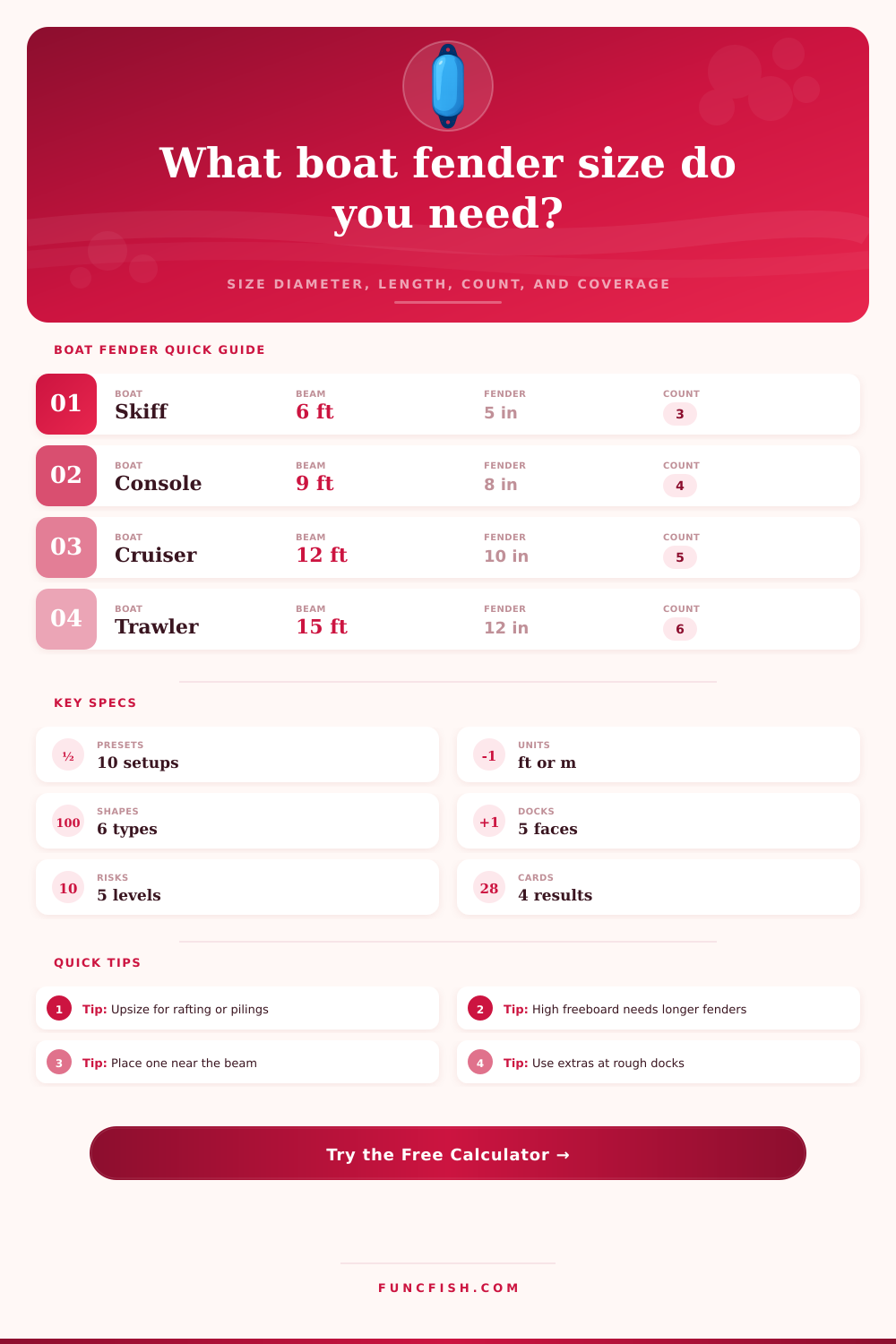
| Boat length class | Typical beam | Starter fender diameter | Common quantity |
|---|---|---|---|
| 8 to 14 ft / 2.4 to 4.3 m | 3.5 to 6 ft / 1.1 to 1.8 m | 4 to 5 in / 10 to 13 cm | 2 to 3 fenders |
| 14 to 22 ft / 4.3 to 6.7 m | 5 to 8 ft / 1.5 to 2.4 m | 5 to 6.5 in / 13 to 17 cm | 3 to 4 fenders |
| 22 to 32 ft / 6.7 to 9.8 m | 8 to 10.5 ft / 2.4 to 3.2 m | 6.5 to 8.5 in / 17 to 22 cm | 4 to 5 fenders |
| 32 to 45 ft / 9.8 to 13.7 m | 10 to 14 ft / 3.0 to 4.3 m | 8.5 to 12 in / 22 to 30 cm | 5 to 7 fenders |
| 45 to 65 ft / 13.7 to 19.8 m | 13 to 18 ft / 4.0 to 5.5 m | 12 to 18 in / 30 to 46 cm | 6 to 9 fenders |
| Dock type | Modeled hardness | Coverage note | Fender cue |
|---|---|---|---|
| Floating finger pier | 0.92 factor | Dock rises with the boat in tide or lake level changes. | Standard cylinders often fit well. |
| Fixed dock or pier | 1.08 factor | Contact height changes with tide, wake, or loading. | Check freeboard coverage. |
| Piling face or timber piles | 1.18 factor | Point contact can concentrate load on one fender. | Round or center-hole fenders help. |
| Seawall or hard bulkhead | 1.25 factor | Flat hard faces increase compression and rub risk. | Use more standoff and more units. |
| Rough work dock or lock wall | 1.32 factor | Irregular edges and vertical faces demand redundancy. | Oversize and spread the load. |
| Fender shape | Best use | Diameter behavior | Length behavior |
|---|---|---|---|
| Cylindrical side fender | Most slips, side ties, and short stays | Baseline standoff | Good vertical coverage |
| Center-hole heavy cylinder | Heavier hulls, longer stays, and rougher docks | Slightly denser cushion | Longer working body |
| Round ball fender | Piles, rafting, and broad standoff needs | Needs larger nominal diameter | Shorter vertical body |
| Flat or foam panel fender | Low freeboard boats and rail protection | Less side standoff | Panel coverage matters |
| Contour or low-profile fender | Rub rail matching and curved hull contact | Efficient fit on shaped hulls | Moderate vertical coverage |
| Oversize rafting ball | Raft-ups, lock walls, and high contact | Largest standoff | Use with extra placement care |
| Exposure or contact case | Wind model | Contact behavior | Quantity cue |
|---|---|---|---|
| Sheltered basin, watched tie-up | 20 mph / 32 km/h | Low movement and short duration | Base count usually works. |
| Normal marina slip | 30 mph / 48 km/h | Moderate surge and routine docking bumps | Add one if dock face is hard. |
| Open fetch or busy dock | 40 mph / 64 km/h | Wake can load one contact point repeatedly | Protect bow, beam, stern, and quarter. |
| Windy coastal slip | 50 mph / 80 km/h | Sustained side pressure and more line motion | Use higher count and larger size. |
| Storm or high contact check | 60 mph / 97 km/h | Shock, chafe, and compression are likely | Use redundant fenders on both sides. |
💡Fender sizing tips
A diameter can be adequate while the fender body is too short to cover the real contact band. Fixed docks, tide, and high rub rails usually need longer vertical coverage.
Place fenders where the hull actually touches: one near the beam, one near the stern quarter, one forward, and extras where pilings, rafting, or wake movement concentrate load.
Use this as a sizing estimate for normal boating decisions. Inspect the actual dock face, rub rail height, hull flare, cleats, lines, and fender attachment points before leaving the boat unattended.
When choosing boat fenders, there are many differents factors that you must consider. If you choose the correct boat fender for your boat, you can avoid the situation where the boat hull rub against the dock. Most people makes the mistake of choosing boat fenders based on what is on sale or the boats that they have used on previous boats.
When choosing boat fenders, you must consider the size of the boat, the displacement of the boat, the type of dock you use, and the environmental factor. The length of your boat will play a key role in what type of boat fenders you must purchase. The longer the boat, the more fender coverage your boat will require.
How to Choose the Right Boat Fenders
This is due to the fact that a longer boat will have more contact with the dock and will swing more when the line is stretch out. The beam of the boat will also play a role in how many fenders you need. Boats that has a wide beam will push the boat further from the dock.
Therefore, the boat fenders must accommodate for the boat beams so that the boat does not experience excessive compression against the dock. Finally, the displacement of the boat is another consideration. The heavier the boat, the more force that act on the dock.
This means that the boat fenders must have a large enough diameter so that the boat does not ride over the boat fender. The freeboard of the boat is another often overlooked factor. The freeboard is the distance between the boats waterline and its rub rail.
The boat fender must have enough length to reach to the boat’s rub rail. If the boat fender is too short, the boat fender will not be able to protect the boat’s hull. The boat may move up and down with the change of tides or due to the movement of the waves.
A boat fender that does not provide for the movement of the boat may only protect the boat against the air. The type of dock that you use will also play a role in the type of boat fenders that you use. If you have a floating dock, you will have to worry less about boat fenders because the dock will rise and fall with the boat.
On the other hand, if you use a fixed pier or seawall, you will have to take into account the fact that the dock will not move. This can cause the contact between your boat and the dock to change. Therefore, the boat fender will have to be more robust to handle such changes in contact.
If the dock has pilings or lock walls, you should use round boat fenders so that the boat fenders can better work against the loads of the dock structures. Wind and other boats may play a role in the boat fenders that you purchase. The force of the wind can push the boat against the dock.
Therefore, the boat fender will have to take the force of the wind. In addition, if your boat often raft with other boats, the rafted boat fenders must be able to provide for the contact between boats. Rafting boats can cause additional fender coverage requirement to accommodate the contact between boats.
The boat fenders should have a large enough diameter to avoid contact between the hulls of the rafted boats. In addition, there should be enough quantity of boat fenders so that no single boat fender takes the force of the rafted boats’ contact with each other. The shape of the boat fender can have a major impact on the type of protection that it will provide.
For instance, cylindrical boat fenders will provide coverage for the boat when it docks in slips. Round boat fenders will provide more standoff between the boat and the pilings or dock structures that it docks to. Round boat fenders cover less of the boat’s height than cylindrical boat fenders.
Flat panel boat fenders will be closer to the boat’s hull so that they can provide protection to the boat’s hull. However, there will be less protection from the flat panel boat fenders than with cylindrical boat fenders. The placement of the boat fenders is also important.
Depending on the type of boat that you have, there are some areas of the boat that will require more focus on boat fender placement. Place at least one boat fender near the boat’s beam. Another boat fender should be placed near the stern quarter of the boat as this is the area of the boat that will swing when the boat is moored.
In addition, there should be a boat fender placed near the bow of the boat so that the bow will be protected when the boat moves lateral. Place boat fenders in these locations so that the boat fender will best match the contact points between the boat and the dock. Most people make several mistakes when purchasing boat fenders.
For instance, many people purchase the same brand of boat fenders that they used for their previous boats. In addition, many people do not consider the fact that their new boat may have a different freeboard or that the docks that they use may be harder to contact with boat fenders. Finally, people may not account for the presence of wind or other boats when setting up the boat fenders on the boat.
If you follow the information provided in the reference table regarding starting diameters and quantities of boat fenders, use the boat fender calculator to account for your boats specific characteristic, and walk the dock with your boat in place to make any adjustments in the placement of the boat fenders, you will have a boat fender setup that is prepared to handle the contact between your boat and dock.