Boat Cleat Size Calculator
Size dock cleats from boat length, displacement, dock line diameter, wind exposure, mooring type, cleat material class, lead angle, safety factor, and unit system.
📌Named cleat sizing presets
⚙Boat, line, cleat, and mooring inputs
Model: the calculator checks three limits: dock line horn-wrap geometry, boat length sizing practice, and estimated working load per cleat after wind, mooring, angle, material class, and safety factor adjustments.
Boat cleat size results
Enter boat and dock line details to calculate a cleat recommendation.
Calculation breakdown
🔩Cleat material class grid
Polymer utility
Cast aluminum
Galvanized steel
Stainless or bronze
The model values are planning estimates in pounds of working load per inch of cleat length. Actual hardware depends on casting, fasteners, backing, deck core, and installation.
📏Cleat, line, and boat comparison grid
Trailer skiff
Short dock stops, light windage, and smaller three-strand or double-braid dock lines.
Bay and bass boat
Common slip and launch-ramp hardware range where line handling matters as much as strength.
Offshore trailer boat
Heavier displacement, taller topsides, and steeper spring-line loads often move sizing upward.
Cruiser or workboat
Permanent berths, stronger current, and large line loads call for larger cleats and backing.
📊Cleat sizing reference tables
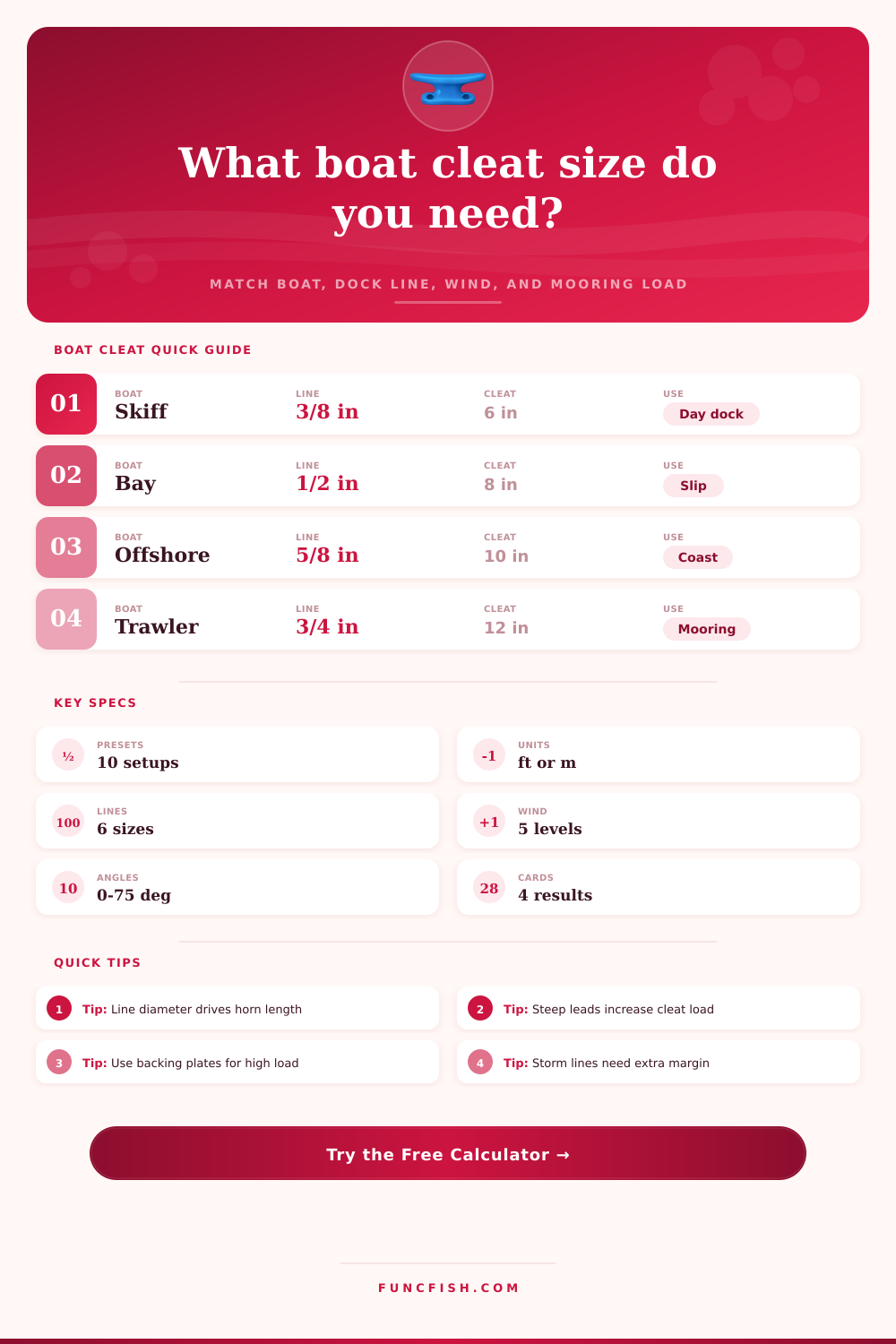
| Dock line diameter | Minimum cleat length | Best boat range | Handling note |
|---|---|---|---|
| 5/16 in / 8 mm | 5 in / 127 mm | Small tenders and dinghies | Short stops and protected water only. |
| 3/8 in / 10 mm | 6 in / 152 mm | Skiffs and light fishing boats | Gives enough horn space for normal turns. |
| 1/2 in / 13 mm | 8 in / 203 mm | Bay boats, pontoons, small cruisers | Common all-round dock line and cleat match. |
| 5/8 in / 16 mm | 10 in / 254 mm | Offshore trailer boats | Use longer cleats for spring lines or wind. |
| 3/4 in / 19 mm | 12 in / 305 mm | Cruisers and trawlers | Room for secure figure-eight turns matters. |
| 1 in / 25 mm | 16 in / 406 mm | Large or commercial craft | Hardware and backing usually govern. |
| Boat length class | Typical displacement | Starter cleat size | Common dock line |
|---|---|---|---|
| Under 16 ft / 4.9 m | 300 to 1800 lb / 140 to 820 kg | 4 to 6 in / 102 to 152 mm | 5/16 to 3/8 in / 8 to 10 mm |
| 16 to 22 ft / 4.9 to 6.7 m | 1200 to 4500 lb / 540 to 2040 kg | 6 to 8 in / 152 to 203 mm | 3/8 to 1/2 in / 10 to 13 mm |
| 22 to 30 ft / 6.7 to 9.1 m | 3500 to 12000 lb / 1590 to 5440 kg | 8 to 10 in / 203 to 254 mm | 1/2 to 5/8 in / 13 to 16 mm |
| 30 to 40 ft / 9.1 to 12.2 m | 9000 to 30000 lb / 4080 to 13600 kg | 10 to 15 in / 254 to 381 mm | 5/8 to 3/4 in / 16 to 19 mm |
| 40 to 55 ft / 12.2 to 16.8 m | 22000 to 70000 lb / 9980 to 31750 kg | 15 to 18 in / 381 to 457 mm | 3/4 to 1 in / 19 to 25 mm |
| Wind and mooring case | Model wind speed | Load behavior | Adjustment cue |
|---|---|---|---|
| Sheltered day dock | 20 mph / 32 km/h | Low shock and short duration | Geometry often governs size. |
| Normal marina slip | 30 mph / 48 km/h | Moderate windage and normal surge | Good baseline for overnight ties. |
| Open basin or fetch | 40 mph / 64 km/h | Higher surge and side loading | Check spring-line angle carefully. |
| Windy coastal dock | 50 mph / 80 km/h | More sustained load per cleat | Upsize hardware and backing margin. |
| Storm preparation | 60 mph / 97 km/h | High load, shock, and chafe risk | Use redundant lines and conservative factor. |
| Cleat material class | Modeled working load | Typical location | Installation note |
|---|---|---|---|
| Polymer or light utility | 90 lb/in / 16 kg/cm | Small deck or light dock use | Use only for low load utility ties. |
| Light aluminum alloy | 160 lb/in / 29 kg/cm | Small boats and light docks | Backing and fasteners remain limiting. |
| Cast aluminum deck cleat | 220 lb/in / 39 kg/cm | Common recreational boat decks | Use a backing plate on cored decks. |
| Galvanized steel dock cleat | 300 lb/in / 54 kg/cm | Dock, pier, and work platforms | Substrate strength can govern the system. |
| Stainless or bronze cleat | 340 lb/in / 61 kg/cm | Marine deck and high-duty installs | Match fasteners and backing to the load. |
💡Cleat sizing tips
A cleat that is strong enough can still be too short for the dock line. Keep enough horn length for clean figure-eight turns, especially with larger double-braid or three-strand lines.
High calculated loads should be checked against fastener size, backing plates, deck core, dock framing, chafe gear, and line layout. Split loads across additional cleats when practical.
When choosing the correct cleat size for a boat, you must consider the load that the cleat will have to bear while the boat is moored to the dock using lines. The size of the boats line, and docking environment will all play a role in determining the size of the cleat that will best secure the boat to the dock. Selecting a wrong cleat size for a boat will result in the cleat not performing in the manner in which it should with the lines attached to the boat.
The diameters of the line that will be attached to the boat and the size of the cleat are directly related. The diameter of the line will dictate the number of turns that the line will make in relation to the cleat horns. Using a cleat that is too short for the diameter of the line will cause the line to bind to the cleat.
How to Choose the Right Cleat Size for Your Boat
Using a cleat that is too large for the line will waste the cleat’s deck space and may cause the cleat to fail if the backing plates isnt of sufficient strength. To determine the cleat size for a boat, a calculator is available online. This calculator will ask for the length of the boat, the boats displacement, the size of the mooring line, the exposure to the wind, the type of mooring setup, the angle of the lead of the boat, the material class of the cleat, and the safety factor.
Each of these factors is necessary to ensure that the calculated cleat size will be apropiate for the boat. Boat length and boat displacement are related to each other and to cleat size. The longer and more heavy the boat, the more load that it will place on the cleat when moored.
A small boat will not place as much load on the cleat as a larger vessel. Wind exposure will impact the load on the cleat. Boats that are exposed to more wind will place more load on the cleat than boats in sheltered areas.
Mooring type determines how long the boat will remain unattended at the dock, and the type of mooring will impact which cleats bears the boats weight. Lead angle impacts the load that is placed on the cleat; the steeper the angle of the boat lead, the less load that is placed on the boat’s deck; the flatter the angle, the more load will be placed on the deck. Material class determines the strength of the cleat.
Polymer cleats are very light and often used on small boats. However, they reach their working limit quickly. Stainless steel and bronze cleats will handle more load than polymer cleats and is also more resistant to corrosion.
However, they, like all cleats, will fail if not installed correctly into the boats deck. The online cleat size calculator will use the material class of the cleat to determine the cleat’s capacity per inch of the cleat’s length. The calculator will compare that capacity to the working load of the boats line and cleat setup after the user has input the safety factor to determine a recommended cleat size that includes a safety margin.
The line-to-cleat ratio ensures that there is enough horn length of the cleat to allow the line to make the necessary number of turns with the cleat. If the ratio is too low, the line will crowd the cleat. If the ratio is generous, the line will easily slide into the cleat without resistance.
Checking the line-to-cleat ratio is important because it can reveal possible problems with the cleat and line setup that are not indicated by the calculations of the size of the cleat. Finally, it is important to account for additional variables of the docking environment. Docking calculators do not account for the strength of the boats deck.
The core of the deck may be soft or the cleat fasteners may hit the bottom of the boats fiberglass. The type of pilings on which the boat will be moored may shift when the boat is loaded or unloaded. The cleat line may experience changes in angles due to the movement of the boat caused by the wind or the water currents.
Additionally, many experienced boaters will add an additional margin to the size of the cleat calculated by the calculator because many of these experienced boaters may need extra security for their boat if the boat will be moored for extensive periods of time. The safety factor input on the online cleat size calculator can be used to add this extra margin to the calculated cleat size. Many people make mistakes when choosing the size of the cleat for their mooring lines.
Some of the most common mistakes include only considering the diameter of the mooring line when choosing the size of the cleat; they fail to consider the displacement of the boat. Other people choose a cleat size according to the length of the boat but dont consider the diameter of the mooring lines. Some people may choose a stainless steel cleat for its strength and do not consider the working load of the cleat.
These human error can all be avoided by using the docking cleat size calculator. The cleat size calculator will require the entry of the various parameters of the mooring site. Additionally, the calculator will indicate which of these parameters resulted in the determined size of the cleat.
The quality of the installation of the cleat will ultimately determine whether the calculations of the size of the cleat will be met. A stainless steel cleat can be pulled free from the boats deck if the backing plate is omitted. The cleat will fail if the fasteners are too short for the boats core.
The working load calculations are estimates and only valid if the proper hardware and substrate is used for the cleat installation. Before the installation of the cleat, one must inspect the boats deck from underneath. The cleat should be installed using large washers or plates to evenly distribute the pressure of the mooring lines, and the areas where the cleats penetrate the boats fiberglass must be sealed.
The goal of determining the size of the cleat is not to overbuild every cleat for every boat. Rather, the goal is to find a sufficient size of cleat that will secure the mooring line and ensure that the boat remains in the same position in which it was when the weather conditions changed.