Trolling Spread Calculator
Estimate lure setbacks, lateral spread, running depth, turn clearance, and tangle risk for freshwater, inshore, and offshore trolling layouts.
📌Scenario presets
⚙Spread settings
Trolling spread forecast
Full breakdown
📋Spread equipment reference grid
Flatlines
Planer Boards
Outriggers
Downriggers
Divers
Lead Core
Umbrella Rig
Natural Baits
📐Reference tables
| Pattern | Typical rods | Side separation | Setback range | Turn note |
|---|---|---|---|---|
| Flatline stagger | 2-4 | 0-8 ft | 30-120 ft | Keep inside short |
| Planer boards | 4-10 | 15-45 ft | 50-180 ft | Outside lines swing wide |
| Outriggers | 5-9 | 25-60 ft | 45-180 ft | Watch short corners |
| Downriggers | 2-6 | 0-12 ft | 15-80 ft | Depth controls spacing |
| Dipsy / diver | 2-8 | 10-35 ft | 70-220 ft | Separate diver angles |
| Mixed bluewater | 5-9 | 20-55 ft | 60-180 ft | Stagger wake positions |
| Kayak compact | 2-3 | 3-8 ft | 25-90 ft | Avoid crossovers |
| Target fish | Common speed | Spread style | Depth window | Setback cue |
|---|---|---|---|---|
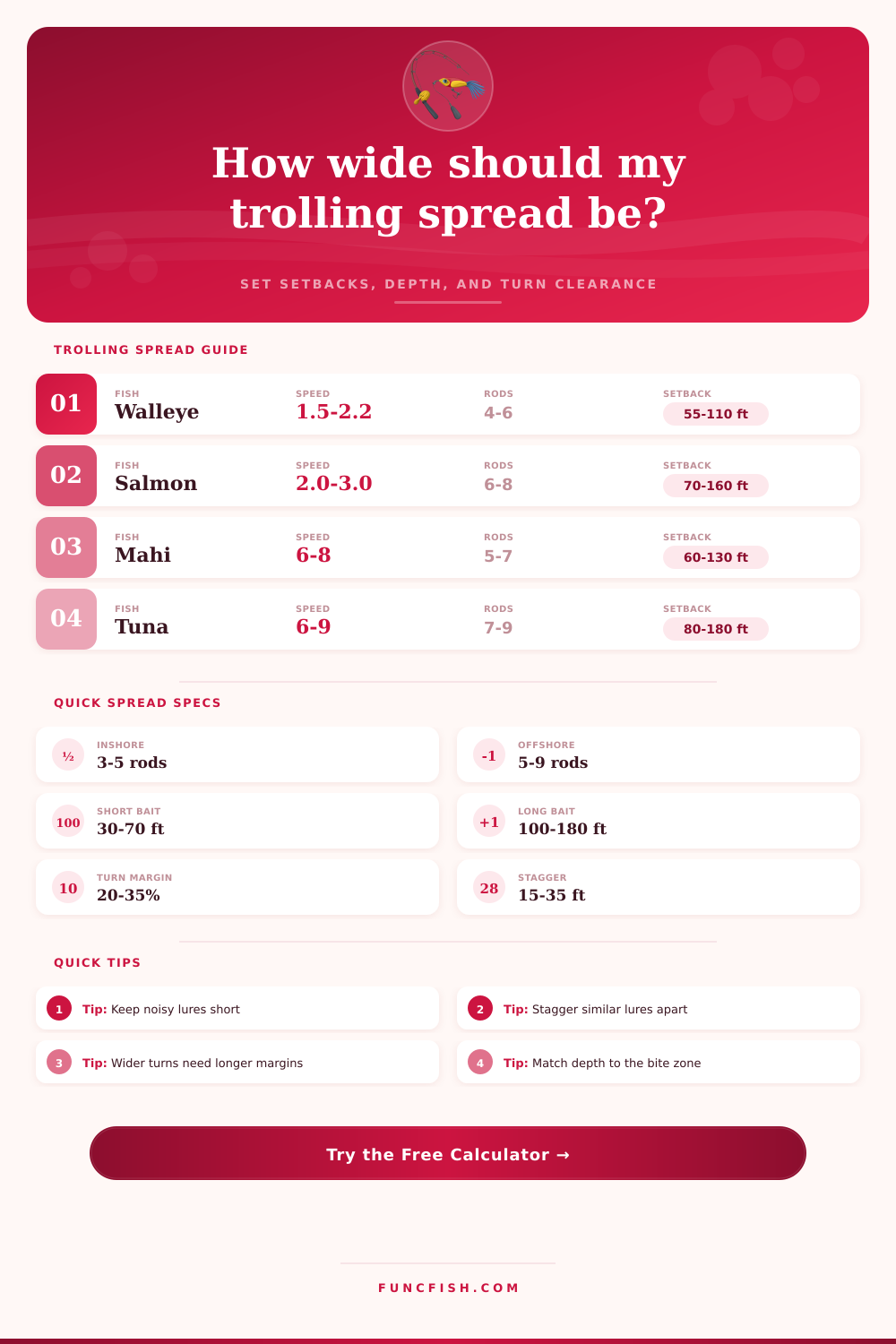
| Walleye | 1.4-2.2 mph | Boards / crankbaits | 8-28 ft | Longer in clear water |
| Salmon | 2.0-3.0 mph | Riggers / divers | 25-90 ft | Mix short and long |
| Lake trout | 1.7-2.4 mph | Deep lines | 40-120 ft | Slow turns help |
| Striped bass | 2.5-4.0 mph | Umbrella / mojo | 10-45 ft | Heavy rigs shorter |
| Mahi | 6.0-8.0 mph | Outriggers | Surface-12 ft | Work the clean wake |
| Tuna | 6.0-9.0 mph | Bluewater mix | Surface-20 ft | Long flats matter |
| Sailfish | 5.5-7.0 mph | Natural bait | Surface-8 ft | Keep baits smoking |
| Kingfish | 0.8-2.0 mph | Live bait | Surface-30 ft | Slow and separated |
| Line type | Drag in water | Depth effect | Best lane | Spread note |
|---|---|---|---|---|
| 20 lb mono | Medium | Baseline | Inside / middle | Forgiving stretch |
| 30 lb mono | Medium-high | Slightly shallower | Short corners | Good bluewater base |
| 50 lb mono | High | Shallower | Teasers / corners | Needs wider turns |
| 20 lb braid | Low | Runs deeper | Boards / divers | Less belly in current |
| 50 lb braid | Low-medium | Runs deeper | Divers / plugs | Strong, low diameter |
| 30 lb wire | Low | Deepest | Divers | Separate from braid |
| Lead core | High sink | Deep at slow speed | Outside long | Needs big turns |
💡Calculation checks
Tip: Use a shorter inside lane than the outside lane when turning often. The calculator flags risk when the long inside line can sweep into its neighbor.
Tip: Deep divers, lead core, wire, and umbrella rigs add drag. When drag is high, increase lateral spacing or reduce the total rod count.
Trolling is a fishing method that involve trolling lines behind a boat. Trolling with a few fishing lines is a simple process. However, trolling with many rod and many lures present a bit of a challenge.
When using many rods, fishermen has to lay out a fishing spread. A fishing spread is the arrangement of the fishing lines behind the boat. Depending on how many rods the fishermen are using, they must plan out the spread of the lines to ensure they dont get in the way of each other.
How to Plan Your Trolling Lines
If the spread is incorrect planned out, the lines will tangle up when the boat turns. To create the fishing spread, there are several specific inputs into the calculator. The rod count is used to determine how many line are being managed by the fishermen.
The rod count will also determine the width of the spread of the fishermen lines. The length and the beam of the boat will determine the starting distance between the fishing tips. The speed of the boat will determine how deep the lines will travel into the water.
The target depth of the water will determine where the fish is located. Finally, the fishermen will have to input the base setback, the stagger of the lines, and the side spacing between lines. From the inputs, the calculator can provide several different forecasts for the fishermen.
The width of the spread will determine how wide the fishermen spread will be. The longest setback will determine how far the furthest line will trail behind the boat. This will help the fishermen to make turns with the boat.
The depth of the fishing lines will allow the fishermen to see whether or not there line will reach the target depth. The calculator will determine the depth from the dive rates of the lures, the type of fishing lines being used, and the speed of the boat. Finally, the clearance rating will provide a number to the fishermen to represent the risk of the lines getting entangled.
This will be calculated from the risk of the lines becoming entangled while making turns with the boat. The stagger and side spacing is two different numbers that the fishermen must understand. The stagger is the distance between fishing lines from the back of the boat.
This will help to ensure the lines do not enter each other wake. The side spacing is the distance between the lines from side to side. This will ensure the lines do not drift into each other.
It is possible that the fishermen may have a good set of stagger but a poor side spacing between lines. This will inevitably cause the lines to become entangled. The line type is another factor in creating a good fishing spread.
If the fishermen use monofilament fishing lines, they will stretch. This can cause the lure to rise higher in the water. Braided lines will not stretch as much as the monofilament lines.
This will allow for the lure to reach deeper depths. Lines such as wire lines and lead core lines will sink on they own. These lines will change the depth of the lures and the distance between the rods.
The spread calculations account for these lines. The condition of the water will change the spread of the lines. Cross currents will change the side spacing of the fishing lines.
The waves in the water will cause the boat to move up and down, which could also cause the fishing lines to become entangled. The calculation of the lines will account for these conditions. The fishermen can use the reference tables before using the calculator.
The reference tables show the number of fishing rods that are typically used and the range of setbacks for the lines for each type of fishing. These tables allow the fishermen to determine if a planer board or outrigger will be needed. These tables can also be used to determine the starting point for the fishermens calculations.
By using the spread calculator before leaving the dock, the fishermen can view the spread of lines. When using the calculator, the fishermen will be able to see the effect that adding more rods will have on the clearance rating. They will be able to determine if the lure will require more side spacing.
It is much easier to view the spread in the calculator on the screen then in the water. If the clearance rating is low, the fishermen can adjust the side spacing of the lines or reduce the rod count. The fishermen can change the depth estimate by changing the speed of the boat or the type of lure being used.
By using this calculator, the fishermen will avoid the lines getting entangled and will avoid losing any of the caught fish.