
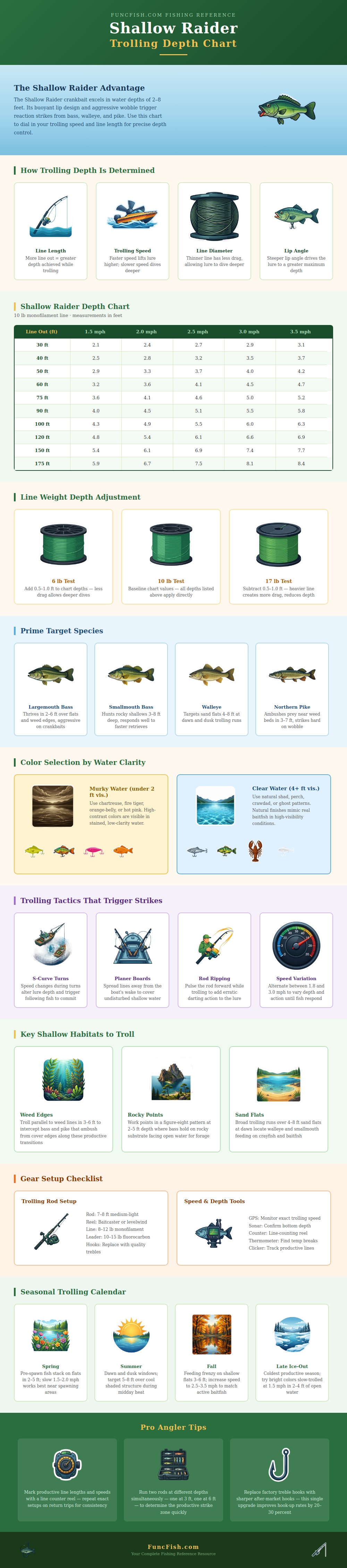
To successfully troll a shallow raider crankbait, an understanding of the behaviors of the shallow raider crankbait when behind the boat are required. The shallow raider crankbait has a specific lip and buoyancy for the top eight feet of the water column. However, because the shallow raider crankbait is designed for these eight foot of the water, any small changes to the trolling speed of the bait or the length of the line will change the depth of the shallow raider crankbait.
If you understand why the shallow raider crankbait will rise or dive at different times, you can make the shallow raider crankbait more predictable when on the water. The line length, trolling speed, and the diameter of the line can control the depth of the shallow raider crankbait. If you use a longer line, the shallow raider crankbait will settle lower in the water.
Trolling Tips for the Shallow Raider Crankbait
This is because a longer line will create a steeper angle of the shallow raider crankbait when trolling. If you troll at a fast speed, the increased pressure of the water against the lip of the shallow raider crankbait will cause the shallow raider crankbait to rise higher in the water column. Conversely, if you decrease the trolling speed of the shallow raider crankbait, the shallow raider crankbait will drop in relation to the water’s surface.
Lastly, the diameter of the line will also impact where the shallow raider crankbait will go. If you use a thinner line for trolling, the shallow raider crankbait will reach a greater depth in the water then if you used a thicker line. A reference chart can help you to avoid guesswork in trolling your shallow raider crankbaits.
The reference chart show you how each of the three variables impact the depth of the shallow raider crankbait. Based off the chart, you can select the starting point for trolling your shallow raider crankbaits. While trolling, you should always watch the rod tip and the water’s surface to watch the shallow raider crankbait’s movement.
However, a reference chart will allow you and your fishing buddy to have an expectation for the depth of the shallow raider crankbait. Having an expectation for the depth of the shallow raider crankbait is important for locating the fish. For instance, bass will stay in four to five feet of water near a weed edge.
Walleye will stay in two foot of water on sand flats. If the shallow raider crankbait is even one foot above or even one foot below the depth where the fish live, the fish will not strike at the shallow raider crankbait. Often you can correct the depth of the Shallow Raider crankbait by simply adjusting the length of the line by ten or twenty feet.
The type of line used also affects the depth of the Shallow Raider crankbait. Six-pound test line will allow the Shallow Raider crankbait to sink deeper into the water. Seventeen-pound test line will keep the Shallow Raider crankbait more high in the water.
Many angler use ten-pound monofilament line. This type of line provides a balance between the strength of the line and the depth of the Shallow Raider crankbait. The color of the Shallow Raider crankbait also affects how the fish will see it.
Bright color are useful in stained water. Bright colors are easier for the fish to see from a distance. In clear water, anglers use colors that match the local baitfish to entice the fish.
Once you have set the depth of the Shallow Raider crankbait, there are a variety of methods to present the Shallow Raider crankbait in a way that will trigger a strike from a fish. Wide S-turns will allow anglers to change the speed at which the Shallow Raider crankbait is moving while also changing the angle of the bait. Using planer boards will allow the Shallow Raider crankbait to move through undisturbed water.
Ripping the rod tip will make the Shallow Raider crankbait move in an erratic fashion through the water. These method will not replace the need to set the proper depth for the Shallow Raider crankbait, but they may assist in triggering a strike from a fish. Finally, there are different methods to using the Shallow Raider crankbait during different seasons or in different structures within the fishing area.
During the spring, the fish may travel along the edge of the weed for several feet before striking at the Shallow Raider crankbait. During the summer, walleye will use rocky points in the area to ambush baitfish so fishing those points at dawn will be productive. During the fall, schools of fish moves over sand flats so using the Shallow Raider crankbait at a faster trolling speed will be productive.
Finally, during the late ice-out period, using bright colors and slow speeds with the Shallow Raider crankbait in shallow waters will be productive. If anglers understand the system for setting the speed of the Shallow Raider crankbait, the line length, and the color of the Shallow Raider crankbait, they can repeat their success using the Shallow Raider crankbait to catch bass.