Knot to Feet per Second Converter
Convert boat speed, current, or drift from knots into feet per second and translate that speed into lure action, drift timing, and short-run distance.
📌Fishing speed presets
⚙Speed and water settings
Converted fishing speed
Full breakdown
📋Fishing speed reference grid
Stream Drift
Jig Pass
Slow Troll
Fast Troll
📐Conversion and timing tables
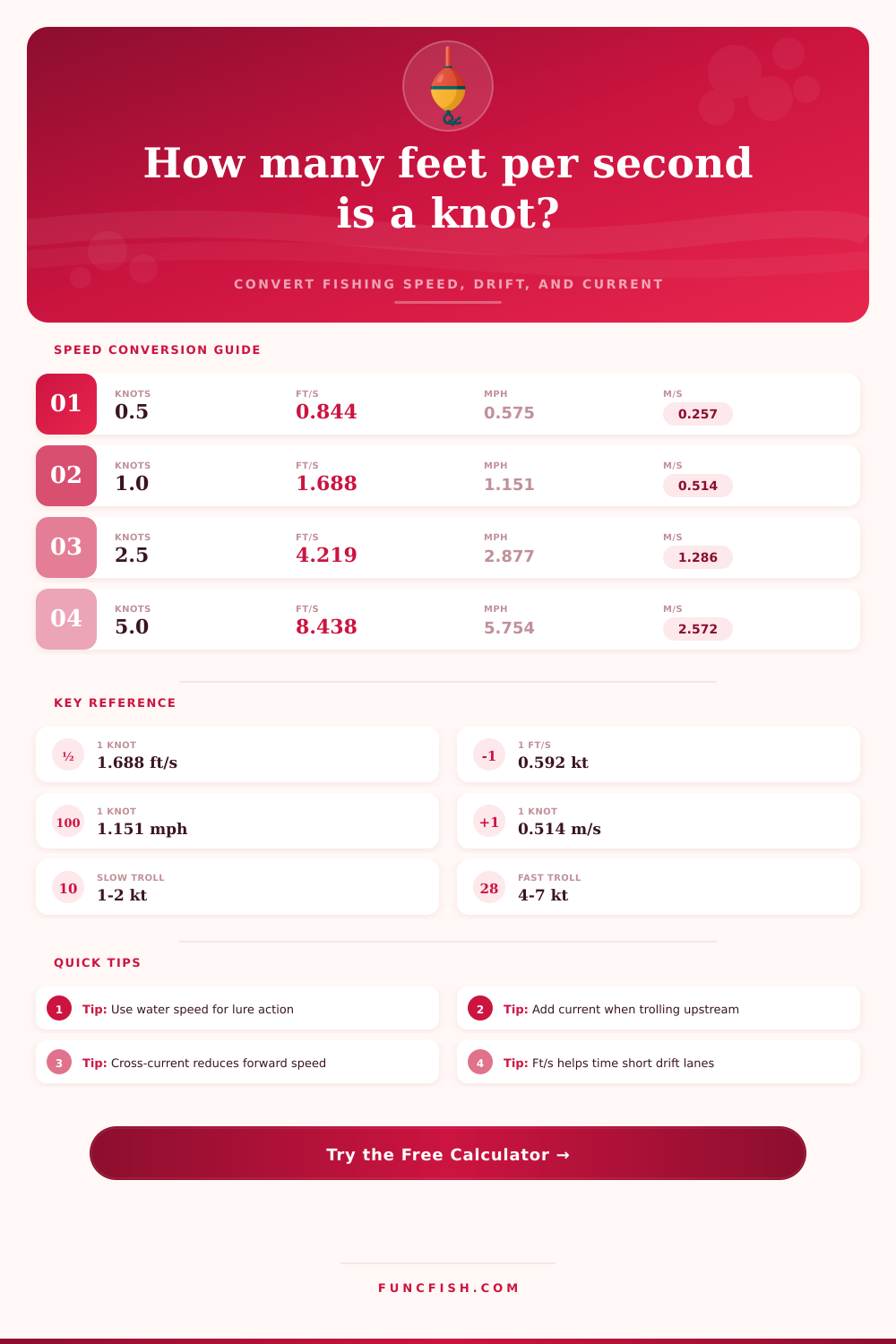
| Knots | Feet per second | Miles per hour | Meters per second |
|---|---|---|---|
| 0.25 kt | 0.422 ft/s | 0.288 mph | 0.129 m/s |
| 0.50 kt | 0.844 ft/s | 0.575 mph | 0.257 m/s |
| 0.75 kt | 1.266 ft/s | 0.863 mph | 0.386 m/s |
| 1.00 kt | 1.688 ft/s | 1.151 mph | 0.514 m/s |
| 1.50 kt | 2.532 ft/s | 1.726 mph | 0.772 m/s |
| 2.00 kt | 3.376 ft/s | 2.302 mph | 1.029 m/s |
| 2.50 kt | 4.219 ft/s | 2.877 mph | 1.286 m/s |
| 3.00 kt | 5.063 ft/s | 3.452 mph | 1.543 m/s |
| 4.00 kt | 6.751 ft/s | 4.603 mph | 2.058 m/s |
| 5.00 kt | 8.438 ft/s | 5.754 mph | 2.572 m/s |
| 6.00 kt | 10.127 ft/s | 6.905 mph | 3.087 m/s |
| 8.00 kt | 13.502 ft/s | 9.206 mph | 4.116 m/s |
| Fishing use | Typical knots | Typical ft/s | Timing note |
|---|---|---|---|
| Float drift for trout | 0.4-1.2 kt | 0.68-2.03 ft/s | Watch 6-12 second lanes |
| Vertical jig boat slip | 0.5-1.0 kt | 0.84-1.69 ft/s | Short drop windows |
| Walleye crankbait troll | 1.3-2.4 kt | 2.19-4.05 ft/s | Track lure cadence |
| Salmon plug troll | 1.7-3.0 kt | 2.87-5.06 ft/s | Measure speed at lure |
| Striped bass umbrella rig | 2.5-3.8 kt | 4.22-6.41 ft/s | Use against-current passes |
| Offshore ballyhoo spread | 5.5-7.5 kt | 9.28-12.66 ft/s | Keep baits tracking clean |
| Surf sweep casting | 0.8-2.5 kt | 1.35-4.22 ft/s | Estimate lateral sweep |
| Fly swing across current | 0.7-1.8 kt | 1.18-3.04 ft/s | Quartering speed matters |
| Line type | Drag factor | Best speed range | Conversion use |
|---|---|---|---|
| Monofilament | 1.08 | 1.0-3.0 kt | General trolling estimate |
| Thin braid | 0.94 | 0.5-2.8 kt | Jig and drift control |
| Fluorocarbon | 1.02 | 0.4-2.5 kt | Leader response check |
| Lead-core line | 1.18 | 1.5-3.2 kt | Sweep and sink planning |
| Wire diver line | 0.98 | 2.0-4.5 kt | Directional trolling load |
| Floating fly line | 1.26 | 0.4-1.8 kt | Swing belly estimate |
| Downrigger cable | 1.14 | 1.5-4.0 kt | Blowback estimate |
| Bottom bouncer | 1.20 | 0.7-1.6 kt | Contact speed check |
💡Practical checks
Tip: Feet per second is useful when the fishing zone is short. Multiply the converted speed by the number of seconds your lure stays in the lane.
Tip: For trolling lure action, compare the water speed at the lure, not only GPS speed over ground. Current direction can change the real pull.
Knowing the differance between knots and feet per second is important for anglers who want to have more control over the movement of there bait through the water. Knots are the speed of the boat over the ground. Feet per second, on the other hand, is the speed of the lure through the water column.
This calculator will help anglers convert knots to feet per second, and even account for various fishing scenario so that the result will accurately depict the speed of the lure that the fish will see. While anglers have used knots for a long time as a unit of measurement, because that is the speed that is displayed on the nautical chart and the GPS of the fishing boat, the speed of the boat through the water is different than the speed over the ground. For instance, if a boat is moving at a speed of two knot over the ground, the actual speed of that boat relative to the water in which it is traveling may be different due to the movement of the water itself.
Convert Knots to Feet per Second for Fishing
This calculator allows anglers to set the speed of the boat, to select a scenario, and to set the strength of the current to arrive at an accurate measurement of the speed of the lure. The various inputs that anglers make into this calculator reflect the various decisions that they will have to make while they are on the water while fishing. For instance, the dropdown menu that allows anglers to select the fishing scenario will impact the speed of the lure that the calculator calculates.
A scenario that involves trout may require different speed compared to a scenario where a fisherman is fishing for ballyhoo at a faster speed of six knots. The selection of line type will also impact the outcome of this calculator; lines like monofilament will allow a boat to travel at a different speed relative to the lure than lines like braid due to the differences in drag that each line type create while traveling through the water. Finally, the direction of the current can also impact the speed of the lure; the current may move the fishing line laterally in relation to the boat movement, and this can be accounted for in the calculator.
Beyond providing the calculated speed of the lure in feet per second, this calculator also provides distances traveled by both the boat and the lure in the selected time span. Additionally, the distance that the lure traveled is a number that many anglers may tend to ignore; however, if the anglors are working a 300-foot lane in the water, the difference between the lure traveling at 1.8 feet per second compared to 2.2 feet per second may have an impact upon how long the fish have to react to the lure. In scenarios in which the fishing zone is relatively short, the unit of measurement of feet per second becomes more important to the angler.
For instance, a 90-foot drift lane may be covered in less than one minute at the proper speed; however, if the angler drifts too quickly or too slowly, the fish will either not find the bait at all, or the drift lane may move too slowly to be interesting to the fish. Additionally, the tool allow anglers to simulate the effect of various strength of current upon the drift lane. Furthermore, the tool can simulate the line sweep that is created by the angle of the fishing line, as well.
Many anglers may think that the only important measurement related to fishing is the boat speed. However, boat speed is not the only number that impacts the bait that is traveling through the water column. Factors like chop in the water or currents will alter the speed at which the lure travel, even though the boat speed remains the same.
Thus, these variables must be accounted for in the calculation of the speed of the lure. While the calculator is not a tool that will replace the angler’s ability to visually monitor the line, the results will provide an angler with a number that is closer to the reality of the situation than if they used boat speed measurements alone. The same logic could of been applied to changing fishing techniques.
For instance, an angler that is interested in catching walleye and using a jig will have different numbers than an angler that is fishing for striper fish using an umbrella rig. Both of these fishing scenarios are represented in the dropdown menu for scenario selection. Thus, when an angler selects these scenarios, the calculator will adjust to account for the different speeds and line drag for these different fishing scenarios.
This tool can take current direction into account. For instance, if the water is moving in the same direction in which the boat is moving, the speed of the lure will be less than if the boat were moving in an area that was relatively still. In contrast, if the boat is moving against the current, the speed of the lure will be more than in an area that was relatively still.
Additionally, this tool accounts for the lateral load that can be created by a current that moves in a cross-current to the boat movement. This tool also can take line choice into account. For instance, thinner braid lines will allow the current and speed to be more immediately transmitted to the lure than lines with more drag, like monofilament line.
Thus, the user can apply drag factor to the various types of line to create a more accurate representation of lure movement. In situations in which an angler must perform a specific pass of the boat with the bait, or in which they are to time a drift lane of bait through a certain zone, this calculator will allow the angler to decide if the distance and time calculation is correct. For instance, if the calculator reveals that the lure will travel 180 feet in a 10 second time span, the angler can make a decision about whether or not the time span is long enough for the fish to find the bait.
If the time span is too short, the angler can adjust the speed of the boat prior to beginning that pass of the water. In each of these situations, the calculator allows anglers to visualize the speed at which the lure will be moving through the water column. Thus, this tool will allow anglers to have a better understanding of the movement of the bait, and to make decisions accordingly.
Knots are the standard unit of measurement for GPS measurements and nautical charts. Feet per second, though, is the unit of measurement for those moving lures that will interact with the fish in the water. Thus, by using both set of measurements, anglers can remove one variable from the situation for which they are fishing.