Fish Curing Salt Ratio Calculator
Calculate salt, sugar, Cure #1, brine strength, and water-phase-salt estimates for refrigerated fish curing batches.
📌Scenario presets
⚙Cure settings
Use 100% for equilibrium. Use a process-tested value for immersion brines.
Cure ratio results
Full breakdown
📋Ratio reference grid
Mild Dry Cure
Firm Dry Cure
Brine Cure
Nitrite Check
📏Salt and nitrite reference tables
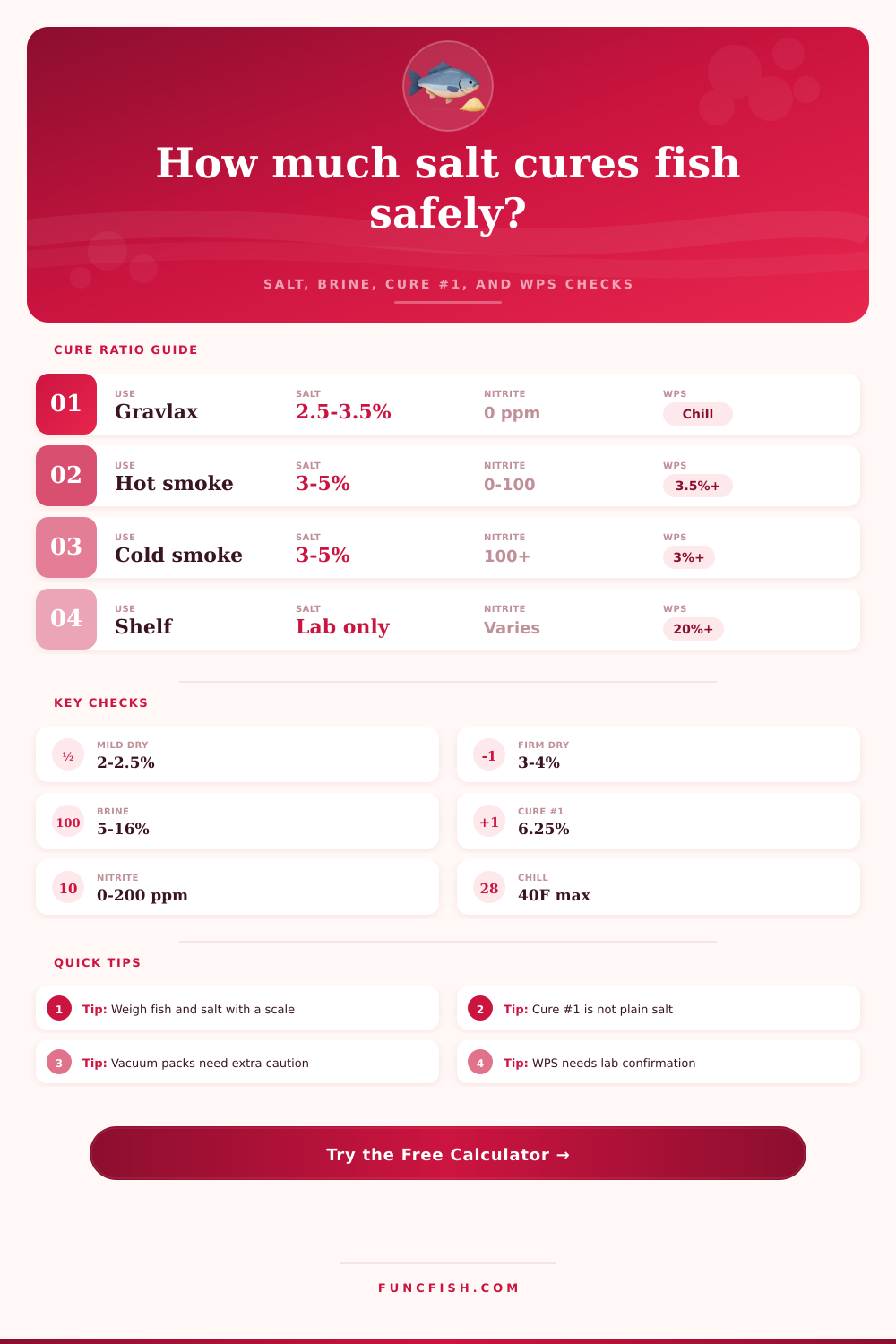
| Target use | Salt ratio by fish weight | Typical sugar ratio | Safety note |
|---|---|---|---|
| Mild refrigerated dry cure | 2.0-2.5% | 0.5-1.5% | Keep cold; not shelf-stable |
| Balanced gravlax-style cure | 2.5-3.5% | 1.0-3.0% | Use fresh fish and refrigeration |
| Firm smoked fish cure | 3.0-5.0% | 0.0-2.0% | Check finished WPS |
| Strong salt fish | 10%+ | 0.0% | Process validation needed |
| Reduced oxygen refrigerated fish | Process specific | Varies | FDA controls rely on WPS, pH, aw, or freezing |
| Formula check | Calculation | Use in calculator | Watch point |
|---|---|---|---|
| Salt grams | Basis g x salt % | Dry and equilibrium brine | Weigh, do not scoop |
| Brine strength | Salt / (water + salt) | Immersion brine estimate | Actual pickup varies |
| Cure #1 grams | ppm x fish g / 62500 | 6.25% nitrite cure | Do not confuse with salt |
| WPS estimate | NaCl / (NaCl + water) | Safety screen | Lab test confirms |
| Drying loss | Water reduction estimate | Raises estimated WPS | Assumes salt retained |
| Fish reference | Moisture estimate | Fat / texture | Calculator effect |
|---|---|---|---|
| Salmon | 68% | Medium-high fat | Moderate WPS estimate |
| Trout | 72% | Medium fat | Slightly lower WPS at same salt |
| Whitefish / cod | 80% | Lean and wet | Needs more salt for same WPS |
| Sablefish | 62% | High fat | Higher WPS at same salt |
| Tuna | 74% | Lean dense loin | Thickness affects cure time |
| Mackerel | 64% | Oily fish | Handle cold and fresh |
| Finished product control | Reference number | What it means | Calculator flag |
|---|---|---|---|
| Smoked fish WPS | 3.5%+ | FDA smoked fish target without nitrite allowance | Passes WPS screen |
| Smoked fish with nitrite | 3% + 100 ppm | Lower WPS pathway where nitrite is permitted | Conditional screen |
| Reduced oxygen refrigerated | 5% WPS | One FDA control option among pH, aw, freezing, or study | Caution flag |
| Shelf-stable by salt only | 20% WPS | Not a normal refrigerated cure target | Lab only |
| Cold storage | 40F / 4C | Refrigeration remains a critical control | Required |
💡Calculation cautions
Safety check: This calculator estimates ratios and water-phase salt from inputs. Finished-product WPS, pH, water activity, and nitrite levels require measured or validated process data.
Cure check: Cure #1 is a nitrite cure, not plain salt. Enter the label nitrite percentage and weigh it accurately; do not substitute volume measures for final batching.
Using the correct amount of salt in curing fish is necessary for flavor. However, using the correct amount of salt is also necessary for texture, shelf life, and safety. If you use too little salt, the fish will remain soft and the fish will be vulnerability to spoilage.
At the same time, if you use too much salt, the texture of the fish will become leathery before you begin the smoking process. You must find a balance in the amount of salt you use in curing fish. The balance of the salt that you use will depend on the types of fish that you are using and the thickness of the pieces of fish that you will be smoking.
How Much Salt to Use When Curing Fish
Fish contains a large amount of water. As the fish is curing, the water will move out of the fishs tissues while the salt moves into the fishs tissues. The salt and water moving into and out of the fish will not occur at the same rate.
A calculator will help you manage the curing of your fish by determining the amount of salt that will result in the percentage of salt that you want in your cured fish. You can use either the fish-only salt basis or the total-weight salt basis. The fish-only salt basis calculates the salt percentage with only the weight of the fish.
In contrast, the total-weight salt basis also takes into account the weight of the liquid in the brine. Fish species contains different amounts of natural moisture or fat. The amount of moisture or fat that the fish contains will change the amount of salt that you need to reach the desired water-phase salt level.
For example, lean whitefish will contain more water than sablefish. Because of the extra water content in lean whitefish, you will need to use a different percentage of salt to achieve the same water-phase salt level in lean whitefish compared to sablefish. Oily fish will release moisture faster than lean fish.
However, oily fish species will mask the true flavor of the salt in the cure, which could lead to adding too much salt to flavor the oily fish. You can use the salt calculator to select the type of fish that you will use in your cure. This will automatically adjust the amount of moisture that the calculator use to determine the percentage of salt that you will use in your cure.
Cure #1 will contain more than just plain salt. Nitrites will be one of the ingredient in Cure #1 as the nitrites will help to preserve the color of the fish and kill certain bacteria that could spoil the cured fish. You must adhere to regulations regarding the amount of nitrites that can be used in your cured fish products.
The salt calculator will ask you for the percentage of nitrites that you will use in Cure #1 as well as the target parts-per-million of nitrite in the cured fish. The calculator will calculate the weight of Cure #1 that will produce the amount of plain salt and nitrite that you require for your recipe. You should never treat nitrites and salt as the same as using the two as if they are interchangeable will result in either under-cured or over-salted fish.
Brine strength will work different than dry cure recipes. The salt that the fish will absorb when using a brine will depend on the thickness of the fish and the time that the fish is in the brine. The salt calculator will estimate the strength of the brine that you will use and the amount of salt that the fish will absorb.
However, you will need to test the actual salt pickup that the fish will absorb. The measurement of water-phase salt is important to ensure the safety of your cured fish products, especially if you are using a reduced-oxygen packaging process to preserve the product. Water-phase salt will tell you the amount of salt in the cured fish relative to the amount of water in the cured fish.
A higher water-phase salt level will slow the growth of bacteria. To achieve a higher water-phase salt level, you will need to either use more salt or remove more moisture from the fish. The salt calculator will estimate the amount of water-phase salt that your cured fish will contain.
This number will then be compared to established safety standards for cured smoked and vacuum-packed fish. An estimate of the water-phase salt level of your cured product is helpful, but you will have to test the finished product to ensure that the water-phase salt level is the number that the calculator showed. The thickness of the fish that you use will have an impact upon the length of the curing process.
A fish that is one inch thick will not cure at the same rate as a fish that is half an inch thick, even if the two fish contain the same amount of salt. The salt calculator will use the thickness of the fish to calculate the minimum length of time that the fish should be cured so that it will not be removed from the cure solution too early. If you remove the fish too early, the center of the fish will not have cured enough to flavor the center of the fish proper.
Storage temperatures and packaging will have an influence upon the safety of the cured fish. If you plan to store the cured fish at temperatures that are above 40 degrees F, you will lose the safety margin that the refrigeration will provide for the cured fish. Additionally, if you are using vacuum-packaging or oil-packaging for your cured fish, you will have to take extra care to ensure that the product is safe to consume.
Vacuum and oil packaging will remove the oxygen from the cured fish, which allows certain types of bacteria to grow. In the salt calculator, these risks will be noted so that you are aware of the extra requirements for safety. Many people will add sugar to their cure to enhance the flavor of the cured fish.
However, sugar will not have the same preserving effects upon the cured fish that the salt will have. The salt calculator will separate the measurement for sugar from salt measurements. You can use the calculator to determine the amount of sugar that will enhance the flavor of the cured fish.
The type of salt that you use will also have an influence upon the measurements that you need for your cure. For instance, salt crystals of different shapes will occupy different amount of space in a measuring spoon. The salt calculator will ask you the type of salt that you will use for your cure recipe.
This will allow the salt calculator to also provide you with the weight and volume of the salt that you will need. Calculating each of these variables is essential to understanding how to properly cure your fish. The curing process is not a recipe that can be applied to any type of fish.
You must understand each of these variables to properly prepare your cure recipe for your specific type of fish. If you understand each of the variables, such as salt ratio, moisture level, salt pickup, nitrite load, and water-phase salt, you can make adjustments to the recipe according to the type of fish that you will use and its thickness.