Albacore Weight Calculator
Estimate albacore tuna weight from fork length, maximum girth, body depth, seasonal fatness, offshore temperature band, gear class, and measurement confidence.
📌Albacore presets
⚙Weight inputs
Albacore tuna weight estimate
Calculation breakdown
🎣Gear class data
Light Live-Bait
Anchovy or sardineCedar Plug Troll
Feather or cedar plugOffshore Troll
Spreader bar or cloneLong-Range Stand-Up
Heavy jig or bait📊Tuna, line, and lure comparison
Albacore Troll
Longfin tuna with compact shoulders and long pectorals.
School Yellowfin
Deeper body than albacore at similar fork length.
School Bluefin
Thicker girth drives a heavier result than albacore.
Skipjack Foamer
Shorter fight, smaller girth, lighter leader window.
📘Reference tables
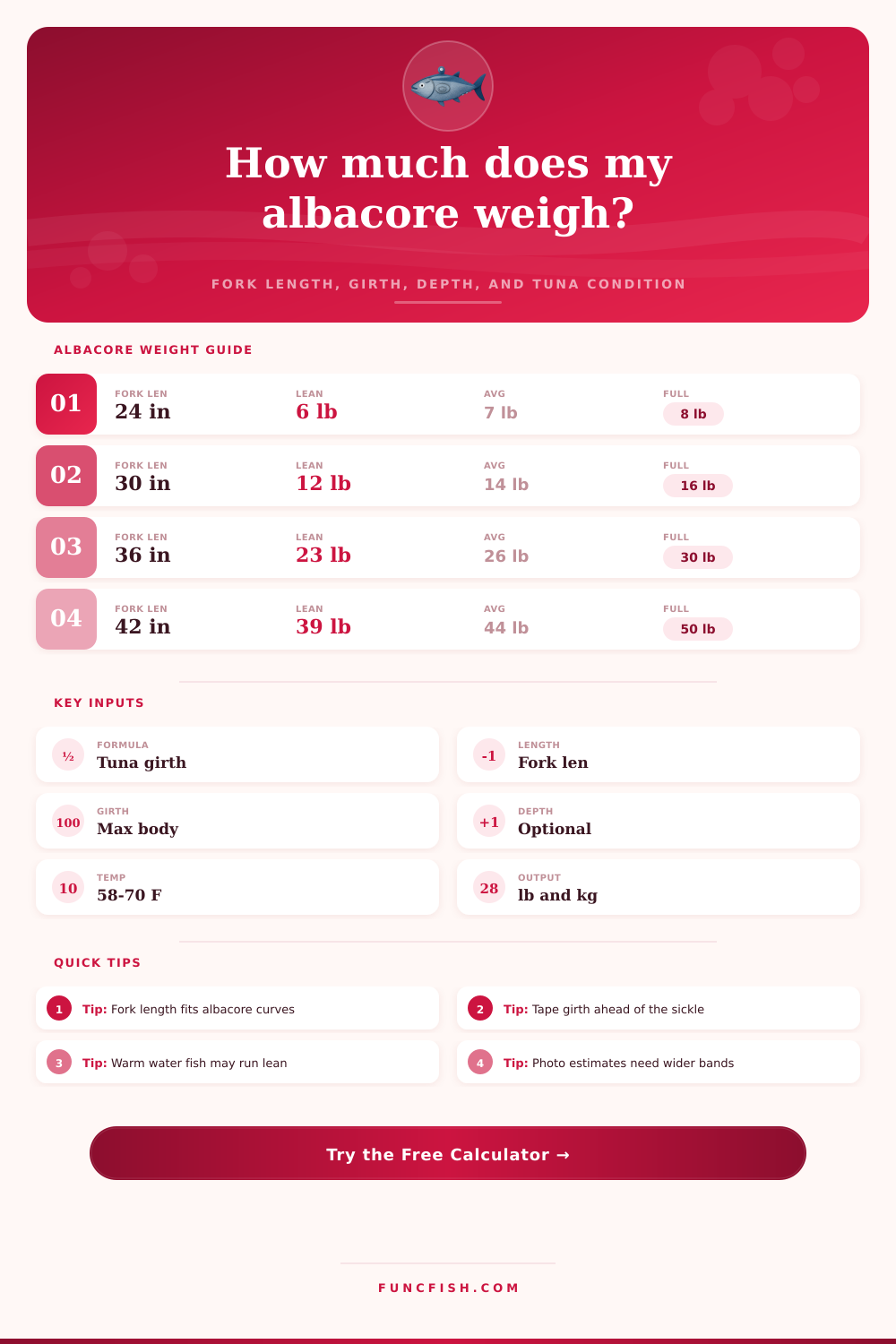
| Fork length | Lean albacore | Average albacore | Full albacore | Typical gear class |
|---|---|---|---|---|
| 24 in / 61 cm | 6-7 lb | 7-8 lb | 8-9 lb | 20-25 lb live-bait |
| 30 in / 76 cm | 12-13 lb | 14-15 lb | 16-17 lb | 25-30 lb troll |
| 36 in / 91 cm | 22-24 lb | 25-27 lb | 29-31 lb | 30-40 lb offshore |
| 42 in / 107 cm | 37-40 lb | 43-46 lb | 49-53 lb | 40-60 lb stand-up |
| 48 in / 122 cm | 58-63 lb | 68-73 lb | 78-84 lb | 60-80 lb heavy |
| Offshore temperature | Albacore behavior | Weight effect | Best measurement note | Confidence note |
|---|---|---|---|---|
| 58-61 F / 14-16 C | Cool edge fish | Slightly lean | Check girth carefully | Add range if rushed |
| 62-65 F / 17-18 C | Prime break | Standard model | Fork length works well | Good tape holds tight |
| 66-69 F / 19-21 C | Fast bluewater fish | Near standard | Depth helps sort shape | Use deck tape quickly |
| 70-74 F / 21-23 C | Scattered warm fish | Often lighter | Girth formula matters | Widen photo ranges |
| Confidence class | Typical source | Band applied | Good for | Weak point |
|---|---|---|---|---|
| Certified | Scale plus tape | 6 percent | Derby log check | Needs scale |
| Careful deck | Fork and girth tape | 9 percent | Most albacore trips | Fish curves on deck |
| Quick deck | Fast ice box tape | 14 percent | Wide-open bite | Girth can slip |
| Photo estimate | Rail or deck photo | 22 percent | After-trip sorting | Perspective bias |
| Gear class | Main line | Working drag | Common lure or bait | Albacore lane |
|---|---|---|---|---|
| Light live-bait | 20-25 lb | 5-7 lb | Anchovy, sardine | 8-22 lb fish |
| Cedar plug troll | 30 lb | 7-10 lb | Cedar plug, feather | 12-35 lb fish |
| Offshore troll | 40 lb | 9-13 lb | Clone, daisy chain | 18-45 lb fish |
| Jig and popper | 50 lb | 11-16 lb | 80-120 g jig | 20-55 lb fish |
| Long-range | 60 lb | 14-20 lb | Heavy jig, bait | 35-75 lb fish |
💡Measurement tips
Fork length first: Albacore have long sickle fins and a forked tail, so fork length is the cleanest input. If you only have total length, the calculator trims it before running the tuna curve.
Girth decides the surprise: Two albacore with the same fork length can separate by several pounds. Wrap the tape around the fullest shoulder area just ahead of the second dorsal and anal finlets.
To accurately estimate the weights of an albacore tuna, several different measurement must be made. The length of the fish is one measurement that can be use to try to estimate the weight of an albacore tuna. However, this is not an accurate measurement of the weight of the albacore tuna, since two albacore tuna can have the same length but have different weight due to the girth of the tuna.
You can determine the weight of the albacore tuna by measuring its length, its girth, and its body depth. To determine the weight of an albacore tuna, you must first measure the fork length of the tuna. Fork length is the measurement from the tip of the snout of the tuna to the notch in the tail of the tuna.
How to Estimate the Weight of an Albacore Tuna
This is a more accurate measurement of the tuna than the total length of the albacore tuna, which can be mislead. Following the measurement of the fork length of the albacore tuna are the measurement of the girth of the tuna. The girth of the albacore tuna is the widest point of the albacore tuna, and is measured at the widest point of its body, prior to the tail of the tuna.
Additionally, you should also measure the body depth of the tuna. Body depth is the vertical measurement of the body of the albacore tuna, and is the deepest portion of the tunas body at its belly. The condition of the albacore tuna can impact the weight of the albacore tuna.
For instance, an albacore tuna that live in warmer water is likely to be lean in its body composition, while an albacore tuna that lives in colder water may have more oil in its body. These different body compositions affects the weight of the albacore tuna. Additionally, during different seasons of the year, the albacore tuna may have eaten more food than at other times of the year.
An albacore tuna that has eaten more food will have a larger girth than a tuna that has eaten less food. Thus, the albacore tuna with the larger girth will weigh more than the tuna with a smaller girth. Accuracy in the measurement of the albacore tuna is important.
For instance, it is important not to measure the length of the tuna while it is resting on a curved surface. If the tuna is resting on a curved surface, the length of the tuna will appear to be more long than the tunas actual length. Additionally, it is important that you dont confuse the body depth of the tuna with the height of the dorsal fin of the tuna.
The body depth of the tuna is the depth of its belly, while the height of the dorsal fin is the measurement from the ground to the top of its fin. Finally, you should measure the weight of the albacore tuna as quick as possible after the tuna is caught. If the tuna weighs too much, it can lose its weight if it is iced too quickly, or if it loses body mass while being fight.
Formulas can be used that calculate the weight of the albacore tuna based off the measurement of its fork length, girth, and body depth. These formulas will provide an estimate of the tunas weight. However, the weight estimate should also include a range of uncertainty.
For instance, if the tape measure is measured on the deck of the boat, the measurement will have a higher range of uncertainty than if someone weigh the tuna on a certified scale. If the weight of the tuna was estimated from a photograph of the tuna, the range of uncertainty in the weight will be higher than either of these other method. Finally, the weight of the albacore tuna can be used to determine the correct gear for when the tuna is being fight.
If the albacore tuna has a high weight, it will require heavy fishing line and drag gear. If the albacore tuna has a low weight, however, it is possible to use lighter gear. By measuring the fork length, the girth, and the body depth of the albacore tuna, it is possible to move from guessing at the weight of the tuna to calculate its weight.