Albright Knot Wrap Count Calculator
Estimate standard or modified Albright wraps for braid, mono, fluorocarbon, wire, Dacron, and backing joins using line diameter ratio, material grip, drag class, and tying conditions.
📌Albright wrap presets
⚙Knot and line settings
Use actual published diameter when possible; braid labels vary by brand and test method.
The Albright performs best when the leader loop is the thicker, stiffer strand.
Typical working drag is often 20-33% of the weaker rated line.
Albright wrap forecast
Calculation breakdown
🧵Line material grip grid
8-Carrier Braid
4-Carrier Braid
Fluorocarbon
Nylon Mono
📊Albright wrap reference tables
| Connection | Common forward wraps | Return wraps | When to add wraps | When to subtract wraps |
|---|---|---|---|---|
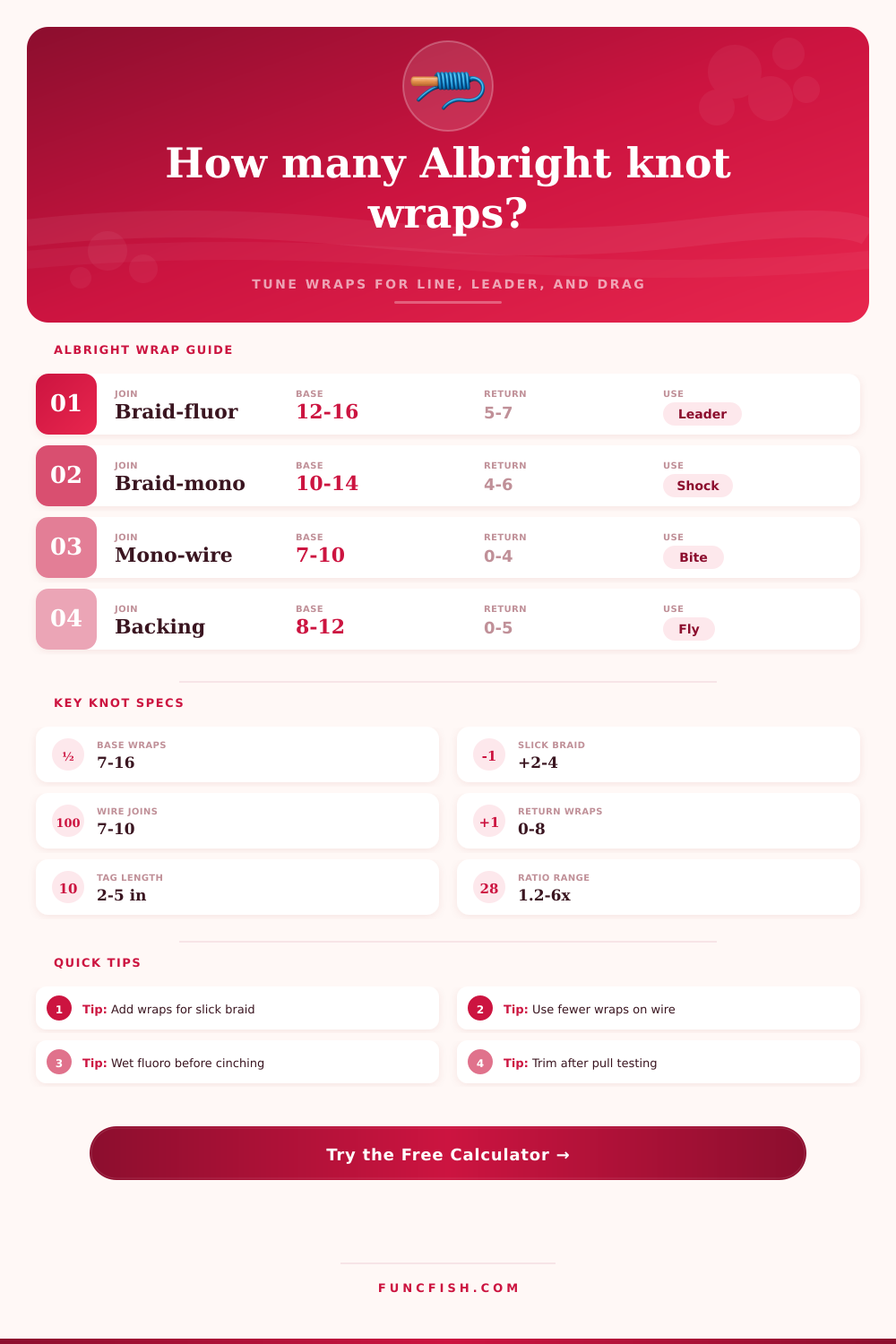
| Braid to fluorocarbon leader | 12-16 | 5-7 modified | 8-carrier braid, hard fluoro, big ratio | Tiny guides or very light drag |
| Braid to nylon mono shock leader | 10-14 | 4-6 modified | Surf casting, wet deck tying, high shock load | Soft mono with low diameter ratio |
| Mono to fluorocarbon leader | 8-11 | 0-5 optional | Stiff fluoro or heavy trolling leader | Equal diameters and bench-tied knot |
| Mono to single-strand wire | 7-9 | 0-3 gentle returns | Coated wire or soft seven-strand wire | Hard wire that kinks under tight wraps |
| Dacron backing to mono core | 8-12 | 0-5 optional | Gelspun backing or slick fly-line core | Dacron bites into supple mono |
| Hollow braid to mono topshot | 10-13 | 4-6 modified | Short topshot, heavy drag, offshore shock | Use splice instead of knot when possible |
| Diameter ratio | Meaning | Wrap adjustment | Guide bulk risk | Albright note |
|---|---|---|---|---|
| 1.0-1.5x | Similar diameters | -1 to 0 wraps | Low | Seat slowly so the loop does not flip |
| 1.6-2.5x | Normal leader step-up | 0 to +1 wrap | Low to medium | Good range for compact modified Albright knots |
| 2.6-4.0x | Heavy leader jump | +1 to +3 wraps | Medium | Keep coils stacked and wet hard leaders |
| 4.1-6.0x | Shock leader or topshot | +2 to +4 wraps | High | Use longer tag length and test before trimming |
| Over 6.0x | Extreme mismatch | Consider another knot | Very high | Short loop, careful seating, heavy pull test |
| Species or technique | Typical main line | Leader or bite material | Drag range | Suggested Albright style |
|---|---|---|---|---|
| Bass casting | 10-30 lb braid | 8-20 lb fluoro | 2-6 lb | Modified, 12-14 forward and 5 return |
| Surf stripers | 20-50 lb braid | 40-80 lb mono shock | 6-14 lb | Improved, 12-15 forward and 5-7 return |
| Trout finesse | 4-10 lb braid | 4-8 lb fluoro | 1-3 lb | Standard or modified, 10-12 forward |
| Pike casting | 30-65 lb braid | 20-40 lb wire | 6-12 lb | Wire Albright, 8-10 forward with gentle returns |
| Tuna topshot | 50-100 lb braid | 80-150 lb mono or fluoro | 15-30 lb | Doubled or improved, 14-18 forward |
| Fly backing | 20-30 lb Dacron | Fly-line core or mono loop | 2-8 lb | Standard, 8-11 forward with smooth trim |
| Material pair | Friction behavior | Heat risk | Trim tag | Pull-test cue |
|---|---|---|---|---|
| Braid over fluorocarbon | Slick over hard surface | Medium | 1/8-3/16 in | Coils bite without creeping |
| Braid over nylon mono | Good compression | Low to medium | 1/8 in | Mono loop stays rounded |
| Mono over wire | Low bite on hard wire | Low | 1/4 in | No sharp kink at loop exit |
| Dacron over mono core | Soft but bulky | Low | 1/8-1/4 in | Backing fibers stay evenly stacked |
| Hollow braid over topshot | Slick and round | Medium | 3/16 in | No milking or sliding under load |
🎣Gear and species comparison grid
| Setup | Species focus | Guide priority | Wrap bias | Check before fishing |
|---|---|---|---|---|
| Ultralight spinning | Panfish, trout | Very compact | 10-12 forward | Knot exits tip guide cleanly |
| Bass baitcaster | Bass, pickerel | Compact and strong | 12-14 forward, 5 return | Leader tag does not catch levelwind |
| Inshore spinning | Redfish, snook | Abrasion reserve | 13-15 forward, 5 return | Pull test after leader scuffs |
| Surf rod | Stripers, salmon | Shock leader security | 14-16 forward, 6 return | Hard cast test with wet knot |
| Heavy conventional | Catfish, tuna | Strength margin | 14-18 forward | Seat under steady glove pressure |
| Fly reel backing | Trout, bonefish | Smooth spool passage | 8-11 forward | Trim and coat only after testing |
💡Albright tying notes
Wrap stacking: Count only clean wraps that sit side by side on the doubled leader. If a coil crosses, unwrap and rebuild that section before seating.
Seating check: Wet the knot, pull the standing lines first, then test both tags. A correct Albright tightens into a slim barrel without the first coil slipping over the loop end.
The Albright knot allows anglers to join dissimilar-diameter lines, but getting the wrap count wrong can add bulk that catches on guides or weakens the strand. When this knot fails during a fish’s initial run, you’re at risk, which is why it’s important to get your wrap count accurate. Not enough wraps and line will slip; too many and the internal friction will weaken the strand.
The calculator uses three main factor to determine the right number of wraps (diameter ratio), material grip and drag setting. This equation relies heavily on the diameter ratio. Combining a thick fluorocarbon leader with a thin braid alters the shape of knot a lot. Because larger changes require a different stacking density, this ratio sets the baseline for the number of wraps needed. It keeps every wrap biting into the last and avoids any potential overlap or flat spot which can lead to failure.
Why Wrap Count Matters in the Albright Knot
Material grip matter just as much as thickness. Eight-carrier moddern braids is slick and slip right up the guides without much effort. So tying them down is tough. Because they don’t “compress” like nylon mono, slick lines gets an additional wrap in the chart’s recommendations. Braid sits atop the leader until forced into gripping, but mono has natural lock points within the coil structure. The calculator also accounts for line type difference, recommending more wraps for slick line.
The other variable in line strength is your drag setting. I find it ironic how most guys will tie one knot and never think about it again until it fails. For long-lasting security, however, you need to consider the working load. When you’re using only 2-pounds of drag while fishing for light trout, a simple number of wraps will suffice. If you’re wrenching on big ol’ tuna with 20-pounds of drag, though, the shock loads will be greater then the static pull of your drag. To account for this, the tool recommends longer/ tighter knots as needed for more stressful situations, giving you a bigger margin of error when under moving weight.
Just as important are those return turns in a modified Albright knot; those loops absorb tension and redirect it outward from where the original loop enters the main line, typically the weakest point in its design. Think of them as shock absorbers that disperse strain along a greater portion of the line. Skipping your turns for efficiency piles the whole load onto a single coil, frequently causing that coil to peel open when put to heavier pressure.
The number of wraps is also limited by physical space in which they reside. That’s why the calculator factors in length of tag you have for your leader; what good does it do to recommend 16 wraps when all you’ve got is three inches? With only three inches of leader left, you can’t fit sixteen wraps and seat them. A loose pile of twenty wraps won’t grip as well as fewer but tighter and well-seated wraps.
Wetting the knot thoroughly before cinching down helps with seating (and avoids heat damage that weakens the knot by up to twenty percent). Don’t get in too big of a hurry when tying a solid Albright knot, patience is what’s needed here, not speed. Carefully observe each coil as it forms and make sure it lays down flat next to the next coil without any overlap. Gently pull the standing lines until the knot starts locking in place, and then apply continuous tension until locked. Pull firmly on the tags of each end of your knot to be sure there’s no slippage before trimming them off.
You should of understand how drag, material, and diameter interact. This lets you create a connection that holds under pressure and prevents your line from dissapearing later.