
There’s a point in Atlantic salmon fishing where it becomes not so much a game as it is an exercise in history. It’s a cold river bank and you’re standing there with burnt-up arms, and this fish, which has endured years at sea, migrations, and predators, are hooked onto your line. What she weighs isn’t important anymore; rather it’s what she represents. That knowledge alters your appreciation for her.
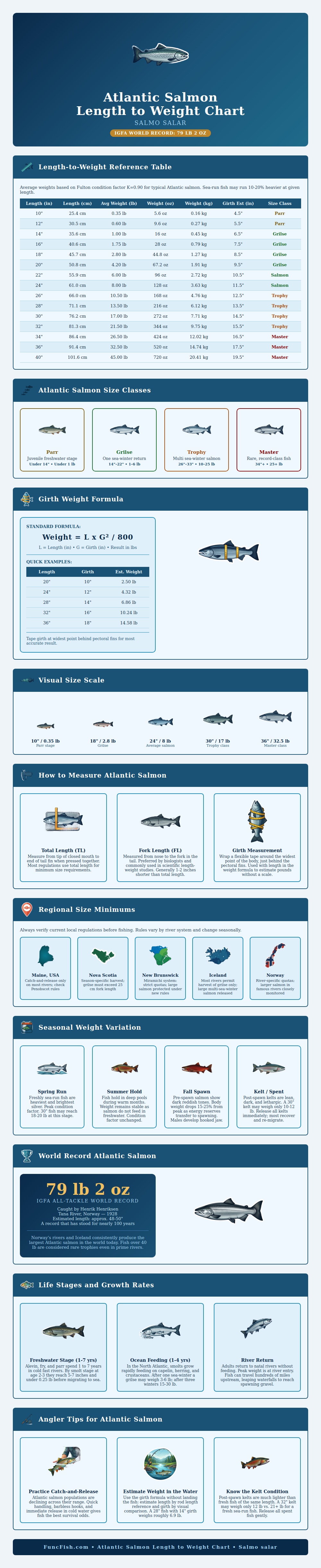
To know the correlation between weight and length allow you to estimate size of the fish at the end of your line and the health of population from which she comes. As you can see on the graph above, mass grows with fish size much more quicker than anglers realize. A fish that feels like an ounce or two in your hands at ten inches long may become a twenty-plus pound prize specimen by the time it reach its maximum thirty-two inches.
Why Salmon Size and Weight Change
This is the reason why estimating fish weight based off length is challenging unless you take condition into account. It’s one thing to become longer, but another to become broader and thicker. Girth is everything, and a heavyweight sea-run salmon of equal length may be quite different then that streamlined river runner in terms of weight.
The thing that most folks overlook is that these figures are hugely seasonal. In early spring, fresh sea-run fish enters the river in prime condition; they’re packing on the pounds from months of feasting on North Atlantic herring and capelin. They’ll be heavy for their length. Conversely, by late summer, a thirty-inch holdover swimming in deep pools or preparing to spawn in the fall have shed considerable body weight.
Upon entering freshwater it ceases to feed. Instead, it begin to burn off the fat it’s been storing up to propel itself upstream to spawn. A salmon of the exact same size, such as one measuring 30 inches, can weighs twice as much as a kelt, a spent fish, even if they is the same length.
Remember: there is a lot of biology going on here so you should of adjust your estimate based off when it was caught. The rules mirror that complexity. For instance, states such as Nova Scotia and Maine has strict size limits or other protective measures targeting particular life stage. Most systems allow fish to be harvested only if they’re “grilse.”
This means they’ve gone back out to sea one winter already (returning after the initial year in saltwater). The larger multi-sea-winter fish is left alone for the sake of genetic diversity. Knowing where your fish fit into that size range can guide you toward making an informed decision. The infographic illustrates those categories and separates them from the small parr stages to the bigger-than-your-arm trophy sizes that makes legendary fisheries famous.
In practical terms this means that often when you’re out there, you don’t land them but you still measure. Compare it to your rod or fly line to get a close enough length. From there, you can use the girth formula to guess weight and enjoy the thrill of maybe catching a record-breaker without prolonging life of the fish.
And quick release isn’t just etiquette: it’s conservation. Atlantic salmon population face pressure throughout their range. Keeping fish alive after release is greatly improved by using barbless hooks and maintaining them in cold water. And those fish can grows as large as they are meant to. They can do this in near-perfect conditions, like the ones they had in Norway almost a hundred years ago when they set a world record of seventy-nine pounds.
Not many will land one of that magnitude but knowing how quickly they grow puts things in perspective. It turns a good ole’ day on the river into appreciating the life cycle, from tiny alevin in the gravel bed to big old silver powerhouses. Every phase of their lives are significant. And when you’re lucky enough to have one come to hand, whether it’s four pounds or forty, it’s not just any fish, but rather a biological marvel that has traveled along an ancient map home.
And that’s what brings us back out onto the water.