⚓ Auxiliary Outboard Size Calculator
Find the right backup outboard HP for your sailboat or vessel — enter your specs and get an instant recommendation
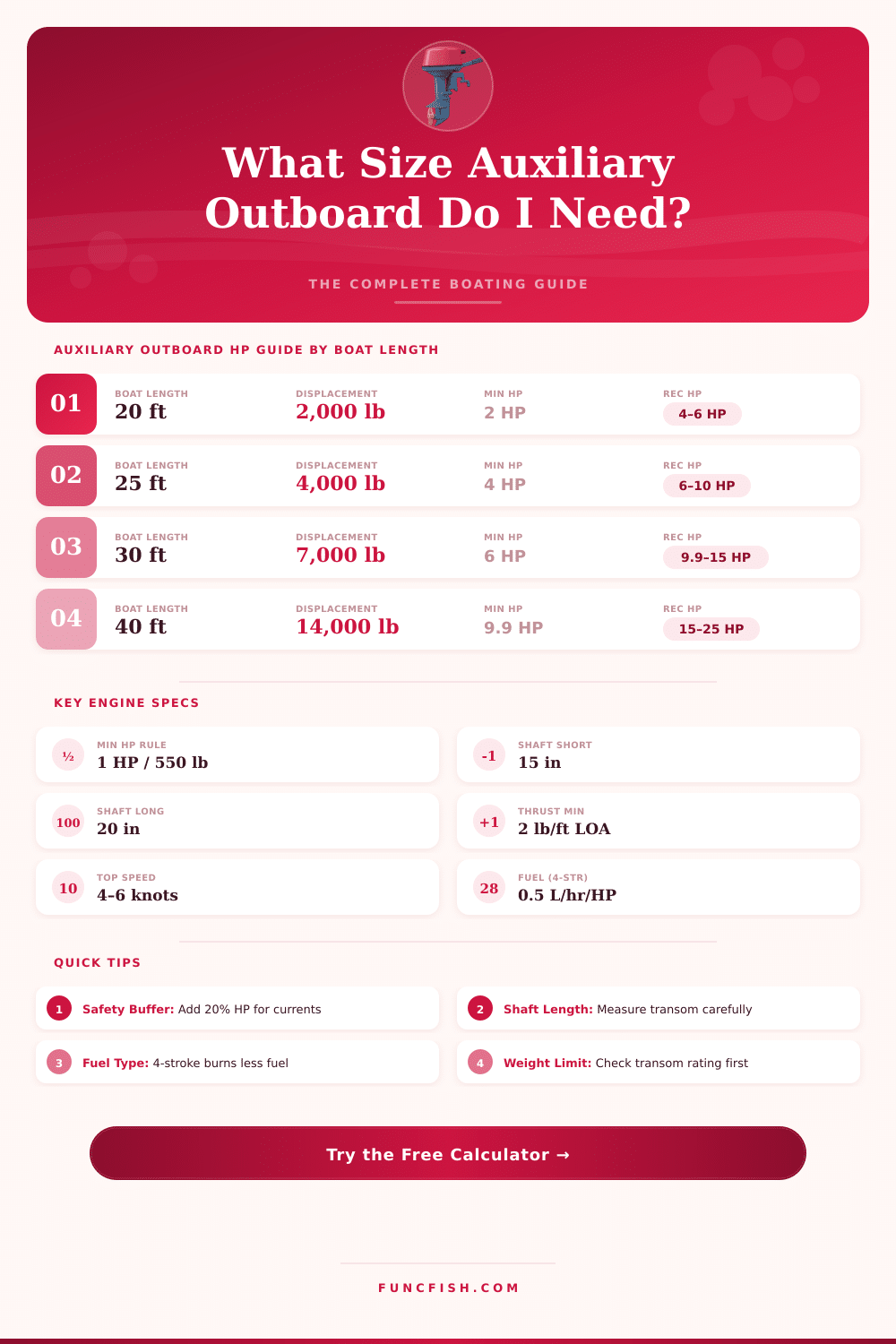
| Boat Length | Typical Displacement | Min HP | Recommended HP | Shaft Length | Avg Speed |
|---|---|---|---|---|---|
| 15–18 ft (4.6–5.5 m) | 800–1,500 lb (360–680 kg) | 2 HP | 2–4 HP | Short (15 in) | 3–4 kts |
| 18–22 ft (5.5–6.7 m) | 1,500–3,000 lb (680–1,360 kg) | 3.5 HP | 4–6 HP | Short/Long | 3–5 kts |
| 22–26 ft (6.7–7.9 m) | 3,000–6,000 lb (1,360–2,720 kg) | 5 HP | 6–9.9 HP | Long (20 in) | 4–5 kts |
| 26–30 ft (7.9–9.1 m) | 6,000–9,000 lb (2,720–4,080 kg) | 6 HP | 9.9–15 HP | Long (20 in) | 4–6 kts |
| 30–36 ft (9.1–11 m) | 9,000–13,000 lb (4,080–5,900 kg) | 9.9 HP | 15–20 HP | Long (20 in) | 4–6 kts |
| 36–42 ft (11–12.8 m) | 13,000–18,000 lb (5,900–8,165 kg) | 15 HP | 20–25 HP | Extra Long (25 in) | 5–7 kts |
| 42–50 ft (12.8–15.2 m) | 18,000–30,000 lb (8,165–13,600 kg) | 20 HP | 25–40 HP | Extra Long (25 in) | 5–7 kts |
| Engine Type | Weight Factor | Fuel Use | Maintenance | HP Range | Best Use |
|---|---|---|---|---|---|
| 4-Stroke Gas | 1.0x (baseline) | 0.5–0.6 L/hr/HP | Low–Moderate | 2–350 HP | All-round auxiliary |
| 2-Stroke Gas | 0.7x (lighter) | 0.6–0.8 L/hr/HP | Low | 2–90 HP | Small dinghies, budget |
| Electric Outboard | 0.8x | 0.5–1.5 kWh/hr | Very Low | 0.5–10 HP equiv. | Calm water, short range |
| Diesel Outboard | 1.3x (heavier) | 0.2–0.3 L/hr/HP | Moderate | 5–50 HP | Long-range offshore |
| Water Conditions | Safety Factor | HP Multiplier | Notes |
|---|---|---|---|
| Calm Lake / River | 1.0–1.1 | Base HP | No significant current or swell |
| Tidal / Estuary | 1.2–1.3 | +20–30% | Currents up to 3 knots, river bars |
| Coastal / Bay | 1.3–1.4 | +30–40% | Wind chop, moderate swells |
| Offshore / Open Ocean | 1.5–1.6 | +50–60% | Exposed conditions, safety critical |
Choosing the right size of outboard engine is very important. That helps to avoid overpowering of the boat and save money for care of boat and engine. The right type and size of the engine depends on the model of the boat, its specifications, limits of the maker, how you use it for boating and fishing, the conditions of the water and the region, together with other relevant factors.
Outboard engines in the range of 2.3hp to 3.5hp are compact and practical. They weigh less than 41 pounds and commonly serve on canoes, folding boats inflatable boats, dinghies and small sailboats. For family outings or more serious fishing trips an outboard engine between 15 and 30 HP is usually ideal.
How to Choose the Right Outboard Engine Size
Big ships, boats and yachts always have inboard engines. Medium ships can use either inboards or outboards, while small ships almost never have inboard engines. It is rare to find a sailboat longer than 27 or 30 feet with an outboard, because an inboard diesel is a lot more convenient and reliable.
Even so inboard engines take up precious interior space, so on a smaller boat an outboard makes more sense.
Boats of 21 to 25 feet are at the bottom end of vessel size, where an inboard/outboard setup is practical. This range is also great for outboards, especially on fresh water where corrosion is much less of a problem. You more easily work with outboards, replace or repower them.
For salt water reliable brands are Mercury and Yamaha. Modern four stroke engines, although more complicated built, commonly match or surpass old two strokes for preformance and always surpass for economy.
Also the length of the shaft matters. On dinghies you tend to use short shaft, because the transom, where the engine mounts, is close to the water. On bigger boats with deep transom you need a long shaft.
For sailboats a longer shaft is better, because sailboats hobbyhorse in short steep waves of deep channels with strong current, and the prop can come out of the water.
When choosing to get on plane the shape of the hull plays a role. Some hulls simply will not plane, and more then 2 HP will do very little on those. For a 16-foot jon style boat, that rates for 60 HP, 40 HP would be fine, but not the best.
Do not fear big power of an outboard. It is really better to have too much than too little. At a 23 or 24-foot outboard boat, twins are worth considering, because outboard props are not very big and two are needed to properly push the boat.
Also remember, that added decks take away from the total capacity.
The overall size of the vessel, that takes horsepower into account, can even decide the type of insurance policy for the boat. Smaller powerboats with less than 25 horsepower are usually covered under a homeowner’s orrenter’s insurance policy.