Bait Dropper Fill Calculator
Estimate bait-dropper chamber capacity, wet payload, dry bait equivalent, drops needed, sink time, flow drift, and bottom feed spread before you lower a swim feeder or dropper.
🎯Fishing Presets
⚙Dropper Inputs
Bait Dropper Fill Results
Full Breakdown
🛠Bait Dropper Capacity Grid
Mini Wire
Small Cage
Standard
Heavy River
🐟Species And Gear Comparison
Roach / Dace
60-140 gSmall dropper loads, loose maggot, hemp, or caster. Keep the feed line tight and repeat often.
Bream / Skimmers
180-360 gMedium loads of crumb, pellet, and seed. Wider release can hold shoals without one hard pile.
Barbel / Chub
220-480 gHeavy river droppers, sticky pellets, and low spread. Add drift allowance before repeating drops.
Carp / Tench
250-600 gParticle-heavy loads, accurate bottom dump, and enough fill headroom for the door to release cleanly.
📊Bait Density Reference
| Bait mix | Loose wet density | Compaction response | Typical release | Calculator note |
|---|---|---|---|---|
| Cooked hemp and seed | 0.72 kg/L | Low | Fast bottom scatter | Best with 65-85% fill |
| Maggots or casters | 0.58 kg/L | Low | Very fast | Do not overpack live bait |
| Damp micro pellets | 0.82 kg/L | Medium | Moderate | Needs air space if swelling |
| Damp groundbait crumb | 0.64 kg/L | High | Cloud then pile | Density rises sharply when squeezed |
| Chopped worm and soil | 0.78 kg/L | Medium | Patchy bottom feed | Allows high scent with modest mass |
| Sweetcorn and particles | 0.86 kg/L | Medium | Firm bottom pile | Large kernels reduce usable fill |
| Boilie crumb and pellets | 0.76 kg/L | Medium | Slow particle trail | Good for repeated carp drops |
| Sticky river pellets | 0.94 kg/L | High | Slow and tight | Often needs more compaction |
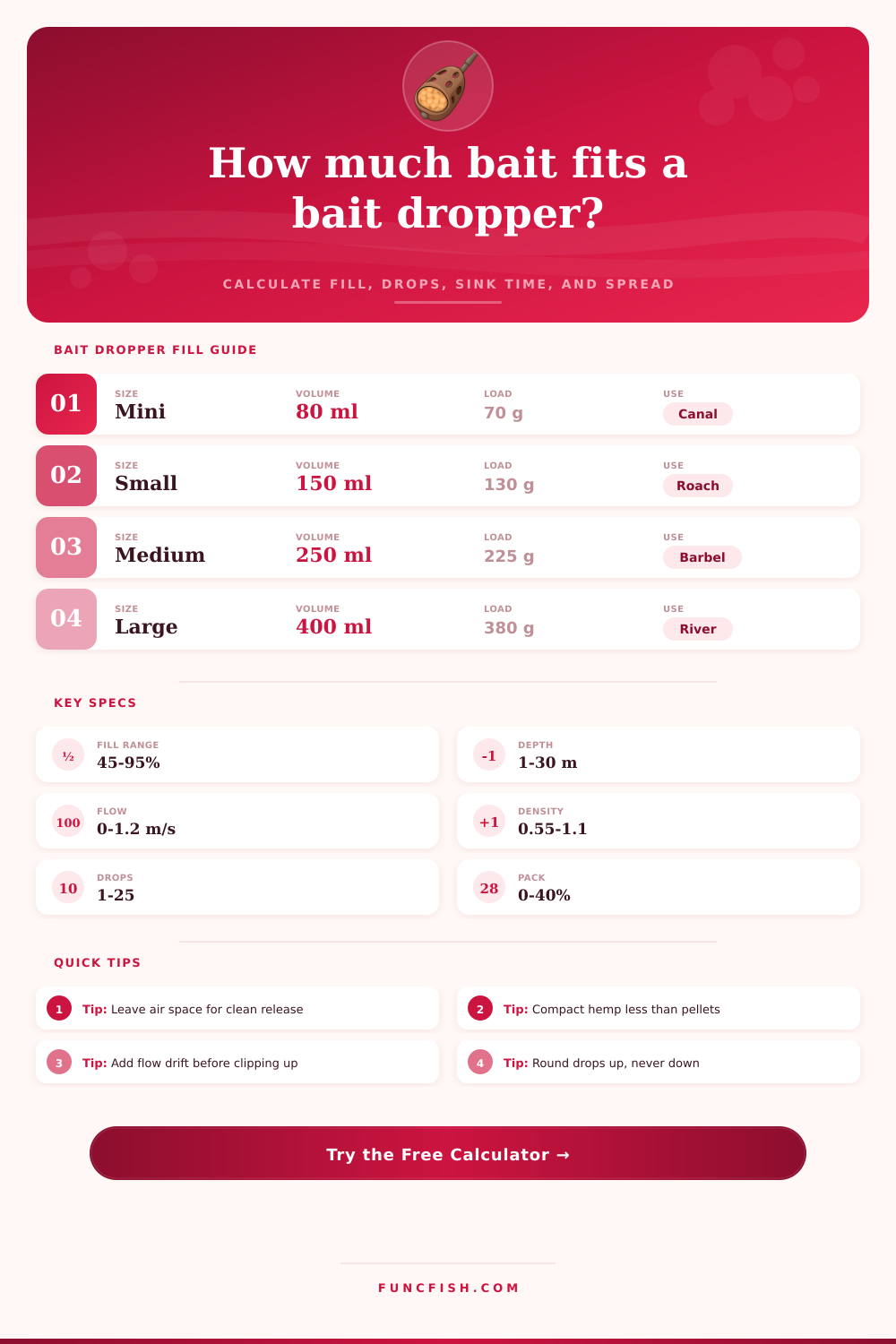
📏Dropper Size And Fill Guide
| Dropper class | Internal volume | Useful fill | Best depth | Flow handling |
|---|---|---|---|---|
| Mini wire dropper | 70-100 ml | 45-80 g | 3-8 ft / 1-2.5 m | Still to slow |
| Small cage dropper | 120-180 ml | 80-160 g | 4-12 ft / 1.2-3.7 m | Canal to glide |
| Standard dropper | 200-280 ml | 150-280 g | 6-18 ft / 1.8-5.5 m | General coarse work |
| Heavy river dropper | 280-380 ml | 230-430 g | 5-20 ft / 1.5-6.1 m | Strong glide |
| Large boat dropper | 400-650 ml | 350-650 g | 12-60 ft / 3.7-18 m | Vertical deep work |
🌊Flow Drift And Release Table
| Water movement | Approx speed | Fill adjustment | Release choice | Expected footprint |
|---|---|---|---|---|
| Still lake | 0-0.05 m/s | Normal fill | Pinpoint dump | Very tight pile |
| Canal tow | 0.05-0.18 m/s | Minus 5% fill | Short trail | Small oval patch |
| River glide | 0.18-0.45 m/s | Plus 5% weight | Sticky bottom | Downstream patch |
| Fast swim | 0.45-0.85 m/s | Heavy dropper | Sticky bottom | Longer tail |
| Deep boat | 0.05-0.30 m/s | Lower slower | Pinpoint dump | Depth-led drift |
🧮Fill Formula Reference
| Calculation | Formula used | Why it matters | Result affected |
|---|---|---|---|
| Chamber volume | pi x radius squared x length | Finds true bait space from dimensions | Payload |
| Packed density | Bait density x compaction factor | Translates volume into wet mass | Payload and sink rate |
| Drops needed | Target feed / delivered load | Rounds up so the swim is not underfed | Drop count |
| Vertical sink rate | Dropper base rate plus load, adjusted by flow | Estimates lowering time to bottom | Sink time |
| Bottom footprint | Flow drift plus release spread plus accuracy | Shows how tight the feed will land | Feed spread |
💡Calculation Tips
Fill headroom: A bait dropper that is filled to the brim can wedge bait against the door or hinge. For crumb, pellets, and chopped worm, leave 10-20% chamber space unless the dropper has a very free trigger.
Flow allowance: Drift grows with both depth and lowering time. In moving water, the heaviest useful dropper is often more accurate than extra line tension because it reduces the seconds spent in the current.
The fish hide behind overhangs on the bank and burrow into gravel on the bottom of river. You need pinpoint accuracy to put bait in front of them. As you hold line trying to make that happen, the water pushes it downstream in your hand. A traditional method feeder will prove too clunky for the task, and holding bait in your fingers just doesn’t put out enough bait to tempt fish out from under cover.
Learn how to load one properly and the bait dropper can become an extension of your arm. For most folks, loading up a dropper is like packing a picnic basket: you stuff it until it’s full without any regard for how you filled it. Typically that results in a lot of scattered baits missing mark by several feet and clogged gates.
How to Use a Bait Dropper Properly
But when that metal tube touches the water, it’s the maths of density and displacement at work. How much wet payload can you deliver on each drop? Too much groundbait in one go will greatly increase compaction because more mass are held within a smaller volume. However, the release mechanism slows down considerabley. This calculator handles the complicated way bait density and chamber size works together.
You can see actual weight of the feed you’re about to make before you’ve even picked up the pole. It transforms raw measures into actions: how far will it drift? How long will it take to sink? Sink time is important because every second a dropper falls through water column, it drifts past where you want it.
If you’ve got a heavy load on the hook, it’ll dive quickly down to the bottom when swimming fast in a river, reducing how far off course it go. A lighter load may be floating around for twenty feet before settling down, making a carefully aimed feed a broad cloud that scares wary barbel or carp. The system takes this into account; it considers both rate of current and depth, and estimates where on the bed bait will land.
You know if you’re fishing for chub in a strong flow, or roach in slow water, and can factor that into your expectations. The one variable that everyone neglects until they have an issue is compaction. Because hemp seeds has a unique shape and internal air pockets, they behave different than damp crumb or sticky pellets. Loose bait will separate and exit the chamber more quickly. In contrast, tightly compacted combinations form a tight wad and deposit as compressed pile.
For consistent performance, leave some chamber headroom. If you fill it all the way up to the top lip, it will likely blow out before fully opening. This happens because of force on the trigger mechanism. Just a little bit of space and gravity takes over with no mechanical help needed.
When you understand those characteristics it changes the process from guessing to strategy. Now instead of wondering why fish won’t stay in the swim, you can target exactly where the food lands. That gives you the ability to create a base of similar baits that match the species behavior your seeking. Tench may need a narrow pinpoint pile whereas bream want more spread out scatter pattern to get them going.
The tool comes complete with common capacity ranges of each dropper size so you know what rigging to use based off flow and depth. The right size dropper is equally important as what you load into it. Ditch one of those mini wire models in deep water and it won’t be seen again. Drop one of the big ol’ boat droppers in up close on a marginal piece of cover and it’s liable to spook them away with its bulk.
The best way to avoid wasting your efforts on the wrong tool for the job is to match the tool to the situation. You’re looking for the smallest tool that still provides enough weight where it matters most. After finding the right compaction level and fill percentage, you will find consistency from one session to another.
You know exactly how many drops it takes to get a respectable swim as long as you don’t overfeed and sate the fish too soon. Being able to do this, like keeping pressure on a particular feature, is what separates the casual angler from the guys who consistently catch numbers. The feed spread estimates allows you to see how it’s going to look on the bottom. They also help you account for any minor hand lowering inaccuracy or effect of having a little bit of line belly.
Bait droppers are an art form that takes time and effort to master. At first, you’ll overcompensate packing them down so hard they plunge straight to the bottom; other times you won’t realize how much the current has pulled them sideways. As you get better at packing and refining your bait dropper technique, though, you begin intuitively understanding connection between what you put in and what happens underwater.
The water tells you how much to compact and you make adjustments on the fly. It’s all about being accurate while still being attractive. If you can land that bait precisely where you desire it to go… And keep it there, waiting for fish to bite becomes a far more pleasant task. That precise focus is what transforms a potentially good day into a great one.
You should of tried this sooner.