How Long Of A Leader For Bass Fishing Calculator
Estimate bass leader length from species, water clarity, cover, lure type, mainline, leader material, rod length, casting distance, and how cleanly you want the knot to pass.
📌Bass leader presets
⚙Leader setup inputs
Bass leader recommendation
Full breakdown
📋Line and cover comparison grid
Clear Open Water
Stained Grass
Wood And Rock
Heavy Mats
📚Bass leader reference tables
| Bass species | Normal leader range | Typical leader test | Calculator bias |
|---|---|---|---|
| Largemouth bass | 18 in to 5 ft / 0.46 to 1.52 m | 10 to 20 lb / 4.5 to 9.1 kg | Shorter around cover, medium abrasion |
| Smallmouth bass | 4 to 9 ft / 1.22 to 2.74 m | 6 to 12 lb / 2.7 to 5.4 kg | Longer in clear rock and open water |
| Spotted bass | 4 to 8 ft / 1.22 to 2.44 m | 6 to 12 lb / 2.7 to 5.4 kg | Stealth weighted for suspended fish |
| Striped bass | 3 to 8 ft / 0.91 to 2.44 m | 15 to 30 lb / 6.8 to 13.6 kg | Pulling power and shock load weighted |
| White bass | 2 to 5 ft / 0.61 to 1.52 m | 6 to 12 lb / 2.7 to 5.4 kg | Shorter for schooling reaction baits |
| Peacock bass | 12 in to 4 ft / 0.30 to 1.22 m | 17 to 30 lb / 7.7 to 13.6 kg | Shock and abrasion weighted strongly |
| Shoal bass | 3 to 7 ft / 0.91 to 2.13 m | 8 to 15 lb / 3.6 to 6.8 kg | Rock contact and current both count |
| Guadalupe bass | 4 to 8 ft / 1.22 to 2.44 m | 6 to 10 lb / 2.7 to 4.5 kg | Clear creek stealth is emphasized |
| Water clarity | Visibility read | Length adjustment | Stealth priority |
|---|---|---|---|
| Muddy or chocolate | Less than 1 ft / 0.30 m | Shorten 12 in / 30 cm | Low: knot and abrasion matter more |
| Stained | 1 to 2 ft / 0.30 to 0.61 m | Shorten 6 in / 15 cm | Low-medium: reaction baits fit well |
| Green tint | 2 to 4 ft / 0.61 to 1.22 m | Neutral starting point | Medium: balanced all-around leader |
| Clear | 4 to 8 ft / 1.22 to 2.44 m | Add 18 in / 46 cm | High: lighter fluoro often helps |
| Gin clear | More than 8 ft / 2.44 m | Add 30 in / 76 cm | Very high: length and diameter matter |
| Lure type | Leader tendency | Test tendency | Why it changes |
|---|---|---|---|
| Drop shot or finesse | Longer by 18 to 24 in | 6 to 10 lb / 2.7 to 4.5 kg | Line visibility and natural fall matter |
| Jerkbait or crankbait | Medium-long | 8 to 14 lb / 3.6 to 6.4 kg | Leader can tune depth and shock |
| Spinnerbait or vibrating jig | Medium-short | 12 to 20 lb / 5.4 to 9.1 kg | Reaction bites reduce stealth needs |
| Jig or Texas rig | Short to medium | 12 to 20 lb / 5.4 to 9.1 kg | Bottom contact adds abrasion |
| Swimbait or topwater | Medium | 12 to 25 lb / 5.4 to 11.3 kg | Hookset shock and lure weight count |
| Frog or punch rig | Very short or none | Heavy braid often wins | Vegetation control beats invisibility |
| Knot preference | Practical cap | Best use | Watch point |
|---|---|---|---|
| Keep knot outside guides | About 18 to 30 in / 46 to 76 cm | Skipping, pitching, heavy cover | May sacrifice clear-water stealth |
| Tip guide only | Rod length minus lure drop | All-around casting rigs | Knot hits the tip under load |
| Through guides | About rod length to 1.2x rod | Spinning braid-to-fluoro leaders | Use a slim connection knot |
| Knot reaches spool | Up to about 2x rod length | Very clear water finesse | Bulky knots can catch on cast |
💡Leader calculation checks
Tip: If the calculator caps the leader because the knot must stay outside the guides, treat the result as a casting-control choice. In clear water, try a slimmer knot before giving up the extra length.
Tip: The test-strength card compares your selected leader to the calculated target. If the selected test is low in wood, rock, shells, docks, or grass, move up before shortening the leader.
A fishing leader is the length of line that connect a main fishing line to a lure. There is several function that a fishing leader perform when fishing. One function of a fishing leader is to provide invisibility to the fish, and another function of a fishing leader is to provide abrasion resistence against the object in the water.
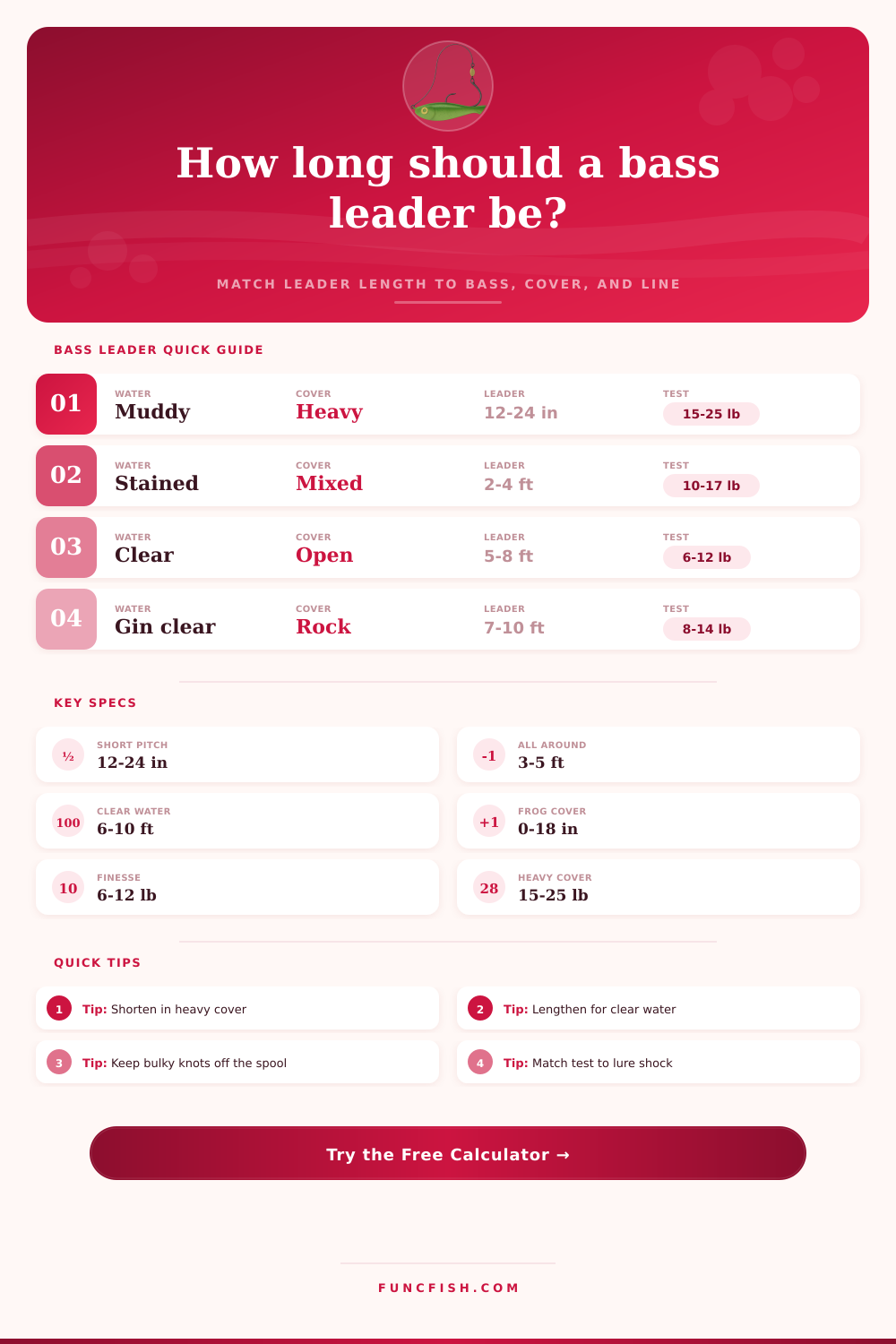
The length of the fishing leader and the material of the fishing leader must be chose based off the clarity of the water in which you are fishing and the amount of cover in that water. If the water is clear, you should employ a longer fishing leader in order to ensure that the fish cannot sees the connection between the main fishing line and the lure. However, if the water is muddy, fish cannot see the line in muddy water so a shorter fishing leader may be used.
How to Choose a Fishing Leader
The type of cover in the fishing areas will dictate the length of the fishing leader that you employ. If the fishing area contains heavy cover, such as weeds, you should use a shorter fishing leader to avoid tangle the fishing leader within the weeds. However, if there is sparse grass and rocks in the fishing area, a medium length fishing leader can be used.
If you conducts fishing near rocks or docks, abrasion resistance is important in the fishing leader. Thus, you should use a fishing leader that can resist being cut by those sharp rocks or docks. The species of fish that you are trying to catch will dictate the requirement of the fishing leader.
If you are fishing for smallmouth bass, which are often wary of visible lines, a long fishing leader should be used. If you are fishing for largemouth bass, which live in heavy cover, a shorter and stouter fishing leader should be used. Striped bass have strong pulling strength, so you should select a fishing leader with high test strength when fishing for striped bass.
The material of the fishing leader will impact the performance of the fishing leader while fishing. Fluorocarbon is a material that you can use to create the fishing leader. Fluorocarbon sink and is difficult for fish to see.
Monofilament is another material that can be used for fishing leaders. Monofilament is often used because it is tough and can withstand abrasion against shell. If you are fishing for species that have teeth, such as pike, you can use a wire fishing leader.
The wire fishing leader can resist the teeth of these fish. The fishing leader is connect to the main fishing line by a knot. You must secure the knot so that it does not fail while fishing.
Slim knots, such as the FG knot or Alberto knot can be used because they will pass more easily through the rod guide. Bulky knots may become stuck on the rod guides during fishing casts. The length of the fishing leader must be chosen to create a balance between fishing stealth and utility.
If the fishing leader is too long for areas with heavy cover, fishing time will be spent removing weeds from the fishing leader. If the fishing leader is too short for areas with clear water, fish may see the fishing leader and refuse to bite the bait. A balance must be established between stealth, abrasion resistance, and casting control.
You can adjust the length and material of the fishing leader to match the condition of the water.