Big Fish Pot Split Calculator
Divide a big fish side pot across winning places, ties, entries, and holdback while keeping the weigh-in math clear for anglers and directors.
📌Scenario presets
⚙Split settings
Big fish pot split
Formula breakdown
📋Split style comparison grid
Winner Sweep
Top Two
Top Three
Heavy First
📐Reference tables
| Payout profile | 1st place | 2nd place | 3rd place |
|---|---|---|---|
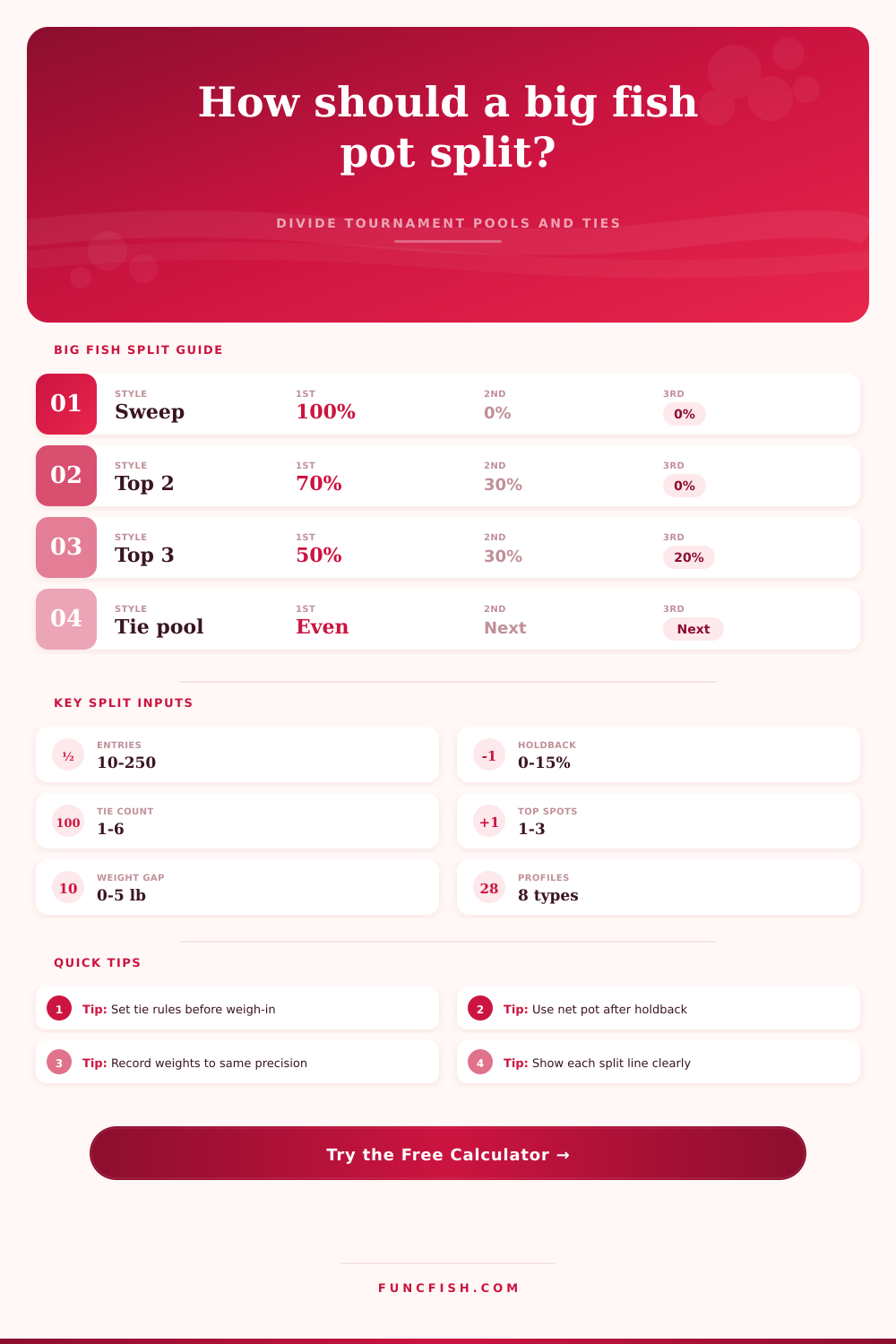
| Winner takes full big fish pot | 100% | 0% | 0% |
| Top two 70 / 30 | 70% | 30% | 0% |
| Top three 50 / 30 / 20 | 50% | 30% | 20% |
| Ladder 60 / 25 / 15 | 60% | 25% | 15% |
| Flat top three equal shares | 33.34% | 33.33% | 33.33% |
| Heavy first 80 / 15 / 5 | 80% | 15% | 5% |
| Tie situation | Calculator treatment | Example with top three | Director note |
|---|---|---|---|
| One first-place fish | Normal place line | 50% / 30% / 20% | Use posted order |
| Two tied for first | Combine 1st and 2nd | 80% split two ways | Next fish is third |
| Three tied for first | Combine 1st to 3rd | 100% split three ways | No next line left |
| More ties than places | Whole net pot split | 100% divided by tied anglers | Cap at available places |
| Big fish category | Typical weight range | Close margin flag | Common split style |
|---|---|---|---|
| Local bass lunker | 4-9 lb / 1.8-4.1 kg | Under 0.10 lb | Top two or three |
| Catfish derby fish | 15-60 lb / 6.8-27.2 kg | Under 0.25 lb | Winner sweep or top two |
| Walleye side pot | 5-13 lb / 2.3-5.9 kg | Under 0.10 lb | Ladder split |
| Offshore jackpot | 20-150 lb / 9.1-68 kg | Under 0.50 lb | Heavy first |
| Ice derby panfish | 0.5-3 lb / 0.2-1.4 kg | Under 0.03 lb | Flat or tie pool |
| Audit item | Why it matters | Calculator field | Clean record |
|---|---|---|---|
| Entry count | Checks pot reasonableness | Paid big fish entries | Whole number |
| Holdback rate | Separates reserve from net pot | Holdback percent | Posted percent |
| Weight precision | Prevents false ties | Fish weights | Same scale units |
| Tie count | Allocates combined places | Anglers tied at top | Verified names |
| Profile choice | Controls every split line | Payout profile | Announced before weigh-in |
💡Split checks
Tip: Run the calculator from the net pot after any announced holdback. That keeps the posted split lines from drifting during awards.
Tip: For tied big fish, combine the affected place percentages first, then divide that combined line evenly among tied anglers.
When it’s time to weigh, everything falls silent. Everyone quiets down and stares at that digital readout. Math ceases to be abstract; now it’s money or heartbreak. Adrenaline is pumping.
A split are important to get right and keep the peace. Most directors think dividing a pot among three people is simple: just split it three ways. Wrong! It’s messier than that in real life. There are holdback to consider; there can be ties; there may be one lunker who should of won the entire side pot (or maybe not).
How to Split the Money Fairly
Should money trickle-down to second- and third-place finishers? To do all this, you need a decision-making process where this calculator does most of the work. All you have to know is how the lever work.
Let’s get to that payout profile first. Because that’s the base. Now, as I mentioned earlier, you have two categories of payouts. The first is winner takes all. This rewards the extreme outlier and creates maximum drama, but the person who comes in second gets nothing. Then there is top three (or whatever number) split, which keeps a larger percentage of participants involved in the event. This makes the effort worth their while even if they don’t catch the big one.
The payout tool lays out those numbers plainly in the reference tables so you’ll be able to see what you’re giving up when making your decision, and you know going into it. Then there is the holdback, which are the money reserved for admin costs and other unforeseen events. Before you can work out how many shares there is, you need to deduct the holdback money. If you don’t, you’ll over promise, which doesn’t make for good PR. The tool requires a percentage and the total gross amount. It spits out the net pot divided by whatever share profile you have chosen, keeping accounts nice and tidy.
The thing about ties; they’re usually a mess at the end of a tournament. Two guys caught exactly the same weight. How do we resolve that? The answer should be in the rules. Not in the argument. It’s supposed to be in the rules, not the debate. Most of the time, the solution is to take the percentage for each of those places and split it equally between them. So if two anglers tied for first, you’d add up the percent of first and the percent of second then divide it in half.
Enter how many times there were ties and it does the math for you automatically. It takes away the stress and the guessing.
Now let’s talk about weight precision. Zero point zero two pounds may not seem like much, but that’s what separates cash from no-cash in some instances. Use one scale for everybody and make sure you calibrates. Write down those weights cleanly; garbage in = garbage out with respect to the math. It won’t help you if your scale is busted; it only works with good input. However, it will guarantee that the output is right, no matter what is fed into the machine.
Consider the type of tournament. With the big weights and large gap in fish, a sweep or top two split is more likely in catfish derbies. In these events, the weight margins are large and the standings has plenty of distance between them. Bass events often have many ties, so a tie pool structure or a flat three-way split work better. This is where the tool has preset options for those situations. But remember they are starting points, they aren’t magic bullets. You will still make changes to fit your event size and number of entries.
Transparency. Post the results so all angler know exactly how their share is calculated. Trust the system. Trust is how tournaments are built, and trust is what gets folks to return again next year.
It’s just basic arithmetic. Where it becomes tricky is establishing clear rules and then adhering to those rules consistent. Before weigh-in take a few seconds and run the numbers. What happens when a tie occurs? How does a change in the payout affect your check with a different holdback? Run through some scenarios and save yourself a large headache down the road.
You’ll be prepared for when the scales go up and the crowd holds their breath. They won’t know what happened either, that’s the beauty of it all.