Bimini Twist Double Line Length Calculator
Back-calculate the line to pull before tying a Bimini twist, including usable double line, seated twist body, tag allowance, finishing wraps, and tightening shrink.
📌Scenario presets
⚙Bimini twist inputs
Bimini twist length results
Full calculation breakdown
🧵Material behavior grid
Nylon mono
Fluorocarbon
Carrier braid
Dacron backing
📏Finished double length reference
| Rig or technique | Common finished double | Typical line class | Why that length is used |
|---|---|---|---|
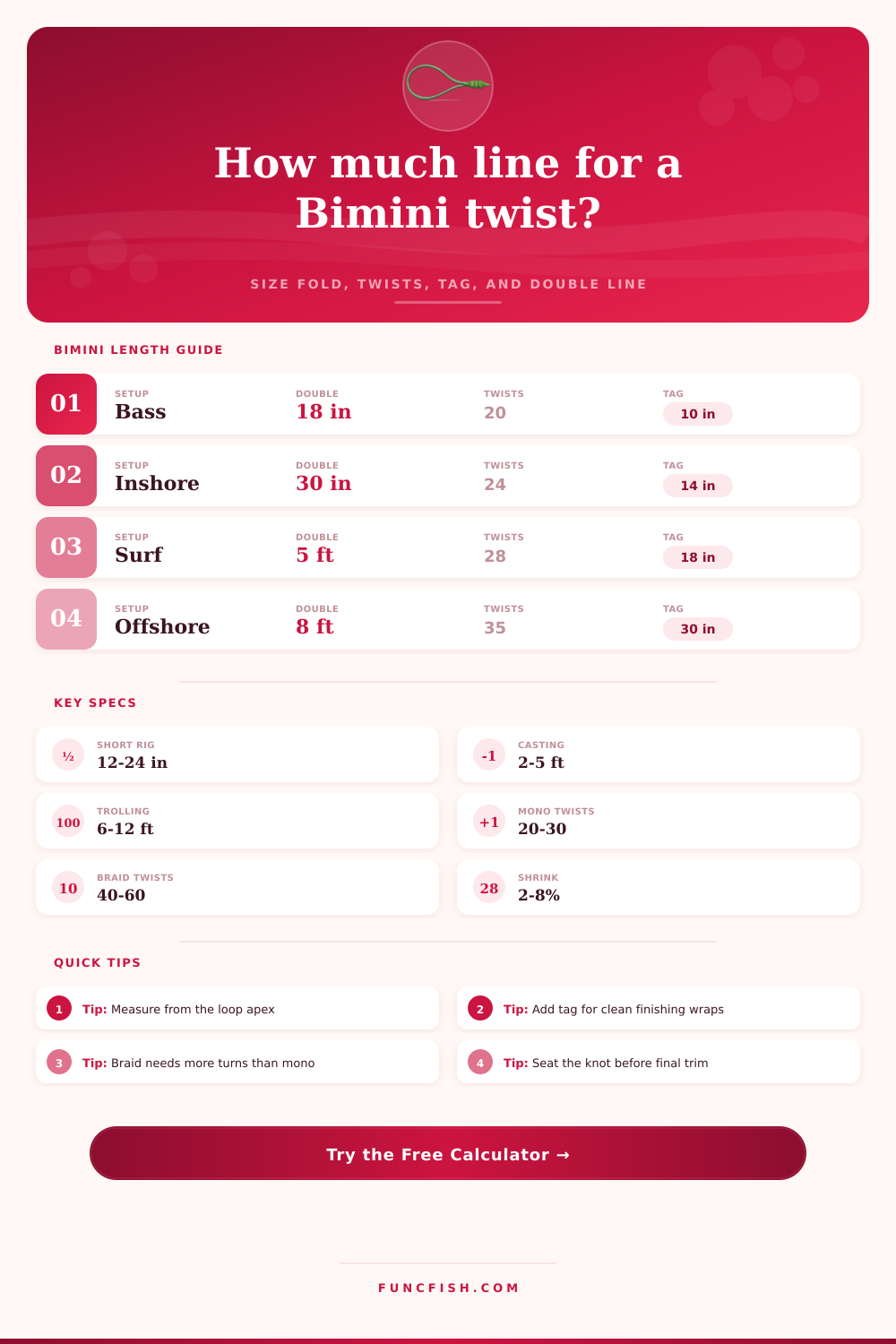
| Bass leader loop | 12-24 in / 30-61 cm | 8-30 lb / 4-14 kg | Short double keeps the connection compact around spinning or casting guides. |
| Inshore braid leader | 24-40 in / 61-102 cm | 15-50 lb / 7-23 kg | Gives enough doubled braid for a slim leader knot and a little handling room. |
| Surf casting shock leader | 4-7 ft / 1.2-2.1 m | 20-60 lb / 9-27 kg | Allows the doubled section to pass through guides while loading a cast. |
| Tarpon class tippet | 12-20 in / 30-51 cm | 12-20 lb / 5-9 kg | Measured systems usually keep the double controlled and repeatable. |
| Offshore trolling loop | 6-12 ft / 1.8-3.7 m | 50-130 lb / 23-59 kg | Long doubles help with wind-on leaders, swivels, and deck handling. |
| Fly backing loop | 8-18 in / 20-46 cm | 20-30 lb / 9-14 kg | Enough doubled backing for loop-to-loop connection without excess bulk. |
🔀Twist count and allowance table
| Line type | Line class range | Useful twist count | Starting tag allowance |
|---|---|---|---|
| Light nylon mono | 2-12 lb / 1-5 kg | 22-30 turns | 8-12 in / 20-30 cm |
| Medium mono or copoly | 15-40 lb / 7-18 kg | 20-28 turns | 12-18 in / 30-46 cm |
| Heavy offshore mono | 50-130 lb / 23-59 kg | 18-26 turns | 24-36 in / 61-91 cm |
| Fluorocarbon leader | 10-80 lb / 5-36 kg | 24-36 turns | 14-28 in / 36-71 cm |
| 8-carrier braid | 10-80 lb / 5-36 kg | 40-60 turns | 14-30 in / 36-76 cm |
| Hollow-core braid | 60-200 lb / 27-91 kg | 35-55 turns | 24-48 in / 61-122 cm |
🐟Gear and species comparison grid
Bass and walleye
1.5-3 ftShort doubled braid or mono section for compact guide clearance, leader knots, and lure casting.
Snook and redfish
2-4 ftMedium double gives extra handling room when connecting braid to abrasion-resistant leader.
Surf species
4-7 ftLong enough to support shock-leader loading without leaving excessive doubled line on the spool.
Tuna and billfish
6-12 ftLong doubles match wind-on leaders, swivels, and leadering needs around the boat.
🧮Formula reference table
| Calculation | Formula used | Input that drives it | Result produced |
|---|---|---|---|
| Estimated line diameter | Interpolated line class chart by material | Line class and selected material | Diameter used for twist spacing |
| Seated twist body | Twists x pitch per turn x material factor | Twist count, diameter, and finish style | Knot body length after seating |
| Shrink reserve | (Finished double + knot body) x shrink percent | Tightening take-up entry | Extra length before tying |
| Fold mark | Finished double + loop + body + shrink reserve + margin | Target double and safety margin | Distance to mark from loop apex |
| Total pull-off | 2 x fold mark + tag + working waste | Folded section, tag, and standing waste | Line to pull from reel before tying |
💡Bimini measurement notes
Marking tip: mark the fold distance from the loop apex before adding twists. If the finished double must be exact, seat the knot wet, pull to working tension, and measure again before trimming the tag.
Turn-count tip: limp braid usually needs more turns and a longer finishing tag than mono because the fibers flatten and can walk under load before the hitches lock.
There you are standing on the dock with a bird’s nest for a leader knot and a spool of braided line all tangled up. Most anglers simply guess at how much line to use in their Bimini twists. They waste time pulling a foot of line off their spool, then they begin twisting and quickly run out of slack because the knot doesn’t seat correctly. This leaves them fumbling around and making a sloppy finish that comes undone under pressure.
Tying is seldom the issue. Measurement strategy are nearly always the issue. A Bimini twist depend on friction between the overlapped strands to maintain tension. And the amount of overlap is what controls that friction, it has to be just right. That means very fine control over the ratio of line that gets pulled into the twist zone vs. The loop. So when you measure final length of the doubled portion, you’re going to miss the mark. You also have to consider the tag end for locking hitches. There is some line used to form the knot body itself. Then there is the line shrinkage caused by the compression of the twist column.
Why Your Bimini Twist Fails and How to Fix It
That’s where all the hidden variables come in… Until now. Enter the calculator above, plug in your desired loop size plus the kind of line you’re using and let the math take care of all that.
When we talk about different materials under pressure, they reacts differently. Monofilament like nylon will stretch quite a bit when cinching down the knot. Its stretch also allows the twist body to compact more than on slick braided mainline or a stiffer fluorocarbon leader. Braid being smooth and round takes more wraps to create enough friction. What’s a solid twenty-twist setup with thirty-pound mono may slip entirely with ten-pound eight-carrier braid.
This is where the tool comes into play because it factors in the type of line and its size (diameter) and number of carriers. It can estimates how tight the knot is based off actual number of wraps you applied to the line. Take the case of tying a heavy leader for fishing offshore for billfish or tuna. You require a big-enough loop for swivel connection; yet small enough to pass through rod guides smoothly.
It’s also important in high stress applications that finishing tag be just right. If the tag is too long, it creates drag and distracts wary fish. Too short and there’s nothing to grip when securing the lock hitches. To illustrate, the table on the page plots out tag allowance according to line class. Bigger lines require longer tags since the fiber diameter are larger and more difficult to wrap tightly.
Many folks forget to account for the shrink reserve. The whole rig shrinks when you get it wet and pull it down into place on a Bimini twist. It can shrinks a few percent of the overall length. So if you make your first fold mark just where you want your finished loop to be, it won’t be big enough at all once tightened. Your reserve is meant as a safety margin before even tying a knot or picking up your knot tying tool or pliers. And it’s there to ensure the usable double line remains intact after the knot is fully seated.
These are the real waste input factors for tying knots in poor conditions: If you’ve ever tried to make a knot on a bobbing platform with some wind, it’s chaotic and not always easy. To spread out the twist equally up the column need a bit of standing line to provide enough tension. Otherwise you’ll pinch off the line or put uneven tension where there shouldn’t be any and weaken the bond. This is the real-world information the calculator uses to determine your total line length, so you don’t run short when you tighten it down.
So in conclusion, a good bimini twist has as much to do with geometry as it does grip strength. It’s creating a mechanical structure designed to distribute the load evenly among dozens of contact points. Proper input stops you from fighting the line and allows the line to do what it was designed to do.
You should of used this earlier. Don’t keep trimming hoping for a better outcome. Measure once you are confident and then be done. Rather than spend all your time untwisting a knot that didn’t work, go catch some fish. Take an additional half minute and get your fold mark calculated out before you ever pick up your knot tying tool. That little bit of prep work will pay huge dividends when those big ones turn on.