Bites Per Hour Calculator
Convert a fishing log into bite pace, landing rate, bites per cast, and a condition-adjusted session score for one angler or a shared boat.
📌Scenario presets
⚙Session log
Bite-rate summary
Full breakdown
📊Method data grid
📋Bite-rate reference tables
| Species group | Slow pace | Productive pace | Fast pace | Notes |
|---|---|---|---|---|
| Bass | 0-1.5 BPH | 2-5 BPH | 6+ BPH | Best compared by lure style and cover |
| Trout | 0-2 BPH | 3-8 BPH | 10+ BPH | Short hatch windows can spike quickly |
| Panfish / crappie | 0-4 BPH | 5-18 BPH | 20+ BPH | Schooling fish favor active-window tracking |
| Walleye | 0-1 BPH | 2-4 BPH | 5+ BPH | Wind and current often change the benchmark |
| Catfish | 0-0.8 BPH | 1-3 BPH | 4+ BPH | Bottom rigs need inactive time removed |
| Striped bass | 0-1 BPH | 2-5 BPH | 6+ BPH | Tide phase matters more than total trip time |
| Pike | 0-0.8 BPH | 1-3 BPH | 4+ BPH | Low bite count can still be a good session |
| Offshore pelagics | 0-0.3 BPH | 0.5-1.5 BPH | 2+ BPH | Track strike rate by spread and pass length |
| Method | Attempt unit | Strong signal | Weak signal | Best comparison |
|---|---|---|---|---|
| Casting lures | Cast | 3+ bites / 100 | Under 1 / 100 | Same bank, same cover |
| Fly fishing | Drift | 4+ takes / 100 | Under 1 / 100 | Same hatch or seam type |
| Jigging | Drop | 5+ bites / 100 | Under 2 / 100 | Same depth band |
| Bobber fishing | Soak | 8+ bites / hour | Under 2 / hour | Same school or dock |
| Bottom rig | Soak | 2+ bites / hour | Under 0.5 / hour | Same bait and current |
| Trolling | Pass | 1+ strike / pass | 3 blank passes | Same speed and contour |
| Surf casting | Cast | 2+ bites / 100 | Under 0.5 / 100 | Same tide stage |
| Drifting bait | Drift | 3+ bites / hour | Under 1 / hour | Same run and flow |
💡Logging checks
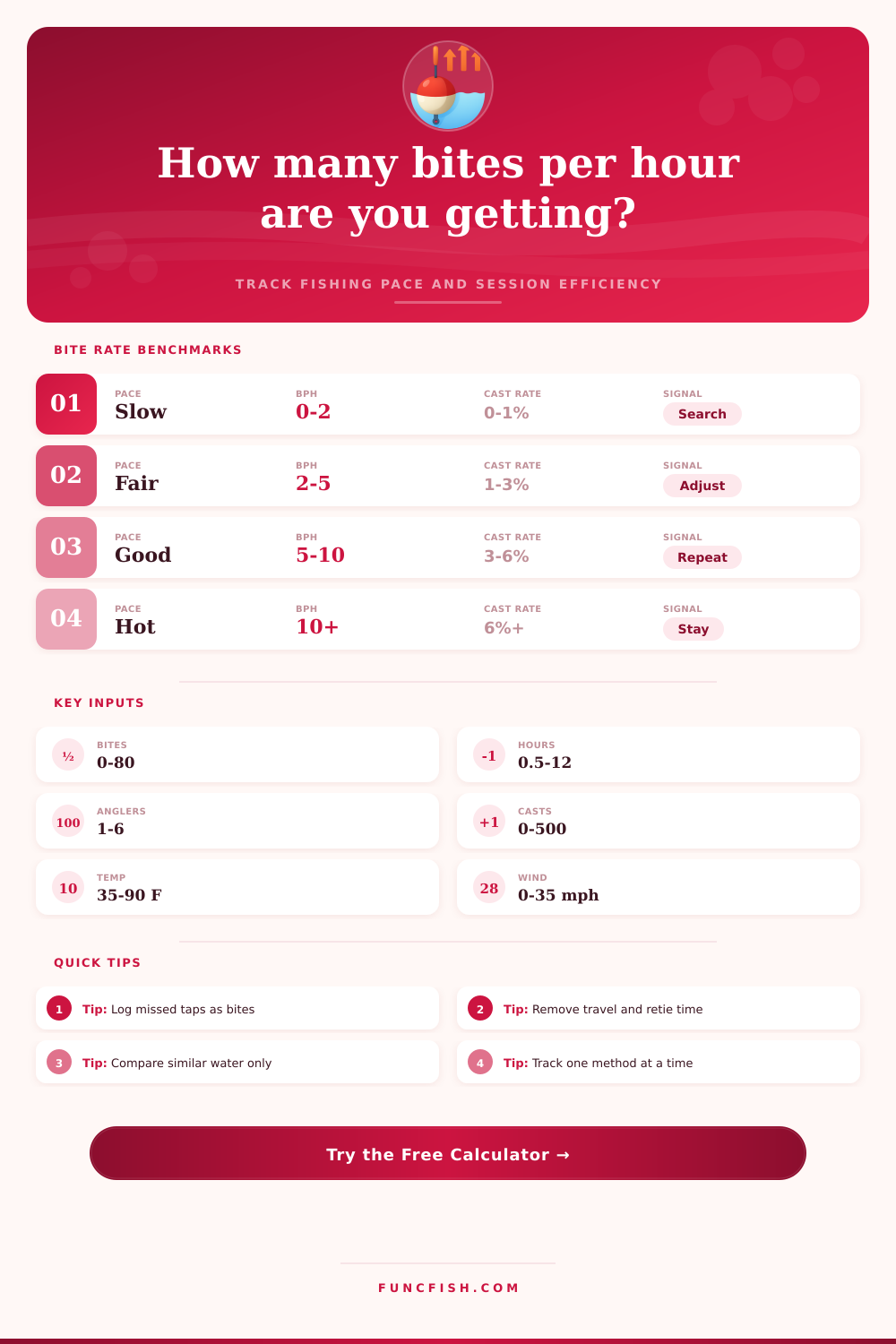
Tip: Count bumps, pull-downs, follows that touch, and missed hooksets as bites. Count only fish in hand as landed fish.
Tip: For a clean trend, compare trips with the same species, method, water type, and similar active fishing time.
Fishing trips can pass without an indication of whether the fishing was productive or if the fishing was merely busy. Many individuals who fish experiences this lack of indication of whether there fishing efforts were productive. As a result of this lack of indication, many individuals choose to track the number of bites per hour that the fish make at their fishing line.
The number of bites per hour is a simple number. However, the number of bites per hour provide a means of measuring the response of the fish to the fishing choices and the environmental factors. By tracking the number of bites per hour, anglers can transform their experiences to data and enable them to compare those data values to one another.
How to Track Fish Bites Per Hour
By comparing the number of bites per hour that anglors experience during different fishing trips, anglers can determine how to improve there fishing skills. In order to calculate the number of bites per hour for a fishing trip, the active fishing time must be separated from inactive fishing time. Inactive fishing time may include trips to the location, tying the line, waiting for the weather changes, and other actions that does not result in any bites at the fishing line.
If inactive fishing time is not subtracted from the total fishing time, the calculation of the number of bites per hour wont be accurate. The calculator allows for the fishing trip length and inactive fishing time to be entered, and the calculator itself will calculate the number of bites per hour. For different species of fish, the number of bites per hour will range.
Anglers must become familiar with these different bite rate per species. For example, bass may only bite twice in an hour with a spinnerbaits. Yet, two bites per hour may be an excellent rate for the bass that are being targeted.
Trout during a hatch may have a much higher number of bites per hour. The higher rate for trout bites per hour is not indicative of the same number of bites per hour that bass fish would make. The calculator allows for species and methods to be selected.
By selecting these variables, anglers ensure that the comparison of bites per hour is fair. The number of bites per hour may also be impacted by the environment in which the fishing is occurring. High atmospheric pressure can cause the fish to eat less.
High atmospheric pressure will impact the number of bites per hour. Conversely, moving tides may move the fish and increase the bites per hour. Other environmental factors can also impact the number of bites per hour.
Anglers should log these factors when they is fishing. By logging these factors, anglors can determine any patterns in the data that they collect. The number of fish that are landed is a separate data from the bites per hour data.
Yet, the number of landed fish is still another important variable. For instance, a high number of bites without the number of fish that are landed may mean that the anglor have an incorrect hook or leader length. By logging both the bites per hour and the number of fish that are landed, anglers can determine whether the problem lies in the encounters of fish or the ability to land the fish that are encountered.
The calculator separates these two data variables so that anglors can determine which variable requires the anglors attention. Anglers may also wish to track the number of attempts that were made to catch the fish. For instance, a high number of fishing attempts yet a low number of bites may mean that the fishing method needs to be changed.
Yet, a low number of attempts yet a high number of bites may mean that the anglor has found a good spot for fishing. The calculator will calculate the conversion rate for the number of bites per number of attempts if the number of fishing attempts is entered into the calculator. The tables that are provided on this page indicate the typical number of bites per hour for each species of fish and each fishing method.
These tables provide anglors with a baseline upon which to evaluate their number of fish bites per hour. While these tables are not critical for anglors, the data that anglors collect themselves will become more important as they progress in there fishing endeavors. The most important aspect of tracking the number of fish bites per hour is to remain consistent in the data that is logged.
Every bump in the line should be logged. Every missed landing of a fish should be logged. By logging each of these variables, anglors will have a complete picture of there fishing efforts.
Additionally, each fishing trip should only be compared with similar fishing trips. For instance, it would not be fair to compare a fishing trip for catfish at night to a fishing trip for bass in the morning. By logging data carefully with the calculator, anglors can trust the number that the calculator produce.
While the number of bites per hour is not a method that anglors should use to attempt to chase the highest score in fishing, the number of bites per hour is a method that anglors can use to note any changes to there fishing environment or tactics. Such changes may include the weather, the choice of lure, or the choice in location for fishing. Even fishing trips that may appear to have averaged bites per hour will yield the information that anglors require to improve there fishing ability.