Blackfin Tuna Weight Calculator
Estimate blackfin tuna weight with a pelagic fork-length curve, curved fork length, maximum girth, body depth, fatness, offshore zone, fight and gear class, and measurement confidence.
📌Blackfin tuna presets
⚙Tuna measurements
Measure from snout tip to fork of tail along the body curve or use a straight board method.
Wrap the thickest shoulder ahead of the second dorsal fin.
Measure back to belly at the deepest tuna profile, excluding fins.
Blackfin tuna weight estimate
Calculation breakdown
📊Blackfin data grid
School Fish
Chunk Fish
Large Blackfin
Trophy Check
📘Reference tables
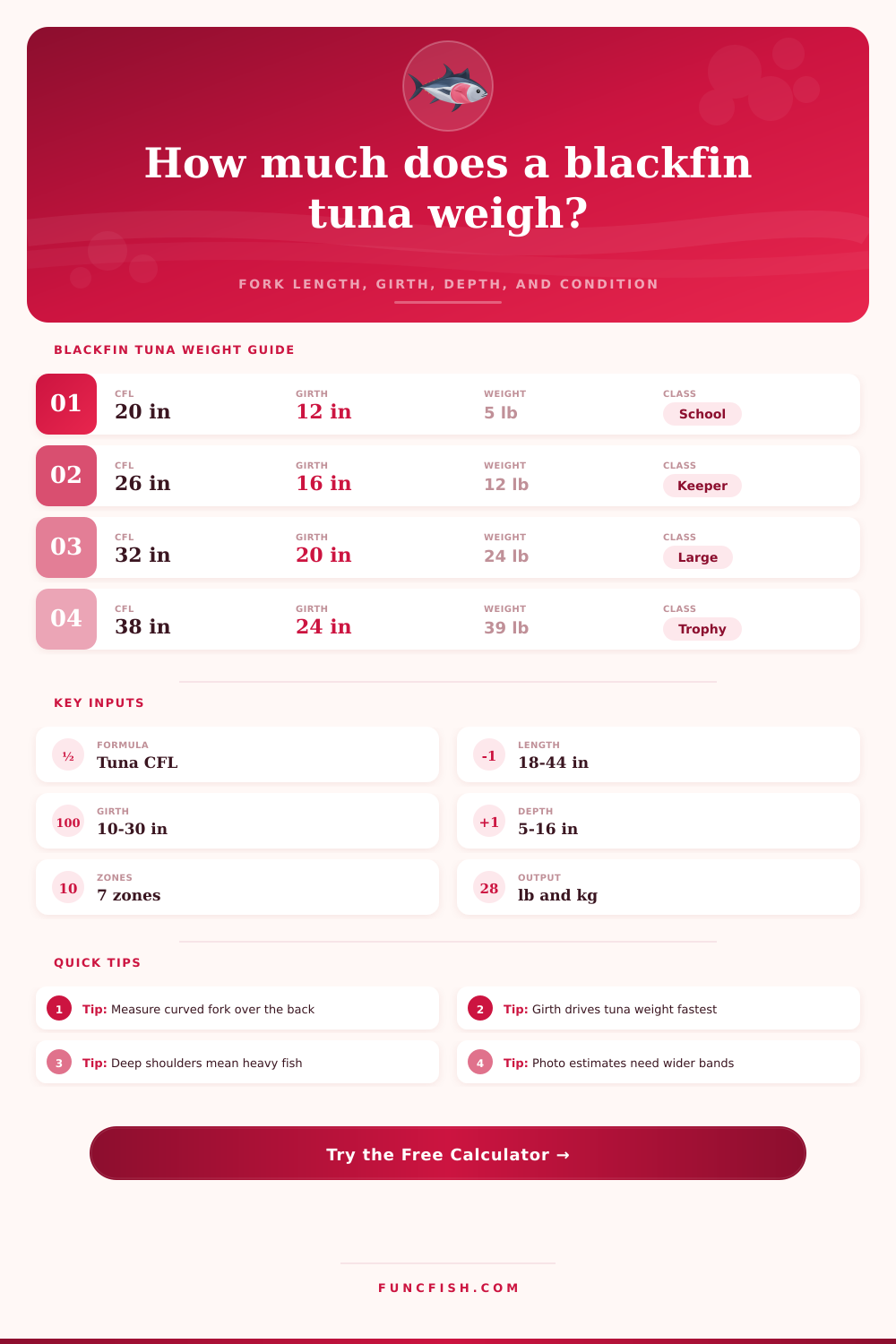
| Curved fork length | Typical blackfin weight | Heavy girth signal | Fish class |
|---|---|---|---|
| 18 in / 46 cm | 3-5 lb / 1.4-2.3 kg | 10-12 in girth | Small school fish |
| 24 in / 61 cm | 8-12 lb / 3.6-5.4 kg | 14-16 in girth | Solid blackfin |
| 30 in / 76 cm | 17-24 lb / 7.7-10.9 kg | 18-20 in girth | Large deck fish |
| 36 in / 91 cm | 31-39 lb / 14.1-17.7 kg | 22-24 in girth | Trophy contender |
| 40 in / 102 cm | 42-52 lb / 19.1-23.6 kg | 25-27 in girth | Exceptional blackfin |
| Offshore zone | Zone factor | Body cue | Calculator emphasis |
|---|---|---|---|
| Gulf weedline / color change | 0.96x | Fast school fish, often leaner | Length and girth balance |
| Florida Keys humps | 1.03x | Mixed current fish with full shoulders | Girth confirmation |
| Bahamas edge / wall | 1.06x | Deep edge fish with broad body | Depth and condition |
| Gulf oil rig or floater | 1.04x | Bait-fed fish around structure | Zone plus gear class |
| Shrimp boat or bycatch trail | 1.08x | Full belly, strong girth jumps | Fatness modifier |
| Fatness condition | Factor | Visible sign | Result effect |
|---|---|---|---|
| Lean racer | 0.90x | Narrow belly and long caudal wrist | Lowers estimate |
| Average blackfin | 1.00x | Normal shoulder and oval body | Baseline estimate |
| Fed-up bait school fish | 1.07x | Rounded belly from recent forage | Raises estimate |
| Chunky deep-bodied fish | 1.13x | Thick shoulders and deep belly | Strongly raises estimate |
| Roe-heavy / full belly | 1.17x | Heavy lower body and firm belly | Highest body bump |
| Spent or narrow belly | 0.86x | Soft, flat, or narrow belly line | Lowest body bump |
| Measurement source | Base band | Best use | Common error |
|---|---|---|---|
| Straight fork board | 7% | Fresh fish on flat board | Tail fork not centered |
| Soft tape over curved back | 10% | Deck tape with curved fork length | Curve length not corrected |
| Deep shoulder curve | 13% | Heavy fish with arched back | Tape follows too much body arc |
| Photo-scaled curved fork | 22% | Known rod, hatch, or cooler scale | Perspective changes the fork length |
🎣Tuna and gear comparison grid
Blackfin Tuna
18-40Common curved fork range in inches for this model.Yellowfin Tuna
HeavierSimilar length can carry far more mass, so do not reuse this curve.Skipjack Tuna
LeanerShorter body and different girth profile than blackfin.Bonito Mix
CheckConfirm species before applying blackfin body factors.Light Spin
10-20Line class in pounds for small school fish and fast fights.Jigging Setup
30-50Line class in pounds for deep fish and heavier drag.Trolling Spread
20-40Balanced tackle class for feathers, small plugs, and birds.Survey Sling
BestMost stable way to pair girth, depth, and length on deck.💡Measurement tips
Curved fork tip: If the tape follows the arched back, the calculator shortens that curved fork length before applying the pelagic length-weight curve.
Girth tip: Blackfin weight changes quickly with shoulder girth. A half-inch girth error can move the result more than a half-inch length error.
Knowing the weight of a blackfin tuna is of importance to many angler for logging the catch or taking a scale photo of the blackfin tuna. The angler can estimate the weight of a blackfin tuna by looking at the tuna. However, looking at the tuna are often inaccurate due to the different body shapes that a blackfin tuna can have.
For instance, blackfin tuna can have a long and lean body to a short and thick body. Each of these different body shapes can lead to the blackfin tuna having a different weight. The length of the blackfin tuna is one of the measurements that should of be used to estimate the weight.
How to Estimate the Weight of a Blackfin Tuna
However, the length of the tuna alone is often insufficient to provide an accurate estimation of the weight. The girth of the blackfin tuna is another factor that should be considered in the estimation of the weight. For instance, blackfin tuna with a larger girth will weigh more then blackfin tuna with a smaller girth.
Therefore, it is important to measure both the length and the girth of the blackfin tuna to provide an accurate estimate of the weight of the blackfin tuna. The length of the blackfin tuna can be measured from the snout to the tip of the tail along the curvedly fork of the blackfin tuna. The weight of the blackfin tuna may also be affected by the condition of the blackfin tuna.
For instance, blackfin tuna that contains alot of food in its body will weigh more than blackfin tuna that do not contain as much food. Additionally, blackfin tuna that is preparing to spawn will have more roe in their bellies than blackfin tuna that have not just recently prepared to spawn. Each of these factors will impact the weight of the blackfin tuna.
The location where the blackfin tuna live can also impact its weight, as blackfin tuna that live in areas with an abundance of food will weigh more than blackfin tuna that live in areas with less available food. In order to correctly and accurately measure the blackfin tuna, there are a few steps that should be followed. First, measure the length of the blackfin tuna from the snout of the tuna to the tip of the tail along the curved fork of the blackfin tuna.
Second, measure the girth of the blackfin tuna by placing a tape measure ahead of the second dorsal fin of the fish. The tape measure should be snug against the blackfin tuna, but should not be pressed against the fish to the point of denting its body. Third, account for the environment in which the blackfin tuna was measured.
For instance, if the blackfin tuna was measured on a moving boat, it may be difficult to obtain an precise measurement of the body of the blackfin tuna. Blackfin tuna can be categorized based off their size and weight. Schooling blackfin tuna typically weighs between 5 and 9 pounds and are under 24 inches in length.
Chunkers, which are larger blackfin tuna, are between 25 and 31 inches in length and weigh between 10 and 22 pounds. Very large blackfin tuna reach lengths between 32 and 37 inches and weigh between 23 and 36 pounds. Finally, trophies are blackfin tuna that are over 38 inches in length and are rare to spotting.
Because of the many different factors that can impact the weight of a blackfin tuna, it is best to provide an estimation of the weight in the form of a range. The range will provide an indication of the low-end and high-end estimate of the weight of the blackfin tuna. The weight of the blackfin tuna can be used to determine if the blackfin tuna is within the legal limits for that area or if it is a trophy blackfin tuna.
Additionally, knowing the weight of each blackfin tuna that is caught allows the angler to maintain accurate and useful records of their blackfin tuna fishing trip.