
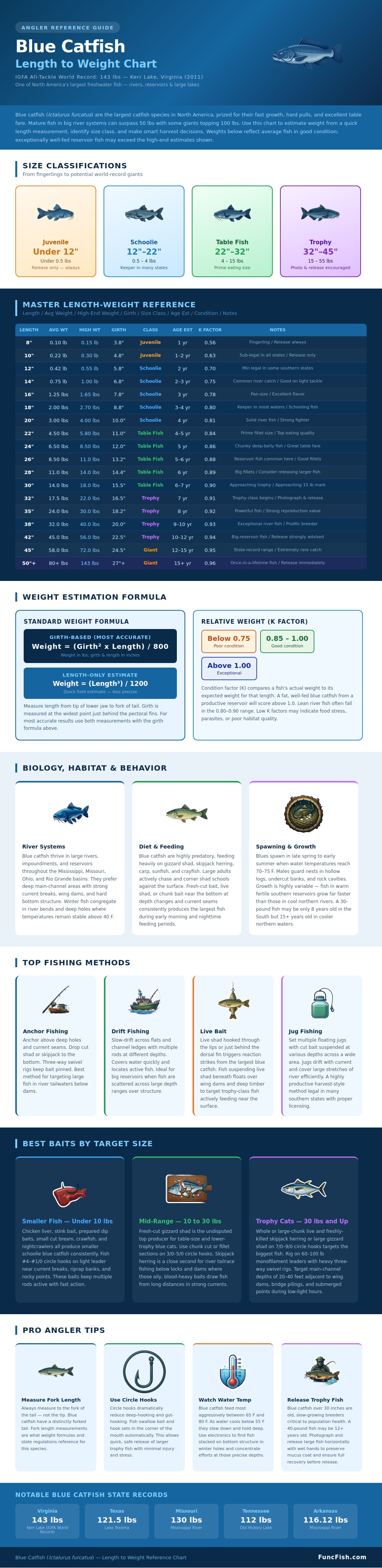
Size Anglers are surprised when blue catfish prove to hide their true size. That is not a lot of weight for what looks like a big fish on the side or that is real heavy with no give, so the length-to-weight relationship comes into play.
How do you know where to fish? What size hook should I use? Should I keep the animal or let it go? This is a visual guide. Blue catfish are divided in categories for this visual guide. They range from small juvenile fish that should be released immediately to giant trophies.
A Visual Guide to Blue Catfish Size and Weight
It’s interesting how close two fish can be in size, like twenty-two-inches versus thirty-two-inches, yet weigh nearly twice as much. That make an enormous difference in what gear is necessary. After reaching the thirty-inch mark, there is another sharp rise in weight, meaning age and conservation realy become important.
We all know how to catch blue catfish; however, we don’t really give much thought about what causes them to get so big. The simple answer is blue cats eats a lot, particularly herring and shad. So a 40 pounder could be a dozen years of age or older. It has survived decades of predator, fishing pressure, and changing water condition. When you hook into one of those fish longer than 30 inches, it’s an apex predator that got there by being patient.
Releasing them is a good plan as older fish are the producers. They lay millions of eggs and keep gene pool healthy. If you take every big one out, average size will decrease quickly in only a few seasons.
Most folks have a hard time measuring a big blue catfish accurately. Use a ruler and go from bottom of mouth to point where the two tail lobes meet at fork. Don’t extend it out to the end of the lobes, which are pretty far apart in most cases, as it’s a forked tail. A lot of folks make that mistake and add inches that aren’t really part of the body, throwing their guess about weight way off.
Length alone will give you a decent starting place, but combining with girth helps refine math. Of course, these figures represent an average condition factor. If you’re dealing with a fish caught in a river, they’ll generaly be skinnier (less dense) than a fish caught on a reservoir filled with lots of nutrients and fat.
Your bait choice changes based off your size target. Rocky bank or current breaks can be good spots for small schoolie fish that will take a piece of nightcrawler or chicken liver. For doubles or better, try larger offerings such as live herring or fresh cut shad. Drop them over deep structure and let them suspend there.
Ambush type predator feeding periods are typically dusk or dawn. Pay attention to water temps as well; below fifty-five degrees blue catfish realy slow down. They’ll park on deep hole bottoms, snuggling up to some form of structure and saving their energy until meal time. A good starting place will even things out for the rookie and experience helps too.
When you know a twenty-four inch blue is about a six or eight pound fish, you’ll know how much room you have in the cooler or livewell. You’ll also know when it’s time to step up to a little more power with that rod before you break off a bigger one, you want to be ready for whatever size bites your bait.
Chasing blues is as much about patience as it is about gear and can be very time consuming. You spend long days sitting anchored in front of wing dams or slowly fishing channel ledges, hoping to encounter an active fish. Finally, you get your chance. The weight says a lot. What does this all mean?
Every outing gets better as each bite helps fill out the picture. Knowing what was caught and how important it is to the bottom of the water column should of made each day a bit sweeter.