
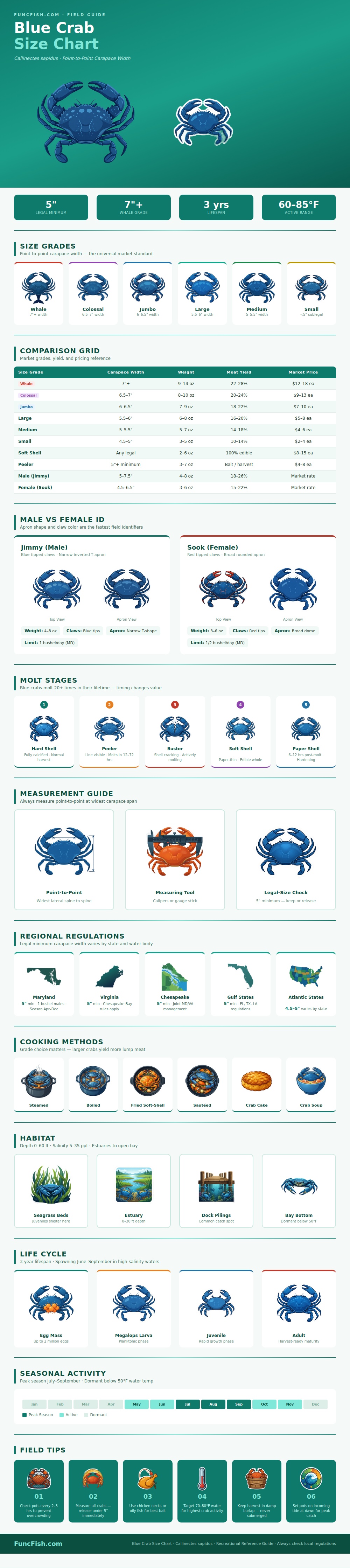
Knowing how to identify a “sook” (female) from a male is important if you’re going to be doing any sort of crabbing. But it will all click into place once you understand exact kind of freak out that happens when you bring up crab pot full of legal sized males. They try to break free from the mesh and discover their tips is painted red instead of blue. Depending upon where you go fishing, the rules vary regarding legality and yield. So before you can becomes a good crabber, you must learn how to tell a Jimmy from a Sook.
Once there’s one in the pot though, knowing what to do with them become slightly more complex different than simply grabbing whatever bucket is closest by. I know this may sound like some professional knowledge that doesn’t belong on a recreational boat, but the market grades break out how much meat each size category will yield (see chart above). This is a big key for home cooks looking to make a batch of crab cakes only to find them tasting muddy one year and sweet the next. That’s because everything boils down to meat yield.
How to Identify Male and Female Crabs
If you’re catching large males, especially ones measuring seven inches or larger across the carapace… You’ll get much more lump meat from them versus a Medium grade crab that just barely meet the five-inch minimum. Even though you’re doing the exact same amount of work for the wait and bait, targeting bigger males simply makes economic sense… unless you plan to sell them. As the visual guide explains, larger crabs not only bring more prestige to your table (that’s the part most folks forget about) but also nearly twice as much meat compared to their smaller counterparts: almost 20 percent for Jumbos and Colossals, versus roughly 10 percent for mediums. This is what makes them more efficient in kitchen.
The good news is determining gender in the wild is easy… Once you learn how. Male crabs has a long, pointed, upside-down T-shaped apron beneath their tail and blue tips on their claws. By contrast, females’ aprons are wide and round and their claw tips will be either brownish-red or reddish-brown. The reason? Many states such as Maryland ban the harvest of females at various times to preserve breeding stock. Even where seasonal limits aren’t imposed, most of us don’t want a big female crab anyway. Her flesh isn’t quite as firm or holds up as well in richly sauced dishes. We prize old males instead, because their muscles are so firm they’re meant for steaming. So it just takes a few moments to make sure your catch matches the description above, avoiding future regulatory heartaches.
Another unique case on the size chart involve soft shell crabs (above). They are plucked at the moment of shedding, when their freshly shed exterior is so delicate that they’re referred to as paper-thin. The advantage: You can eat them whole. Except…until you learn that if mishandled or not timed precisely enough, those softies will become toast far more quickly than their harder-shell counterparts. Why? The molt period is brief. It is typically just a few hours before the new shell begins to set up, spoiles even faster.
Then there’s the peeler crab (pictured below), with its telltale line along the back indicating a new shell in progress. You might opt to let it go another day or two in hope of catching a buster or even better, a soft shell. However, this isn’t something you should of do without permission from your particular location and close attention to detail.
Crabbing depends on water temperatures; below 50 degrees F crabs is inactive (dormant). Therefore crabbing will usually be most effective during the late spring into early fall, as they are more likely to be active and feeding then. The type of bait used can influence how many crab you catch. Herring or mackerel-type oily fish baits seem to be more attractive than chicken necks. Crabs will die very fast if you put them in water, so use damp burlap sacks to keep them alive after you have caught them; avoid leaving them submerged in water, as this quickly uses up the oxygen.
Reading the size grades and learning them will also help set your expectations at dinnertime. You’ll know that the balance of body mass versus shell thickness means a smaller crab won’t have much meat, and you’ll quit wondering why. Before you decide whether or not something goes in the boat, take a closer look at the shape of its apron and measure it out; how wide it is matter more than just whether or not it meets the limit. It is not all about filling the quota; it is about having the right ingredients for the meal you realy want to make.