
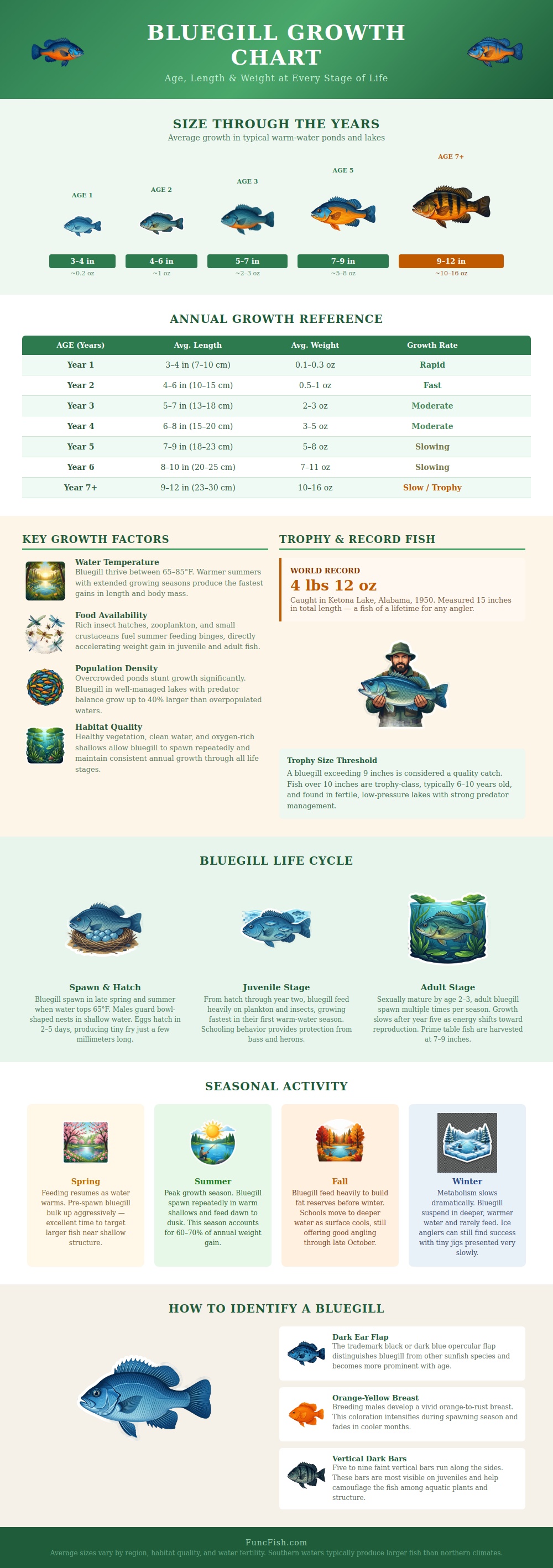
Have you ever hooked into a bluegill and it starts thrashing around on the end of the line? At first, it feel like a small fish. Then it gets real lively and makes you think there’s more to bluegills than you originally thought. Though bluegill are main fish in any pond, they are also one of the most misunderstood species as far as their growth potential goes.
Most folks believe if they’re going to catch a bunch of them, they’ll be tiny fry and every now and again they might luck out and find a good keeper. That simply isn’t the case. There is much more structure to how these guys realy do grow. Knowing this changes everything from what bait to throw to where you’re throwing it.
How Bluegills Grow
It’s not a linear growth curve. Instead, it begins with an explosion of growth peaking in the first year. And the early spurt is crucial, because if the fish doesn’t make at least some headway during its first year, there’s no guarantee it’ll survive through its first winter.
As you can see on the graph above which breaks down size milestones for each age milestone, a bluegill may gain just ounces in the first year of its life, reaching maybe three or four inches. That sounds like nothing… until you understand that every time a bluegill doubles in size, it needs almost twice as much body mass to achieve it. Growing from one inch to two is very different then growing from four inches to five. So that first summer is incredibly important. Without sufficient water temperatures or enough available food to fuel growth, all those early gains are lost and the fish must struggle to recover for the rest of its life.
Around the two-year mark, however, things begins to resemble what an average angler is used to seeing. That four-to-six-inch fish starts to become a real target with live bait and small jigs. It’s also the sweet spot for population density in many lakes. From there, it’s where habitat quality realy starts to define the difference between a good pond and a great one.
Bluegill prefer warm water. Anything from sixty-five to eighty-five degrees Fahrenheit is essential. If your water has maintained those conditions throughout late summer, you’ll notice their feeding window extended. The fish will quickly pack on some muscle by converting insect hatches and plankton. If not, your water cleared up too quick or stayed cold and no matter how many bugs hatch, you’re going to be looking at stunted growth.
In the third and fourth years, the rapid growth slows to a more gradual pace. Now these fish is full-fledged adults and can spawn several times during the year. But this reproduction process comes at a cost; namely it slows the growth rate of the fish itself. That’s why you’ll begin to find them no longer increasing in size much from one year to the next. They’re getting heavier rather then longer.
The graph does a great job of demonstrating this, as it shows where length increases start declining whereas body mass will keep climbing. Again, it’s a small difference, but it is easily overlooked. People who casually watch these fish often focus on length alone and forget about the girth that makes a seven-inch bluegill feel more like a pounder in the hand.
Environment becomes the determining factor when it comes to reaching trophy status. While nine-inch bluegills are a quality catch, it takes special conditions to get ’em beyond a ten-incher. The number one enemy is overcrowding. When you have a lot of fish in a pond and not enough bass to cull out the weak ones, they’ll compete for food and drive each other’s size down dramaticly. On the flipside, when lakes are well managed with proper numbers of predators, a few choose to thrive over time and can reach six or more years old. Those who survive can develop into doubles and push toward double-digit weights, sometimes close to the world record mark established in 1950. Although rare, it demonstrates that size isn’t always guaranteed by age, instead proving that opportunity makes all the difference.
The fish are also more identifiable with age. The young of the year use vertical stripes to blend into the weed environment, but once old enough to spawn, they grow the obvious dark ear flaps and rusty orange breast that scream “I’m ready to get it on”. This is where the visible signs come into play: knowing the fish are mature and ready means knowing when to pick up the pace and go get ’em. In spring, they hunker down over a nest in the shallows and act very aggressive. Come winter, they’re headed back out to the channel edges, metabolisms nearly stalling. Understanding their seasonal cycle can help your decision making: press the action now or hold off? You should of known that.
Catching a large bluegill is less lucky than it seems. Every millimeter of length represents a story of space, food and temperature.