
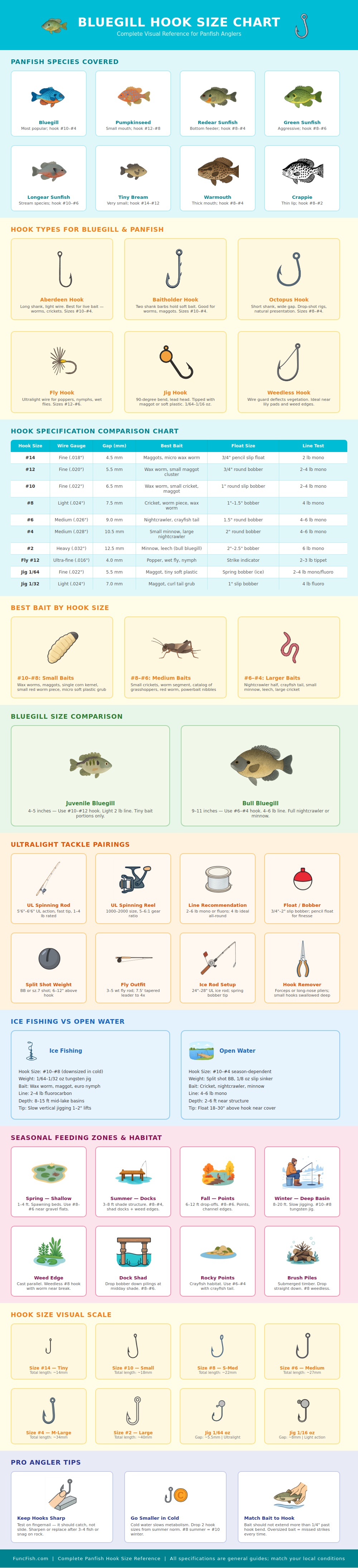
Selecting the correct hook size is an necessary step in the process of catching panfish. The size of the hook will determine whether the hook will be succesful in its attempt to catch a panfish or whether the panfish will eventualy escape the hook. Panfish species has different sizes of mouths; the person fishing for these fish must select the appropriate hook size according to the species of panfish that he or she are targeting.
For instance, species like pumpkinseeds has smaller mouths than other panfish species like warmouths, thus requiring smaller hook. If the hook is too large for the panfish species, the panfish wont be able to fit the hook into its mouth. If the hook is too small for the panfish species, the hook will not have enough strength to hold the panfish.
How to Choose the Right Hook for Panfish
The style of the hooks can also have an important affect on the ability of the fishing hook to successfully catch panfish. Aberdeen hooks has long shanks, which allow the bait to look natural while drifting. Baitholder hooks have barbs that hold the soft bait to the hook.
Octopus hooks have a wide gap between the hook bends, which allow the bait to be easy dropped onto the panfish. Weedless hooks have wire guards that prevent the hook from becoming stuck in the vegetation in which the panfish live. Each of these hook styles are created for a specific way to fish with the hook; thus, the angler should chose the style of hook according to the environment in which fishing will occur.
The size of the hooks must also be select according to the size of the panfish species that will be targeted. Small panfish require the use of micro hooks and thin fishing lines; small panfish dont require as much strength in the fishing gear to be caught. However, large panfish will require larger sized hooks and fishing line to create the strength necessary to remove the panfish from the area in which it live.
Thus, the angler should increase the strength of the fishing line in response to the increase in hook size. The bait that is used in fishing for panfish must also be chosen in accordance with the size of the hook. Small hooks work best with small bait, such as a single maggot.
Small panfish will be able to easily consume the bait if you insert it into the fish mouth with such a small hook. However, larger bait, such as a piece of a nightcrawler, should be used with a larger hook. If the bait is too large for the hook, the panfish will not be able to pull the bait into its mouth and the hook will not be able to catch the panfish.
In the same way, if the bait is too small for the hook, the panfish will not be able to move the heavy bait with its mouth. The environmental condition and the season in which panfish are being targeted will also play a role in the type of hook and bait that should be selected. For instance, in the spring when panfish are located in shallow water, smaller sized hooks may be used.
However, during the summer panfish may be located deeper in the water or near docks, thus altering the depth at which the hook should be cast. During the winter panfish are also found in shallower waters and with smaller jigs. In these cases where panfish are less active, smaller sized hooks and jigs should of be use to stimulate the panfish to bite at the bait.
Additionally, winter time changes in the temperature of the water will alter the metabolism of the panfish, leading to alterations in the hook size used to catch these fish. Finally, the final requirement for succesful fishing is the maintenance of the fishing hooks. If the hook is not sharp it will not be able to hook the panfish; the panfish will be able to slide the hook out of its mouth.
A test of sharpness is to drag the hook across the fingernail of one’s hand; if the hook snag the fingernail it is sharp. If the hook is dull it will not be able to hook the panfish. Thus, maintaining the sharpness of the hooks is a necessary part of using the correct hook sizes to catch panfish.