⛵ Boat Motor Speed Calculator
Calculate boat speed, RPM, prop pitch requirements, and performance metrics for any outboard or inboard motor
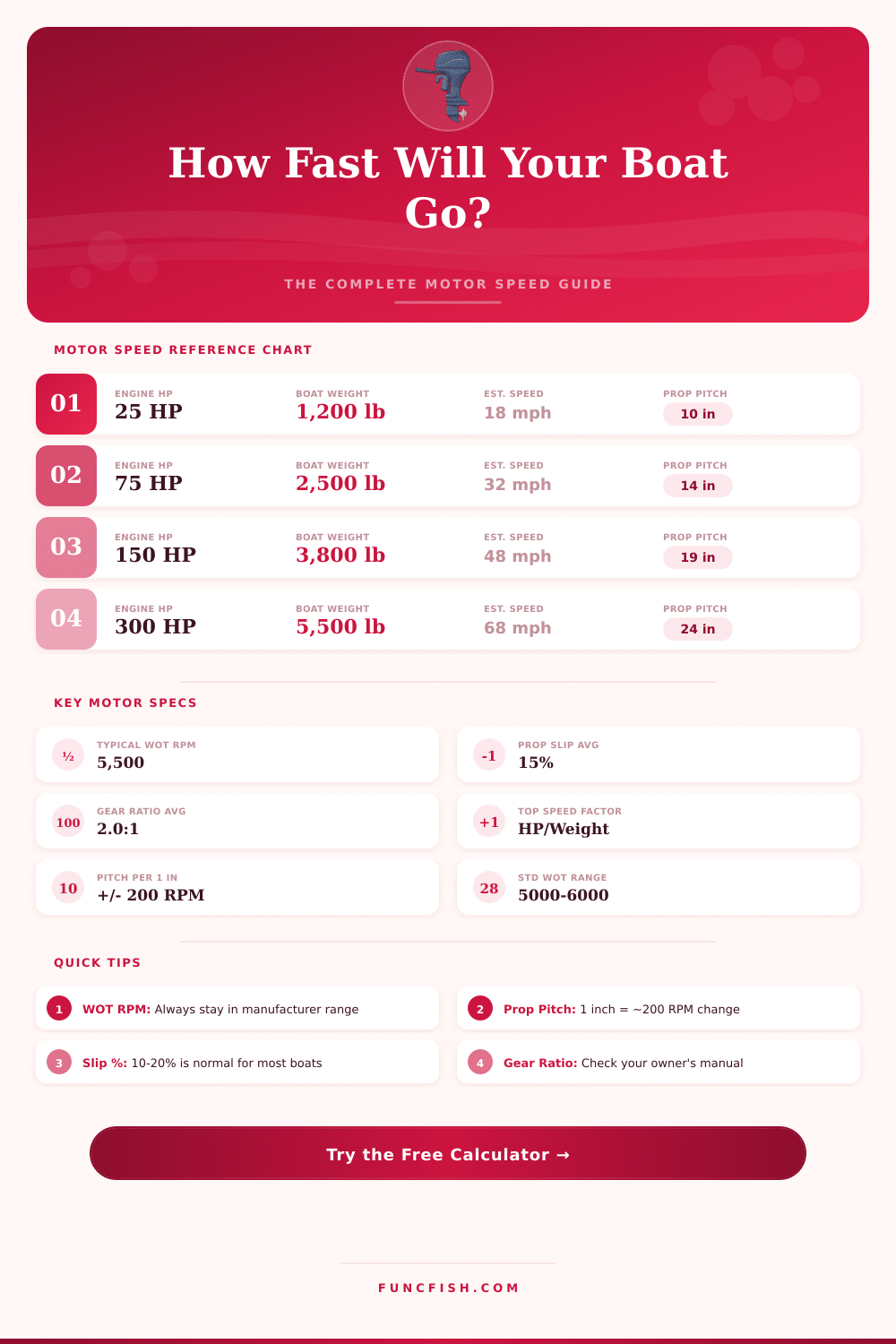
| Boat Type | Engine HP | Avg Weight (lb) | Est. Top Speed (mph) | Prop Pitch (in) | WOT RPM Range |
|---|---|---|---|---|---|
| Jon Boat (14 ft) | 15 HP | 600 lb | 20–24 mph | 8–10 in | 5000–5500 |
| Aluminum Bass Boat | 60 HP | 1,800 lb | 38–44 mph | 15–17 in | 5000–6000 |
| Fiberglass Bass Boat | 200 HP | 3,400 lb | 60–68 mph | 21–23 in | 5500–6200 |
| Pontoon (24 ft) | 115 HP | 4,200 lb | 22–28 mph | 13–15 in | 5000–5500 |
| Center Console (21 ft) | 150 HP | 3,600 lb | 42–50 mph | 19–21 in | 5500–6000 |
| Offshore Sportfish | 300 HP x2 | 12,000 lb | 45–55 mph | 22–26 in | 4800–5600 |
| Ski / Wakeboard Boat | 350 HP | 5,200 lb | 45–55 mph | 13–14 in | 4500–5000 |
| Walleye Troller | 90 HP | 2,200 lb | 40–48 mph | 17–19 in | 5000–5800 |
| Prop Pitch (in) | Prop Pitch (cm) | Best For | Speed Range (mph) | Typical HP Range |
|---|---|---|---|---|
| 6–8 in | 15–20 cm | Small inflatables, trolling | 8–15 mph | 2–10 HP |
| 9–11 in | 23–28 cm | Jon boats, small aluminum | 14–25 mph | 10–25 HP |
| 12–14 in | 30–36 cm | Pontoons, heavy loads | 20–32 mph | 40–90 HP |
| 15–17 in | 38–43 cm | Aluminum bass boats | 32–45 mph | 60–115 HP |
| 18–20 in | 46–51 cm | Center console, walleye | 40–55 mph | 115–200 HP |
| 21–23 in | 53–58 cm | Fiberglass bass, offshore | 55–70 mph | 200–300 HP |
| 24–26 in | 61–66 cm | High-performance offshore | 65–85+ mph | 300–600+ HP |
| Motor Brand / Type | Gear Ratio | Best Use | Pitch Range |
|---|---|---|---|
| Most 4-Stroke Outboards | 2.08:1 | General purpose | 17–21 in |
| High-Speed Performance | 1.62:1 – 1.75:1 | Racing / sport | 22–28 in |
| Heavy Duty / High Torque | 2.33:1 – 2.50:1 | Pontoon / heavy | 12–16 in |
| Small Outboard (<40 HP) | 2.15:1 – 2.42:1 | Jon boat / dinghy | 8–13 in |
| Sterndrive (I/O) | 1.47:1 – 1.84:1 | Ski / wake boat | 14–20 in |
| Large V6 / V8 Outboard | 1.75:1 – 2.00:1 | Offshore / sport | 21–26 in |
The Speed of a Boat Motor depends on several factors. Weight of the boat size of the engine and even the kind of body all affect the result. There is no simple answer about how fast a boat can move, but some key numbers are worth noting.
The highest Speed of a boat ever reached was 317.6 mph. That happened in 1978, when the boat used a jet engine instead of a propeller. In the early times of boating, a boat called Kitty Hawk was the fastest in the world, passing the then amazing Speed of 50 mph.
How Fast Can a Boat Go
Cigarette boats are motorboats designed for fast travel on open water.
For smaller boats the numbers are much more humble. An aluminum boat 12.3 feet long and wide can raech around 15 mph with a 6 hp engine, 20 mph with 10 hp and around 23 mph with 15 hp. On the other hand, too many factors exist to give a precise number for any case.
A boat with only one person weighing around 150 pounds could reach only under 20 mph with a more lightweight engine. Adding a trolling motor battery in the bottom can drop the maximum Speed from 21 mph too 19 mph.
Horsepower and water Speed follow a logarithmic course. So if 10 hp give 10 mph, doubling to 20 hp can only reach around 15 mph. There is no direct proportion really.
Around 1 hp for every foot of boat length is enough for good cruise, similar to a car against strong wind.
Boats with V-shaped bottoms can reach speeds of up to 90 knots, which matches around 103 mph and are commonly used for racing. Some basic boats are built to drive much faster than 40 to 70 mph and have sharp V-shaped bottoms for more Speed and stability. When a fishing boat reaches 70 mph, you wonder if it is a speedboat now.
A boat with a 250 hp engine can reach about 50.4 mph at full gas. Adding a 300 hp engine only gives an extra 2 to 4 mph. One boat with triple Mercury 350 engines reached a maximum of 69.8 mph, with good cruise at 41.5 mph at 4,000 RPM.
A pontoon boat can go quite fast enough for water skiing with a 100 hp engine.
Pushboats are a whole other thing. They are not built for high Speed. An engine with strong push more than high Speed works better for them.
The Coast Guard limits automatically to a maximum of 9.9 hp for any boat classed as a pushboat. Using 6 hp against 8 hp in a pushboat does not show a big difference in Speed, although 8 hp helps more when going against current and wind.
Boat Motor RPM can keep growing, but the actual Speed starts dropping if the propeller does not respond. Watching a GPS while changing the propeller pitch at full gas helps to find the maximum Speed. The pitch and diameter of the propeller is themain source of power and Speed, not the material of it.