⛵ Boat Trailer Tongue Weight Calculator
Calculate tongue weight, hitch class requirements & safe towing specs for your boat trailer
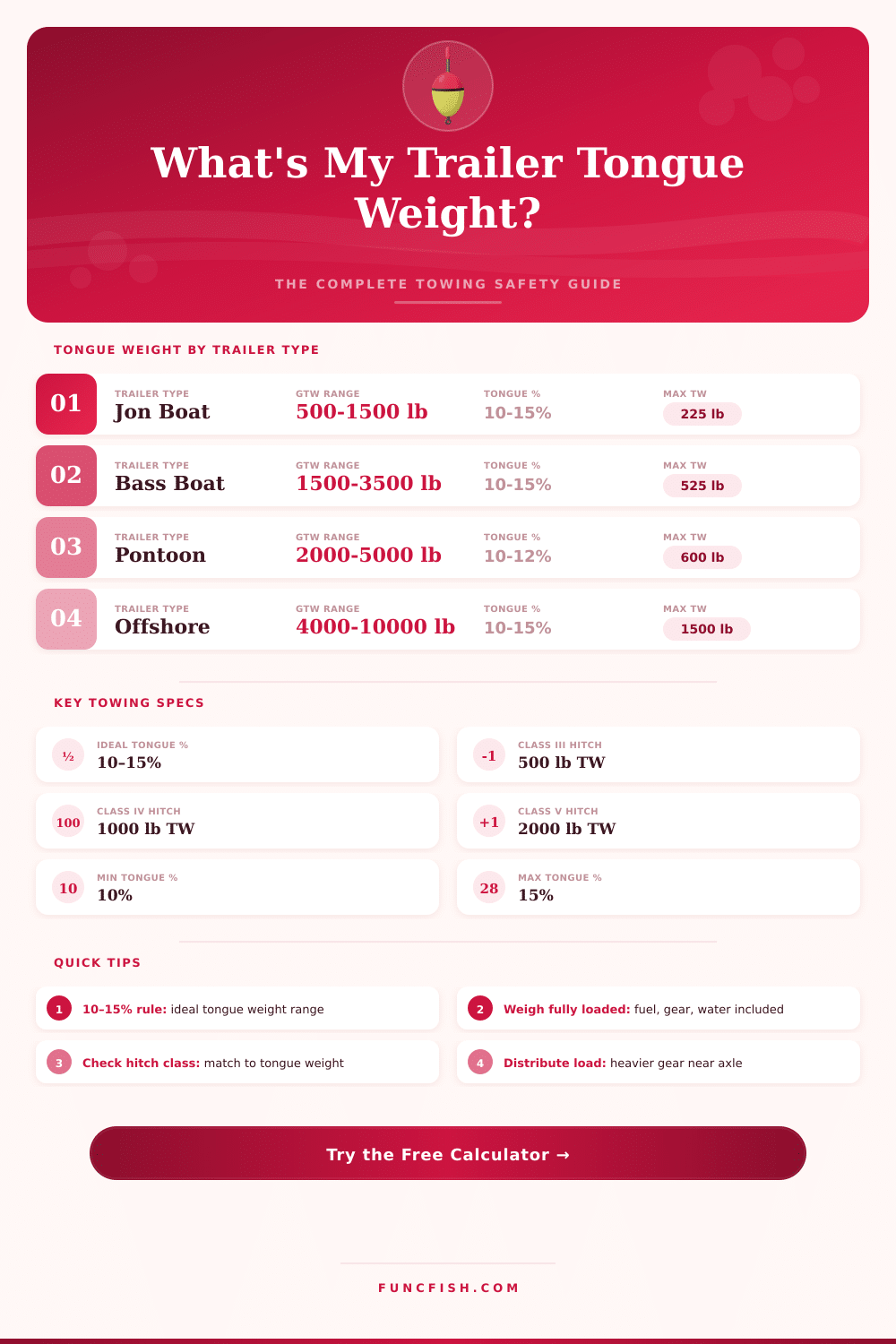
| Boat Type | Avg GTW (lb) | Avg GTW (kg) | Ideal TW (lb) | Min Hitch Class |
|---|---|---|---|---|
| Canoe / Kayak | 200–600 | 90–272 | 20–90 | Class I |
| Jon Boat (12–14 ft) | 600–1,500 | 272–680 | 60–225 | Class I / II |
| Aluminum Fishing (16 ft) | 1,200–2,200 | 544–998 | 120–330 | Class II / III |
| Bass Boat (18–21 ft) | 2,000–4,000 | 907–1,814 | 200–600 | Class III |
| Walleye / Fishing (18 ft) | 1,800–3,200 | 816–1,451 | 180–480 | Class II / III |
| Ski / Wake Boat (21 ft) | 2,800–5,000 | 1,270–2,268 | 280–750 | Class III / IV |
| Pontoon (22–24 ft) | 3,500–6,000 | 1,588–2,722 | 350–900 | Class III / IV |
| Tri-Toon (24–26 ft) | 4,500–8,000 | 2,041–3,629 | 450–1,200 | Class IV / V |
| Center Console (24 ft) | 5,000–10,000 | 2,268–4,536 | 500–1,500 | Class IV / V |
| Cabin Cruiser (26+ ft) | 8,000–15,000 | 3,629–6,804 | 800–2,000 | Class V |
| GTW (lb) | GTW (kg) | Min TW @ 10% (lb) | Ideal TW @ 12% (lb) | Max TW @ 15% (lb) |
|---|---|---|---|---|
| 500 | 227 | 50 | 60 | 75 |
| 1,000 | 454 | 100 | 120 | 150 |
| 1,500 | 680 | 150 | 180 | 225 |
| 2,000 | 907 | 200 | 240 | 300 |
| 2,500 | 1,134 | 250 | 300 | 375 |
| 3,000 | 1,361 | 300 | 360 | 450 |
| 4,000 | 1,814 | 400 | 480 | 600 |
| 5,000 | 2,268 | 500 | 600 | 750 |
| 7,500 | 3,402 | 750 | 900 | 1,125 |
| 10,000 | 4,536 | 1,000 | 1,200 | 1,500 |
| Vehicle Type | Max GTW (lb) | Max TW (lb) | Hitch Class | Best For |
|---|---|---|---|---|
| Midsize SUV (V6) | 3,500 | 350 | Class II | Jon / Aluminum |
| Full-Size SUV (V8) | 8,000 | 800 | Class III | Bass / Ski Boat |
| Half-Ton Pickup (V6) | 6,000 | 600 | Class III | Pontoon / Bass |
| Half-Ton Pickup (V8) | 10,000 | 1,000 | Class III / IV | Pontoon / CC |
| Three-Quarter Ton Pickup | 14,000 | 1,400 | Class IV / V | Tri-Toon / CC |
| One-Ton Pickup | 20,000+ | 2,000+ | Class V | Cruiser / Large |
| Minivan | 3,500 | 350 | Class II | Small Jon / Kayak |
| Compact SUV | 2,000 | 200 | Class I / II | Canoe / Kayak |
The tongue weight of a boat trailer is made up of the downward force that a fully loaded boat trailer applies to the ball of the hitch on the towing vehicle. Imagine the towing vehicle together with the boat trailer like a seesaw. When the balance tips everything becomes unstable and dangerous.
Like this one understands, why the tongue weight has such importance.
How to Check and Fix Boat Trailer Tongue Weight
If the tongue weight is too little, it can cause swaying of the boat trailer. When it is too heavy, it pushes the rear of the towing vehicle down and hurts the steernig. When more mass sits behind the axle of the boat trailer than before it, the journey risks becoming extremely dangerous.
Why the ideal proportion? The advised range sits between 5 and 7 percent of the whole mass of boat trailer, boat, engine, fuel and gear. Boat trailers with one axle work best at around 6 percent.
Some setups require almost 10 percent of the total weight of the boat trailer on the tongue. For instance, a load of 5 000 pounds requires around 500 pounds of tongue weight. A boat trailer loaded at 2 000 pounds means 200 to 240 pounds on the hitch.
8 percent forms a typical expected value for many cases.
One can fix the tongue weight fairly easily. One moves the boat forward on the boat trailer, or moves the axle backwards, or combines both ways. A common method is to move the axle step by step in one inch until the feel seems write.
The support stops of boat trailers commonly move forward or backwards to help in this case. For instance, moving the axle by 14 inches was enough to pass from 50 to 160 pounds of tongue weight. Loosen the U-shaped bolts at the support of the slide and stick it back to offer another way to change the position of the boat.
The tongue of the boat trailer should stay level when it connects to the towing vehicle. One must change the height of the hitch on the towing vehicle so that the tongue stays flat during towing. A bit of tilt down is not a disaster, but the level position is the goal.
On boat trailers with two axles, the level is even more important.
Home measures of tongue weight are possible using a flat heavy scale. Lay a tube directly under the tongue of the boat trailer, press the pole until the hitch sits on the tube above the scale, read the number and triple it. Like this one gets the tongue weight.
The weight range for home boat trailers goes from around 1 100 to 4 400 pounds, with an average at about 2 200 pounds. Loaded big boats raise that number a lot. Long boat trailers usually offer more stability and are easier tokeep up.
Set the boat right on the rollers, with the last roller at four to six inches from the back, to give good balance before changing the axles for proper tongue weight.