⚓ Boat Weight Calculator
Calculate total boat weight including hull, engine, fuel, passengers & gear — in imperial or metric units
| Boat Type | Length Range | Dry Weight (lb) | Dry Weight (kg) | Typical Engine (lb) | Max Capacity (lb) |
|---|---|---|---|---|---|
| Kayak | 9–14 ft | 45–80 | 20–36 | — | 250–400 |
| Canoe | 14–18 ft | 50–90 | 23–41 | — | 600–900 |
| Jon Boat | 10–18 ft | 250–700 | 113–318 | 50–150 | 600–1,800 |
| Bass Boat | 16–21 ft | 1,400–2,200 | 635–998 | 200–500 | 900–1,800 |
| Pontoon | 18–28 ft | 1,800–4,500 | 816–2,041 | 150–700 | 1,500–3,500 |
| Inflatable / RIB | 8–14 ft | 80–300 | 36–136 | 0–150 | 500–1,200 |
| Center Console | 18–30 ft | 3,000–8,000 | 1,361–3,629 | 400–1,500 | 2,000–5,000 |
| Ski / Wakeboard | 18–24 ft | 2,800–4,500 | 1,270–2,041 | 400–700 | 1,500–3,000 |
| Cabin Cruiser | 24–36 ft | 5,000–15,000 | 2,268–6,804 | 600–2,000 | 2,500–6,000 |
| Walkaround / Sportfish | 24–35 ft | 6,000–18,000 | 2,722–8,165 | 700–2,500 | 3,000–7,000 |
| Engine Type | Horsepower | Approx. Weight (lb) | Approx. Weight (kg) | Typical Boat Use |
|---|---|---|---|---|
| Electric Trolling Motor | 30–80 lb thrust | 15–35 | 7–16 | Kayak, Jon, Bass |
| Small Outboard | 4–25 HP | 35–120 | 16–54 | Jon, Inflatable, Canoe |
| Mid Outboard | 40–115 HP | 120–280 | 54–127 | Bass, Pontoon, CC |
| Large Outboard | 150–300 HP | 280–560 | 127–254 | Center Console, Sportfish |
| V6 Inboard | 200–350 HP | 600–900 | 272–408 | Ski, Cabin Cruiser |
| V8 Inboard/Sterndrive | 300–500 HP | 850–1,200 | 386–544 | Walkaround, Sportfish |
| Twin Outboard (ea.) | 200–400 HP | 400–700 | 181–318 | Center Console, Walkaround |
| Trailer Type | Trailer Weight (lb) | Trailer Weight (kg) | Typical Boat Size | GVWR Range (lb) |
|---|---|---|---|---|
| Kayak / Canoe Trailer | 150–300 | 68–136 | Up to 17 ft | 500–1,000 |
| Small Bunk Trailer | 400–700 | 181–318 | 14–18 ft | 1,500–3,500 |
| Bass Boat Trailer | 800–1,200 | 363–544 | 17–21 ft | 3,500–5,000 |
| Mid-Size Roller Trailer | 1,000–1,800 | 454–816 | 20–24 ft | 5,000–8,000 |
| Heavy Duty Trailer | 1,800–3,500 | 816–1,588 | 24–30 ft | 8,000–16,000 |
| Commercial / Triple Axle | 3,500+ | 1,588+ | 30+ ft | 16,000+ |
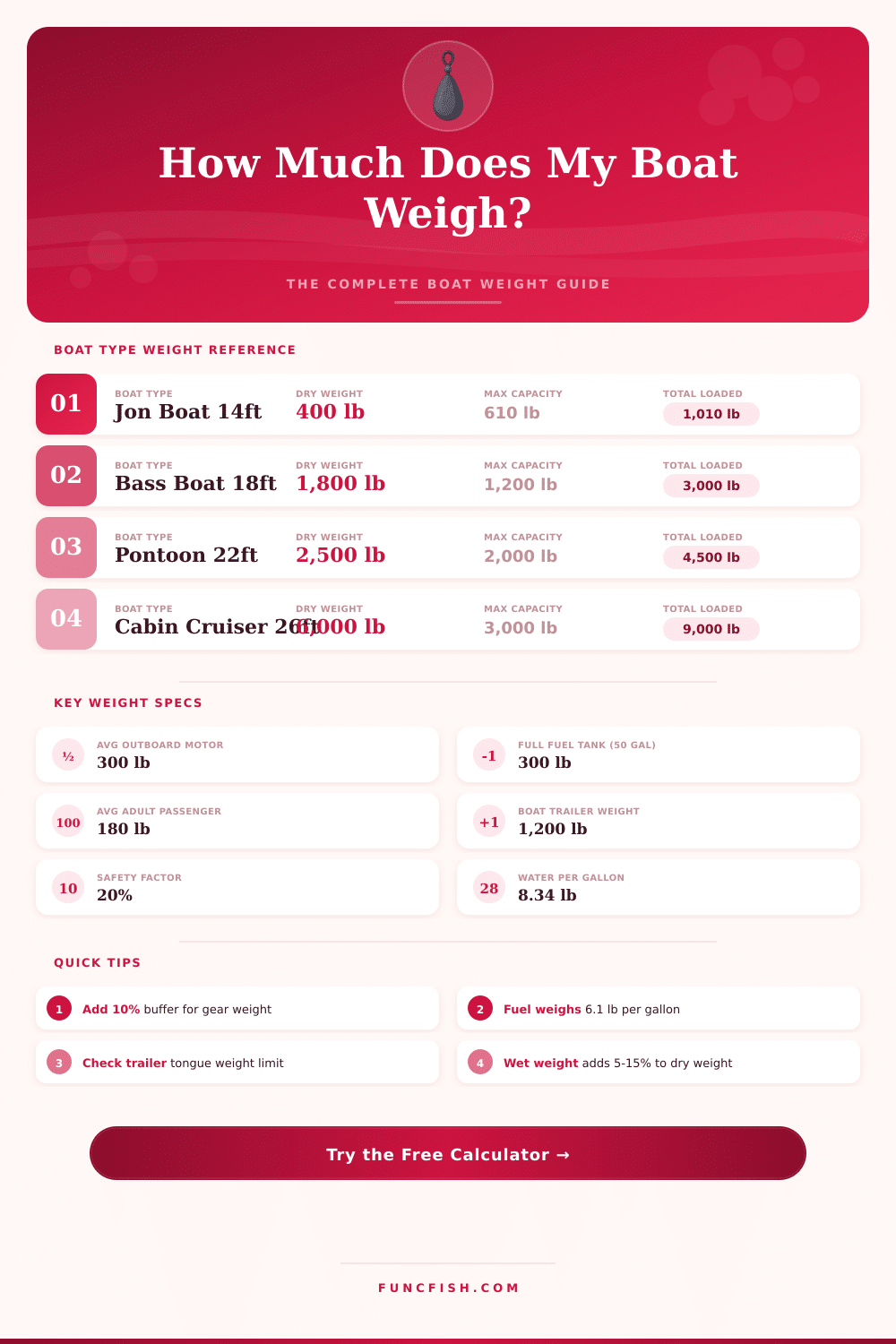
The Weight of Boat matters much more than many folks imagine. It affects the motion of the Boat on the water, the amount of gear that one can lay in it, and even what type of vehicle is needed to drag it. Weight of Boat depends on its model, size and content.
Some boats are surprisingly lightweight. An inflatable dinghy or tiny ship weighs between 100 and 800 pounds. An aluminum jon-boat of 3 to 4 meters long is in a similar range.
How Much Do Boats Weigh?
Boats for sailing, that lack an engine, tank for fuel or bedrooms, commonly reach 400 to 800 pounds, because they have only the body and mast.
Big boats quickly become heavy. A typical household Boat of 20 to 26 feet, fully loaded, usually weighs between 3,500 and 6,000 pounds. Some trawlers of 34 feet have around 20,000 pounds.
For instance, one big vessel starts at 12,000 pounds base Wieght, when one adds the engine and other parts, that lays more 1,500 to 2,000 pounds above the body.
Pontoon boats enjoy big popularity. Most weigh around 2,200 pounds together with the engine, and they can bear around 2,000 pounds of folks and stuff. A trailer for such Boat adds almost 1,200 pounds.
Contents of a Boat add up soon. Gear like anchors, life vests and tools can add 100 to 200 pounds. Weight of fuel one counts buy multiplying the gallons by around six pounds each gallon.
A fully equipped set with Boat, engine, trailer, fuel and fishing gear reaches a whole of 4,750 pounds.
Limits on Weight have big presence. Maximum load capacity shows the hole Weight that a Boat lasts, including folks, parts, fuel and engine. Good advice is to stay at 70% or 80% of the rated skill.
Reaching the limit fully makes the Boat unstable and hard to steer, especially in bad weather, when it receives water more easily and can capsize.
To estimate how many folks a Boat bears, use a simple rule: length times beam divided by 15. Every folk counts as 150 pounds. The Coastal Guard recently changed the standard Weight of a folk from 140 pounds to a bigger value, because folks widely weigh more now.
Like this, new boats show lower person capacity than old.
An overloaded Boat moves hardly and sitsbelow. A lightly loaded Boat becomes unstable. Find the right amounts for balance.
A practical way to get exact Weight is to drive with the Boat on a trailer to a truck scale. It maybe costs around five dollars, but the result is worth the expense.