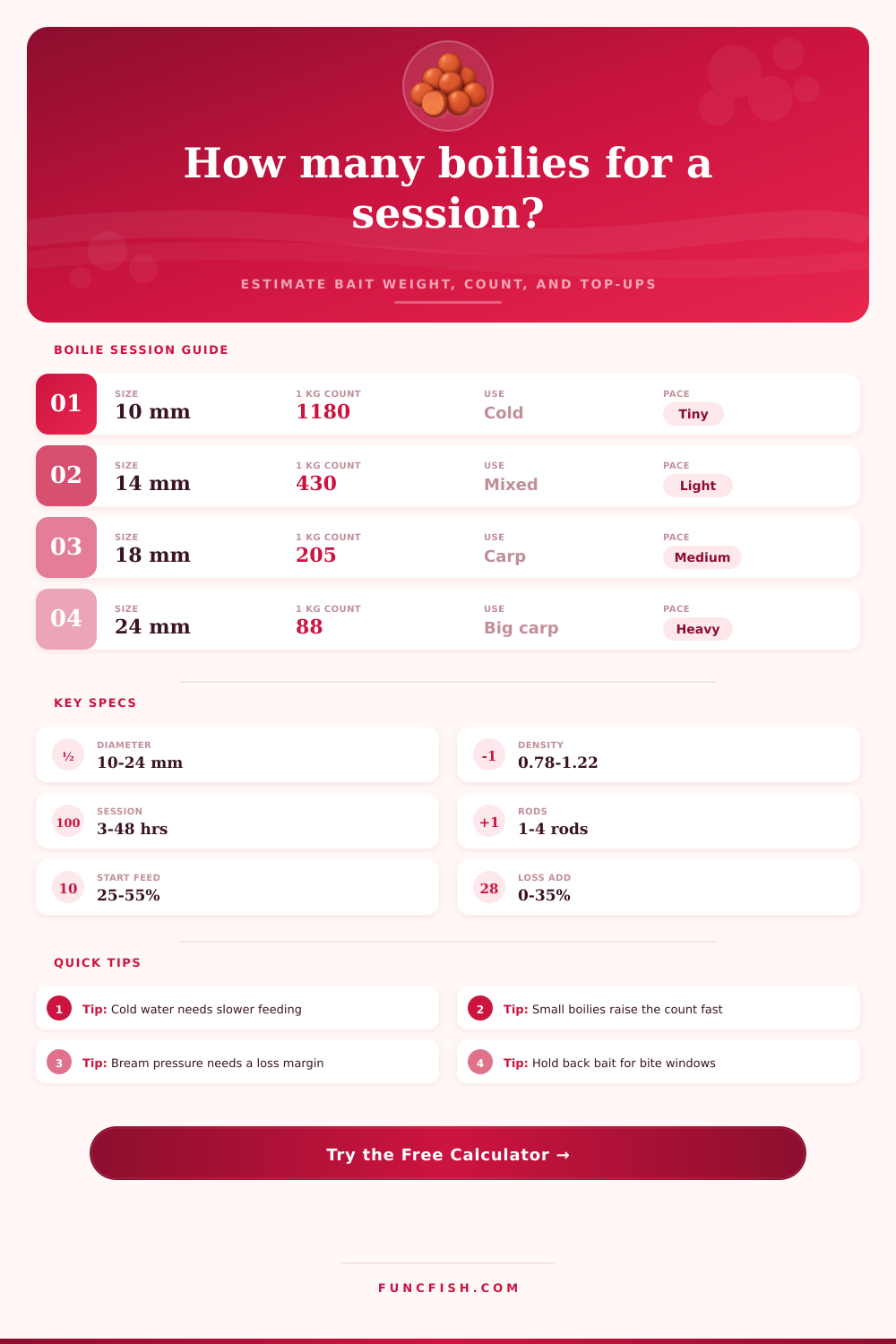
Boilie Quantity Per Session Calculator
Estimate the total boilie weight, actual bait count, starting feed, and top-up plan for a carp session using boilie diameter, bait density, rods, hours, water temperature, stock level, and nuisance-fish loss.
📌Session presets
⚙Boilie and session inputs
Boilie session plan
Calculated bait weight, count, start feed, and top-up allowance.
Formula breakdown
🧪Boilie mix density grid
Fishmeal freezer
Birdfood seed
Nut meal bait
Cork balanced
📊Reference tables
| Boilie diameter | Approx grams each | Approx count per kg | Best session use |
|---|---|---|---|
| 10 mm | 0.85 g | 1180 boilies | Cold water, silver-fish activity, tight PVA work |
| 12 mm | 1.46 g | 685 boilies | Light feeding, pressured carp, mixed-species waters |
| 14 mm | 2.32 g | 430 boilies | Club lakes, short sessions, scattered feed |
| 16 mm | 3.46 g | 290 boilies | General carp fishing and medium-stock venues |
| 18 mm | 4.87 g | 205 boilies | Standard carp sessions and boilie-only approaches |
| 20 mm | 6.69 g | 150 boilies | Big-fish waters, bird pressure, longer casts |
| 24 mm | 11.56 g | 86 boilies | Selective feeding, rivers, and nuisance bream avoidance |
| Feeding style | Base rate per rod hour | Starting feed share | Top-up rhythm |
|---|---|---|---|
| Single hookbait plus crumbs | 8 g | 25% | After a show, liner, or confirmed pickup |
| Stringer or PVA bag | 14 g | 30% | One bag per recast or fish landed |
| Light boilie spread | 28 g | 38% | Small handfuls through the session |
| Standard loose feed | 46 g | 45% | Refresh every 3-5 hours or after a bite |
| Heavy bed of bait | 82 g | 55% | Larger top-up after feeding spells |
| Campaign top-up plan | 62 g | 42% | Measured repeat spots and night windows |
| Water band | Temperature | Feed multiplier | Boilie approach |
|---|---|---|---|
| Cold | Under 46 F / 8 C | 0.42x | Small count, soluble crumb, long pauses |
| Cool | 46-54 F / 8-12 C | 0.68x | Light spread with high leakage bait |
| Mild | 55-63 F / 13-17 C | 1.00x | Balanced starting feed and measured top-ups |
| Warm | 64-72 F / 18-22 C | 1.28x | More confident feed when oxygen is stable |
| Hot or stressed | Over 72 F / 22 C | 0.82x | Short feeding windows and smaller reserves |
| Species or target mix | Typical bait response | Useful boilie size | Quantity adjustment |
|---|---|---|---|
| Common carp | Often patrols and clears lines of bait | 16-20 mm | Use the calculator baseline |
| Mirror carp | Confident over food bait on stocked venues | 14-18 mm | Add 5-15% on runs waters |
| Grass carp | Lower boilie conversion than commons | 12-16 mm | Reduce boilies and watch signs |
| Bream and tench present | Can remove small bait quickly | 18-24 mm | Add nuisance loss or size up |
| Catfish present | High bait removal and heavy disturbance | 20-24 mm | Add 20-35% loss margin |
🎣Gear and delivery comparison
Throwing stick
18-24 mmBest for whole boilies, wide scatter, and wary carp. Counts are easier than weights when feeding by hand.
Spomb or bait rocket
80-220 gBest for accurate beds at range. Use the top-up result as a measured load target.
Catapult pouch
10-60 gGood for short to medium range. Works well with 12-18 mm baits and small repeat feeds.
PVA bag or mesh
5-40 gBest for cold water, singles, and precise hookbait feeding without building a large bed.
💡Calculation tips
A 1 kg bag of 14 mm boilies can contain more than twice as many individual baits as a 20 mm bag. This calculator converts diameter and mix density into count, so a light winter pouch and a heavy food-bait bed do not get treated the same.
Holding back 30-45% gives you room to respond to liners, shows, recasts, and a quick bite. On low-stock waters, a smaller start feed with a larger reserve is usually a better risk balance than putting the whole allowance in at once.
The calculator estimates boilie quantity for planning and comparison. Real feeding response still depends on oxygen, pressure, weed, undertow, bird activity, and how much bait is already in the swim.
There you are, standing on the bank with a bag of boilies and an empty swim before you. The carp is out there somewhere beneath the silt, waiting for you to make the right offer. Throw in half the bag just to be sure? Sure. Now you have every bream in a five-hundred-yard radius crawling all over you. It is too bad if they’re holding back. Be stingy and risk a silent session as your isolated hookbait sits in some barren patch of mud, or guess at the amount you need and end up wasting money (or worse still, not using enough).
The above boilie quantity calculator puts you in the middle. No more vagueness. Instead, it turns those hazy instincts into a concrete plan for how many pellets to put in your bag, how much bait to lay down, and when to top it up again.
How to Use the Boilie Calculator
First, as the name implies it begins with understanding your conditions and venue. Water temperature makes a difference. Carp slow their metabolism dramatically when temperatures falls below 46 degrees Fahrenheit; they’re eating less and digesting even slower. So, in those instances the feeder will ramp the feed rate down automatically to avoid filling up nuisance species and spooking otherwise wary fish. In the warmer summer months, fish is more active and oxygen levels are good. The feeder will increase the amount to match, because the fish are working hard and burning calories at higher rates. Instead of going by some one size fits all rule of thumb you pick the scenario that matches what’s currently going on.
Fewer anglers think about the importance of boilie size. For example, in a kilo of ten millimetre baits, there are more than eleven hundred separate baits; in a kilo of twenty four-millimetre baits, there is fewer than ninety. This impacts not just the rate at which they get picked off, but also their appearance on the bottom. Small boilies create a carpet effect with lots of volume to trigger a feeding response, but then clear out rapidly as roach and skimmers nip away. Large boilies stays down longer and present as prime food items for wary carp, but take more confidence to feed up on. To see the impact of diameter on number regardless of total weight, look at table of references on the page.
Your bait also rests on the bottom of the lake with a bit of subtlety. Baits made from fishmeal have higher density, sink quicker and can be helpful in deeper channels where you need to make a fast presentation or combat the wind. Baits that include floating ingredients such as cork-dust or nut-meal mix tend to float a while before sinking down allowing tentative fish more time to check them out without feeling pressure from the thud of a heavy object. The calculator considers this difference in densities and adjusts your weight estimate based on the approximate volume of the wet bait you’ll see on the water, not just its labeled volume on the dry package.
Nuisance loss is a silent budget killer in carp fishing. If you suspect there are pike or maybe bream cruising your swim you can tack on a buffer amount for your total allowance. By entering an estimate of your nuisance loss as a percent, the tool will build those losses right into the first feed and reserve calculations. So you don’t wind up with no lunch offering left when three pounds of fish come along and steal it, leaving you running dry just as the evening bite rolls around. The logic would of hold some reserve for you as well, protecting you from any unexpected weather change or bad luck early in the session that shuts feeding down temporarily.
Rhythm is dictated by feeding style. Small crumbs on a single hookbait need very little total weight but must be added at the right time after shows or liners. Heavy bed of bait strategy will burn through your stocks fast, but will keep the fish interested for longer as they can graze constantly. So the calculator gives you amounts and portions for refreshing your swim, whether it’s the starting feed amount or how much you should top-up to ensure fish are kept happy at all times. It stops you from making common mistake of throwing everything out in an hour because you were too nervous while setting up.
There’s nothing that says a school of tench won’t swim across the spot, or some random squall come through and muck up your day. For me these are better tools as prep and not something to follow blindly. Having them gives you a starting point, but more importantly, they give you the confidence to go in instead of worrying if you took too much or too little gear. If it doesn’t work out you’ll adjust to what the water tells you, not what the spreadsheet told you it would be.
Being prepared with bait can make for good carp fishing, but so does observing and being patient. Having the confidence that you know exactly how many boilies are in your pocket frees up your mind and time to focus on reading the rods rather than counting them out of a pocket when you get to the spot. Being able to do the math ahead of time means you have the confidence to commit to whatever you’re doing because you already know it’s correct.
You walk away from the lake with more than just fish. You also have a better understanding of what worked and why, so you are ready to refine the plan for your next trip.