Brackish Salinity Mixing Calculator
Blend freshwater, saltwater, or dry marine salt to hit a target brackish salinity for bait tanks, holding buckets, estuary matching, and controlled acclimation ramps.
📌Brackish mixing presets
⚙Mixing inputs
Brackish salinity mix result
Full breakdown
📊Brackish salinity bands
Fresh to Trace
Low Brackish
Mid Brackish
High Brackish
📋Reference tables
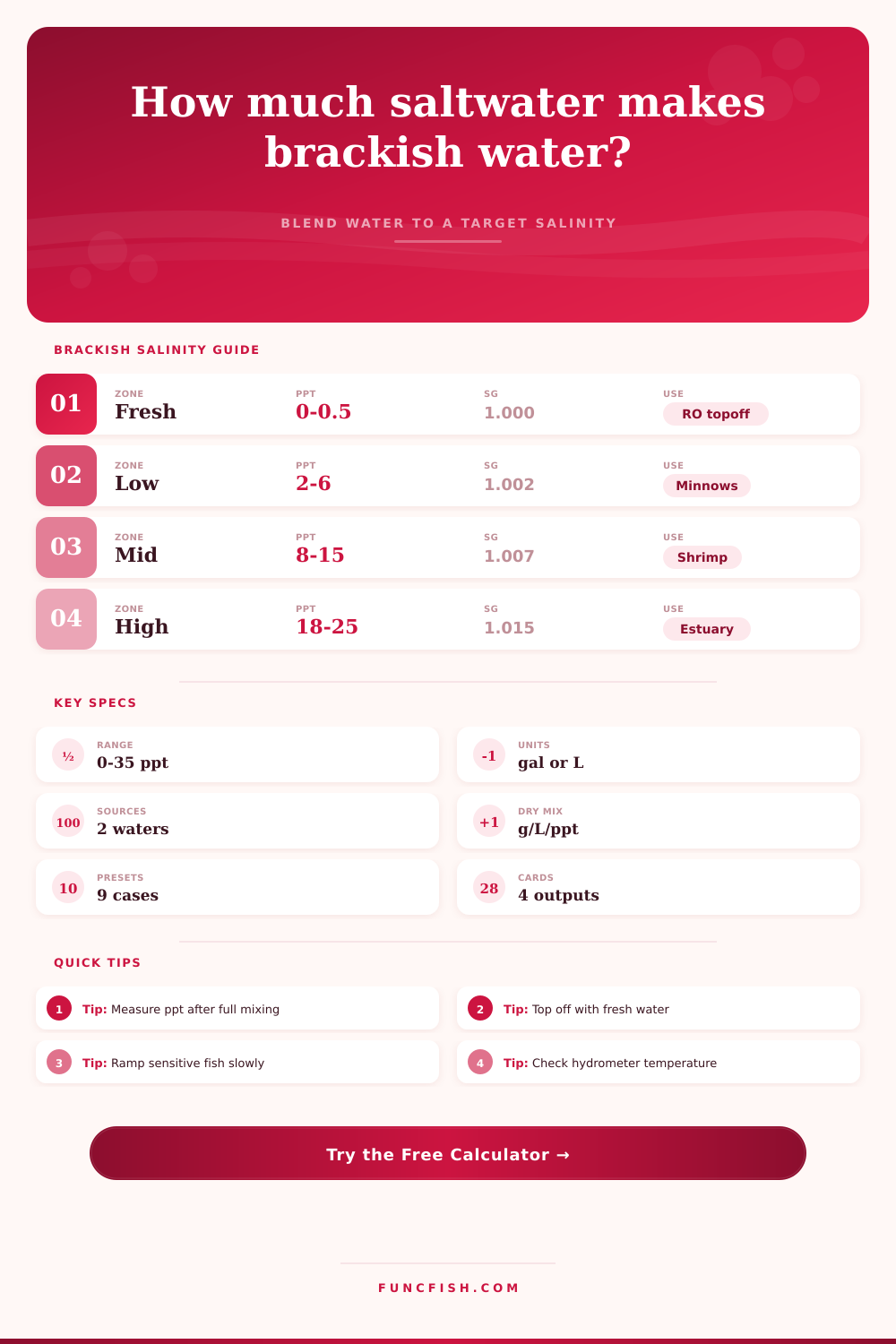
| Salinity band | Ppt range | Approx specific gravity | Typical fishing-water use | Mixing note |
|---|---|---|---|---|
| Fresh to trace | 0-0.5 ppt | 1.000-1.001 | RO top-off, freshwater rinse, very low mineral source | Use as the dilution side of the blend |
| Low brackish | 2-6 ppt | 1.002-1.005 | Minnow tanks, low-stress holding buckets | Small salt additions change ppt quickly |
| Mid brackish | 8-15 ppt | 1.006-1.011 | Shrimp, hardy forage, tidal-creek matching | Recheck after aeration and full dissolution |
| High brackish | 18-25 ppt | 1.014-1.019 | Estuary flats, drum, mullet, and transition water | Ramp sensitive fish across multiple steps |
| Near marine | 28-35 ppt | 1.021-1.026 | Ocean-influenced holding or source seawater | Use as the high-salinity source water |
| Target batch | Target ppt | Using 35 ppt saltwater | Using 0 ppt freshwater | Dry salt equivalent |
|---|---|---|---|---|
| 10 gal bait bucket | 5 ppt | 1.43 gal saltwater | 8.57 gal freshwater | 195 g at 1.03 g/L/ppt |
| 20 gal shrimp tank | 12 ppt | 6.86 gal saltwater | 13.14 gal freshwater | 936 g at 1.03 g/L/ppt |
| 30 gal livewell | 16 ppt | 13.71 gal saltwater | 16.29 gal freshwater | 1872 g at 1.03 g/L/ppt |
| 55 gal holding tank | 10 ppt | 15.71 gal saltwater | 39.29 gal freshwater | 2145 g at 1.03 g/L/ppt |
| 100 L tote | 8 ppt | 22.9 L saltwater | 77.1 L freshwater | 824 g at 1.03 g/L/ppt |
| Use case | Working salinity lane | Fast-change caution | Best source strategy | Result to watch |
|---|---|---|---|---|
| Baitfish or minnows | 2-8 ppt | Keep shifts under about 3 ppt per day | Blend small batches from weak brine | Respiration and balance |
| Live shrimp or prawns | 8-20 ppt | Avoid sudden fresh top-offs | Use pre-mixed brackish replacement water | Molting and activity |
| Mullet or hardy forage | 10-24 ppt | Hardy, but temperature adds stress | Match tidal source water when possible | Schooling response |
| Striped bass holding | 4-12 ppt | Ramp slowly when moving from freshwater | Use controlled water-change steps | Gill rate and orientation |
| Redfish or drum match | 10-28 ppt | Match the capture zone before transfer | Use field-measured estuary water as source | Acclimation behavior |
| Juvenile snapper holding | 15-28 ppt | Do not overshoot target ppt | Blend high brackish water first | Color and feeding |
| Correction problem | Likely cause | Calculator mode | Formula cue | Practical check |
|---|---|---|---|---|
| Target is above current ppt | Need more salt mass | Dry salt or water change | grams = delta ppt x liters x yield | Dissolve before adding to live water |
| Target is below current ppt | Need dilution | Lower with freshwater | replace fraction = delta / current gap | Remove water before adding fresh |
| Replacement water seems extreme | Change limit is too small | Adjust tank by water change | replacement ppt solves mass balance | Increase ramp days instead of overshooting |
| Dry salt result differs from label | Mix brand and moisture vary | Dry salt | edit g/L per ppt strength | Calibrate with a measured small batch |
| Hydrometer reads high later | Evaporation removed water | Dilute or top-off | salt mass stayed in the tank | Top off with freshwater, not saltwater |
💡Mixing checks
Tip: Salinity is a mass-balance problem. Use the source-water volumes from the calculator, aerate or circulate thoroughly, then measure ppt again before transferring live bait or fish.
Tip: Evaporation raises salinity because salt stays behind. For normal top-off, add freshwater or RO water until the original volume is restored, then recheck ppt.
Salinity is not a binary switch, freshwater vs saltwater; it’s far more complex than most people realize. Estuary are a place where fresh river water mixes with seawater to become its own unique mixture of the two. That gray area is where you’re at when you’re acclimating fish or holding live baits. And if you get that mix off, result is stress on the animal that shows up as poor performance or even dropping the bait entirely.
The calculator above does all the math for you in mixing together your source waters to reach specific target values. But knowing why those numbers makes a difference is what ultimately keeps the fish alive. The heart of the matter is osmoregulation. That means fish expends energy to match the salt concentration in water surrounding them with the concentration within themselves. Change that external concentration abruptly and you make him work harder then he should.
Why Getting Salinity Right Is Important
That’s where so many people gets tripped up. They look at a static tank and think, “the water must be OK.” What they fail to recognize is that a quick SG shift put the animal into shock. And as the table on the page illustrates, various species prefers different bands. Redfish will generally flourish in higher salinities; minnows can survives lower concentrations. Even if a species is robust, there are still limits to how fast they can adapt.
Basically what you’re doing when you use this tool, is you’re solving a mass balance equation. Your working volume. Your current salinity. And your target. You must enter the strength of both your freshwater and saltwater sources. That’s relevant because not all seawater are created equal. Pure ocean water vs collected estuary water means you start with something different. By telling it exactly how much of each type of water you want to add, the calculator adjust accordingly.
The same applies to you if you don’t have access to bulk saltwater and only have access to dry salt mix. The density of the salt and the ingredients in your marine salt (which varies from brand to brand) is why the yield coefficient are so important here. By adjusting that number you ensure you’re dosing appropriately rather than guessing at some generic rule of thumb.
This is where the theory fails. Sensitive fish don’t appreciate jumping from zero to twenty parts per thousand in one leap. This is where the ramp feature in the calculator come into play. It breaks total change into daily steps. For example, if you’re moving your striped bass from fresh water to brackish, spreading that change out over several days will be the difference between keeping them or losing them. It forces you to slow down and that’s precisely what the fish need.
Unfortunately, evaporation adds another wrinkle. While water evaporates, the salt remains behind so salinity creeps up on you without notice. That’s why you top off with freshwater rather than saltwater. It may seem like a minor habit but it keeps those accidental spikes from happening; something that can crash a tank.
Specific gravity, something of an old fashioned measure is another metric pointed out in the reference tables. Parts per thousand correlate very closely to this measure, and if yours shows up high on your hydrometer, you’ve got too much salt. If it reads low, you has too much fresh. Again, the tool will convert between them for you, so there’s no need to have a conversion chart on hand.
This is also helpful for water changes. How much should you change and remove? You want to make adjustments in tanks where the water is already set at some level and not shock the occupants by adding or removing too much. The percentage limit input lets you go into safe bounds for such changes.
In the end, managing brackish water boils down to precision and patience. While the tool eliminates the guesswork of mixing it up, you still need to do the measuring. That’s where a hydrometer or refractometer come into play. Let the water circulate, wait for the salt to completely dissolve then check the reading. Remember, temperature also impacts density, so make sure you give it time to stabilize before moving any live thing.
And be careful… The math works based off how well you measure. Once you get it dialed in, the fish will settle down, start breathing easier and act like themselves. It’s that easy. And that hard.
Mixing water isn’t just mixing water. You’re creating an environment. Get the salinity right, and you retain the wildness until it matters.