Bream Weight Calculator
Estimate common or silver bream weight from total length, widest girth, body depth, stillwater or river habitat, shoal size, condition factor, seasonal feeding index, confidence, and units.
📌Named bream presets
⚙Bream measurements and water setting
Bream model: deep-bodied bream gain weight quickly through girth and body depth, so this calculator blends length x girth squared with a depth index, then applies habitat, shoal, condition, season, and confidence adjustments.
Bream weight estimate
Results update from the current bream measurements and adjustment choices.
Full calculation breakdown
📊Bream class data grid
Silver Bream
Common Bream
Hybrid Profile
Slab Common
The grid describes weight-estimation shape classes only. It does not identify legal species status, waters, rules, or retention decisions.
🐟Bream and coarse-fish comparison grid
Common Bream
Deep body, broad flank, girth-led weight gain.
Silver Bream
Smaller, tidier outline, lighter for equal length.
Tench
Rounded and dense, but less plate-sided than bream.
Carp
Powerful shoulders and belly change coefficient sharply.
Roach
Shorter depth and lower girth, so length misleads.
📘Bream reference tables
| Bream stamp | Total length | Typical girth | Body depth | Expected weight |
|---|---|---|---|---|
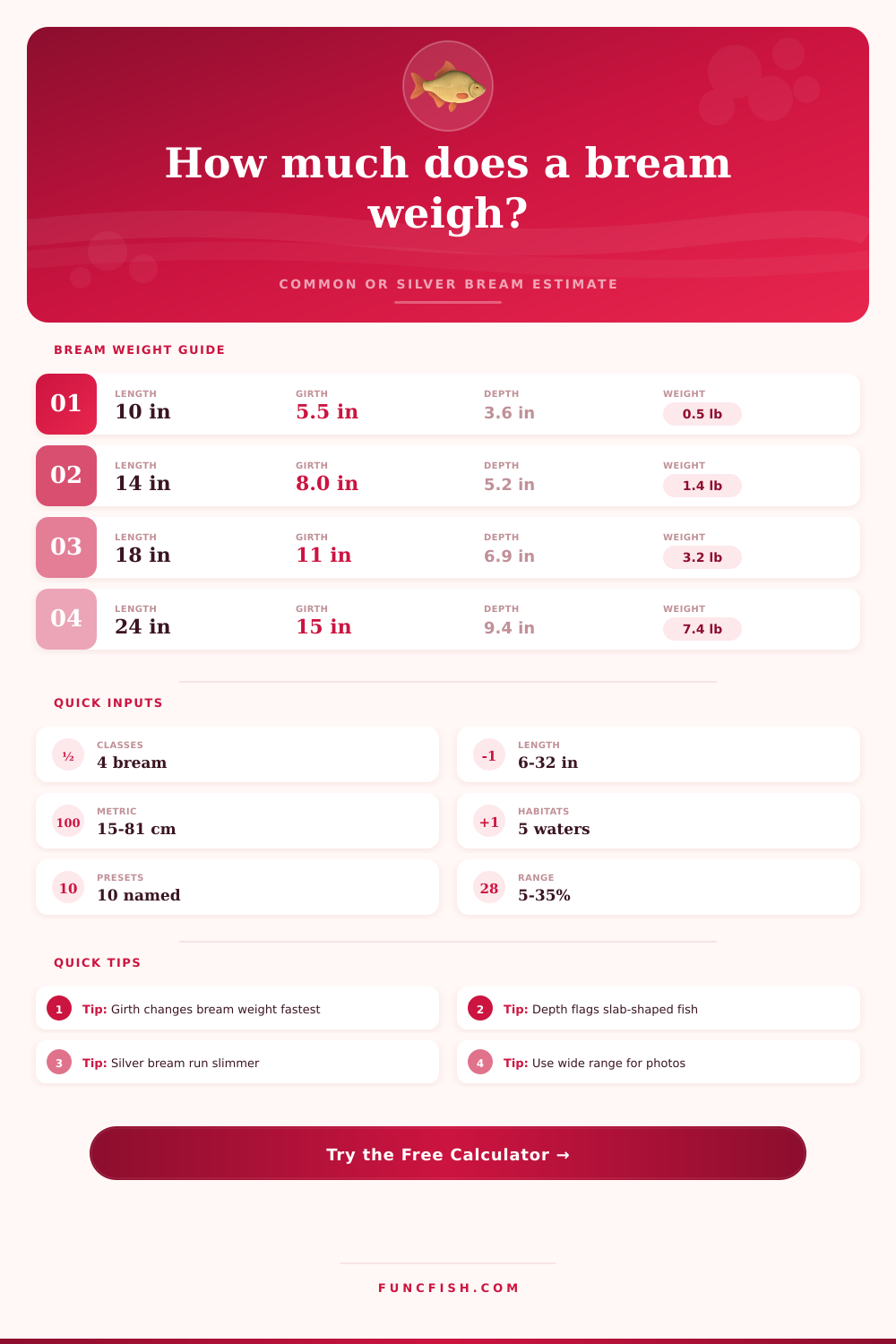
| Silver skimmer | 6-10 in / 15-25 cm | 3.5-5.5 in / 9-14 cm | 2.0-3.5 in / 5-9 cm | 2-8 oz / 60-230 g |
| Small common bream | 10-14 in / 25-36 cm | 5.5-8.0 in / 14-20 cm | 3.6-5.2 in / 9-13 cm | 8 oz-1.5 lb / 0.23-0.68 kg |
| Lake shoal bream | 14-19 in / 36-48 cm | 8.0-12.0 in / 20-30 cm | 5.2-7.4 in / 13-19 cm | 1.5-4 lb / 0.68-1.81 kg |
| Specimen slab | 19-25 in / 48-64 cm | 12.0-16.0 in / 30-41 cm | 7.4-10.0 in / 19-25 cm | 4-9 lb / 1.81-4.08 kg |
| Very large bream | 25-32 in / 64-81 cm | 16.0-20.5 in / 41-52 cm | 10.0-13.2 in / 25-34 cm | 9-16 lb / 4.08-7.26 kg |
| Class choice | Best fit | Base divisor | Expected depth | Shape caution |
|---|---|---|---|---|
| Silver bream | Light silver-sided bream | 760 | 33% of length | Do not overrate girth from photos |
| Common bream | Normal bronze lake or river fish | 710 | 38% of length | Depth and girth both matter |
| Hybrid profile | Mixed outline or uncertain class | 735 | 36% of length | Use broader confidence range |
| Slab common | Deep, mature common bream | 675 | 41% of length | Can jump weight quickly by girth |
| Habitat or shoal cue | Calculator effect | Typical body clue | Range effect | Use when |
|---|---|---|---|---|
| Canal or slow cut | Slightly lighter | Trim belly, small shoals | Moderate | Urban canals and narrow drains |
| Estate lake or pit | Neutral to full | Broad flank, steady feeding | Moderate | Most stillwater bream |
| Open reservoir shoal | Length can outrun girth | Long body, roaming shoal | Wider | Wind lanes and open water |
| Steady river glide | Firmer but not bulky | Clean flank, less belly | Wider | Lowland river bream |
| Dense stunted shoal | Lowers condition | Many similar small fish | Wider | Small competitive shoals |
| Season or confidence | Multiplier cue | Range cue | Best measurement | Notes |
|---|---|---|---|---|
| Spring pre-spawn | Fuller fish | Moderate | Length, girth, depth | Heavy belly can lift estimate |
| Post-spawn recovery | Lean fish | Wider | Depth and girth | Spent fish sit below length tables |
| Autumn heavy feeding | Strongest fullness | Moderate | Girth at deepest point | Often best body condition |
| Measured all dimensions | No penalty | Narrowest | Mat plus soft tape | Best for calculator accuracy |
| Photo-only estimate | No exact penalty | Widest | Visible scale clue | Use as rough bracket only |
💡Bream measuring tips
Bream are plate-sided fish, so a half-inch error in girth can move the estimate more than a longer-looking tail angle. Take girth around the deepest shoulder and belly line.
A long, thin silver bream and a shorter common slab can photograph alike. Body depth gives the calculator a second shape check before it adjusts the final range.
Bream fishing require that you understand the weight of the bream that you catch. Knowing the weight of the bream is importance to being able to compare the bream that you catch. For instance, you can use the weight of the bream to determine if a particular bream is a small fish or if it is a large fish.
Additionally, you can use the weight of the bream to compare the weight of bream caught in different bodies of waters, or to compare the weight of bream caught in different seasons. It is difficult to find the weight of a bream due to the deep bodies of the fish, and the fact that the shape of the bream change based off the habitat in which the bream live and what the bream eats. The weight calculator use three different measurements to determine the weight of the bream.
How to Estimate Bream Weight
The calculator will ask for the length of the bream, the girth of the bream, and the depth of the bream. Each of these measurement will help the calculator to determine the weight of the bream; the length of the bream may be long or short, the girth may be small or large, and the depth of the bream may be deep or shallow. In addition to these measurements, the calculator will also ask for the type of water in which the bream was caught, as well as the size of the shoal from which the bream was caught.
The type of water and size of the shoal may impact the weight of the bream; for instance, a bream that was caught in a shoal of many bream may weigh less than a bream that live in a shoal of few fish. One of the factor that is used in calculating the weight of the bream is a condition factor. The condition factor is a value that helps to describe the weight of the bream in relation to it’s length.
A condition factor of 1.00 indicate the bream has an average weight for its length. A low condition factor indicates the bream may be lean. Lean bream may have recently spawned, or may be eating in cold water.
A high condition factor indicates the bream is heavy; it is likely eating alot of food during the autumn season. Another of the factors that will impact the weight of the bream is the size of the shoal of bream from which it was caught, as well as the season in which the bream was caught. For instance, large shoals of bream contains many fish, but there is limited food for all of the bream in the shoal.
In the spring, the bream may be heavy with eggs, but in the winter the bream may be light with little food available during the winter months. Both of these factor will impact the weight of the bream, and will impact the weight calculation. Additionally, the calculator will provide a range of weights for the bream, and the range will be broad if the only input to the calculator is a photograph of the bream.
Another of the features provided on this calculator are reference tables that indicate the size of bream of each category. These tables are not strict rules, but they do provide context for the weight of the bream that was caught. The tables can help to indicate if the bream that was caught was a small bream or a common bream.
In order to calculate the weight of the bream accurately, certain technique should of been employed in measuring the bream. For instance, you should measure the girth at the deepest portion of the bream, but without pressing the scale of the bream. The depth of the bream should be measured from the top of the breams back to the bottom of its belly, and without altering the shape of the bream.
The length of the bream should be measured from the tip of the nose to the end of the tail of the bream. Small error in measuring the bream will have a large impact on the calculated weight of the bream. In addition to the factors that are accounted for in the calculator, bream may have different weights based upon the habitat in which they were spotted.
For instance, bream that live in canals may have different body shape than bream that live in reservoirs. Bream that live in rivers may be more muscular than bream that live in still water. These various habitats may impact the shape of the bream, but cannot be accounted for in this calculator.
However, an informed fisherman may use his knowledge of the habitat from which the bream was caught to adjust the weight calculation. The most important use of this calculator is in the ability to compare the weights of the bream that are caught over time. By recording the weight of many of the bream that are caught, it is possible to determine if the bream in the water are getting larger.
It is also possible to use the calculator to determine if the bream of each season weigh the same, and the calculator can help to make it more easy to record the weights of the bream that are caught. Thus, the weight estimate indicated from the calculator will help to compare the bream that are caught today to the bream that were caught in the past.