
A first-time buyer of a cast net will always get frustrated by the purchase. They step out on dock intending to throw a beautiful circular throw and their wet cast net slaps the surface with all the grace of a sopping dishrag. It clump up and doesn’t even open. Then it catches itself and the bait fish has time to scatter while you was standing on the bank forgetting about the physics of the cast.
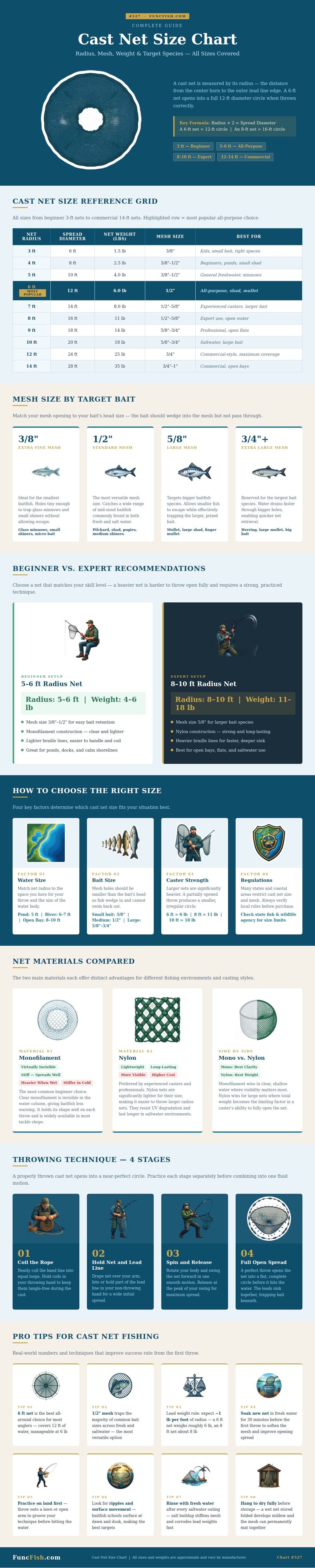
Most first-timers base the size of their purchase solely on which one appears largest in the catalog and honestely that’s almost always the wrong decision. First thing you should know is that radius doesn’t translate directly to water covered. As the chart above demonstrate, a six-foot net do not cast like a six-foot net. Six-foot nets make a twelve-foot circle. Most folks gets confused about what a diameter is versus what a radius is. If you think an eight-foot net is going to cover just a little more than the six-footer, youre really looking at sixteen feet of spread.
How to Choose Your First Cast Net
As a result, there will be a lot more weight. And the work isn’t linear but rather exponential. For instance, the six foot net might be roughly six pounds and easy enough for a weekend angler to handle. Eight jumpers are up to eleven pounds and require a bit of practice with the snap and stout shoulder. Ten is pushing it into the dedicated ranks with eighteen pounds. Heavy stuff can’t be thrown effectively without solid technique or the net won’t open flat. Air gets caught in the folds and the weight is simply too great for your current skills.
Beyond just size there’s an element of complexity added by your choice of material. For starters, your beginner net should be made from mono. Mono is nearly undetectable in clear water. The minute a shad or minnow sees your net coming, they don’t have much time to get out of the way. The stiffness also help the net spread on its own momentum. But mono will absorb water and become heavier the longer you fish it.
Nylon is different. Even wet, nylon remains light and resists corrosion better than anything else. That’s why pros who fish hours in open bay areas love it. Nylon is more noticeable to fish than mono but again, that’s what makes it durable. Because nylon doesn’t maintain the same stiffness through the cast, it might be tougher for the novice angler to master. Stealth versus durability. You can’t have one without sacrificing the other. It all depends on where you are fishing and which tool fits best.
The same goes with mesh size. You don’t want it too big, or water will drain out slowly and you will drown when lifting it out of the water. You also don’t want it to small, or it will catch the head of whatever you are trying to catch. A happy medium is a half-inch mesh which covers most saltwater and freshwater species well. For those little glass minnows, go down to about three-eighths of an inch. Those nets is heavier and harder to throw. For something like mullet which can get quite large, you may step up to five-eights or bigger. Some smaller fish will fall through, but the goal is efficiency rather than catching every single one. Think about what kind of fish you want to catch before buying any size or type.
Smaller nets (typically five or six foot radius) are required for ponds and narrow stretches of river bank. Why? You have to spin it without hitting tree limbs and fellow fishermen. Big throws is fine when fishing open flat areas, as long as you have the technique to make it happen. Practice on grass. It’s much more humiliating to get tangled up in a net while mowing your yard compared to a few feet away from old-timers who starts their day well before daylight.
Wet down new nets with fresh water prior to casting to relax the fibers and ensure better spread. After using them in saltwater, give ’em a good rinse to prevent corrosion of lead weights and rigidity of the mesh.
Cast netting takes time to learn. Work your way up to bigger sizes, perfecting the circle until your confidence increases along with your radius. The six-foot circle that you botched on your first attempt will one day seem like an extension of your own arm.