Caviar Yield Calculator
Estimate green roe, screened roe, cured caviar weight, salt addition, grade split, and jar count from fish weight, species, maturity, and processing conditions.
📌Batch presets
⚙Yield settings
Use the number of mature females in the batch.
Start from the species guide, then adjust from sampling.
Caviar yield forecast
Full breakdown
📋Species yield reference grid
Osetra
Beluga
Sevruga
Kaluga
Siberian
White
Paddlefish
Salmonid
📐Yield and packing tables
| Roe source | Typical roe yield | Processing loss | Salt target | Useful batch note |
|---|---|---|---|---|
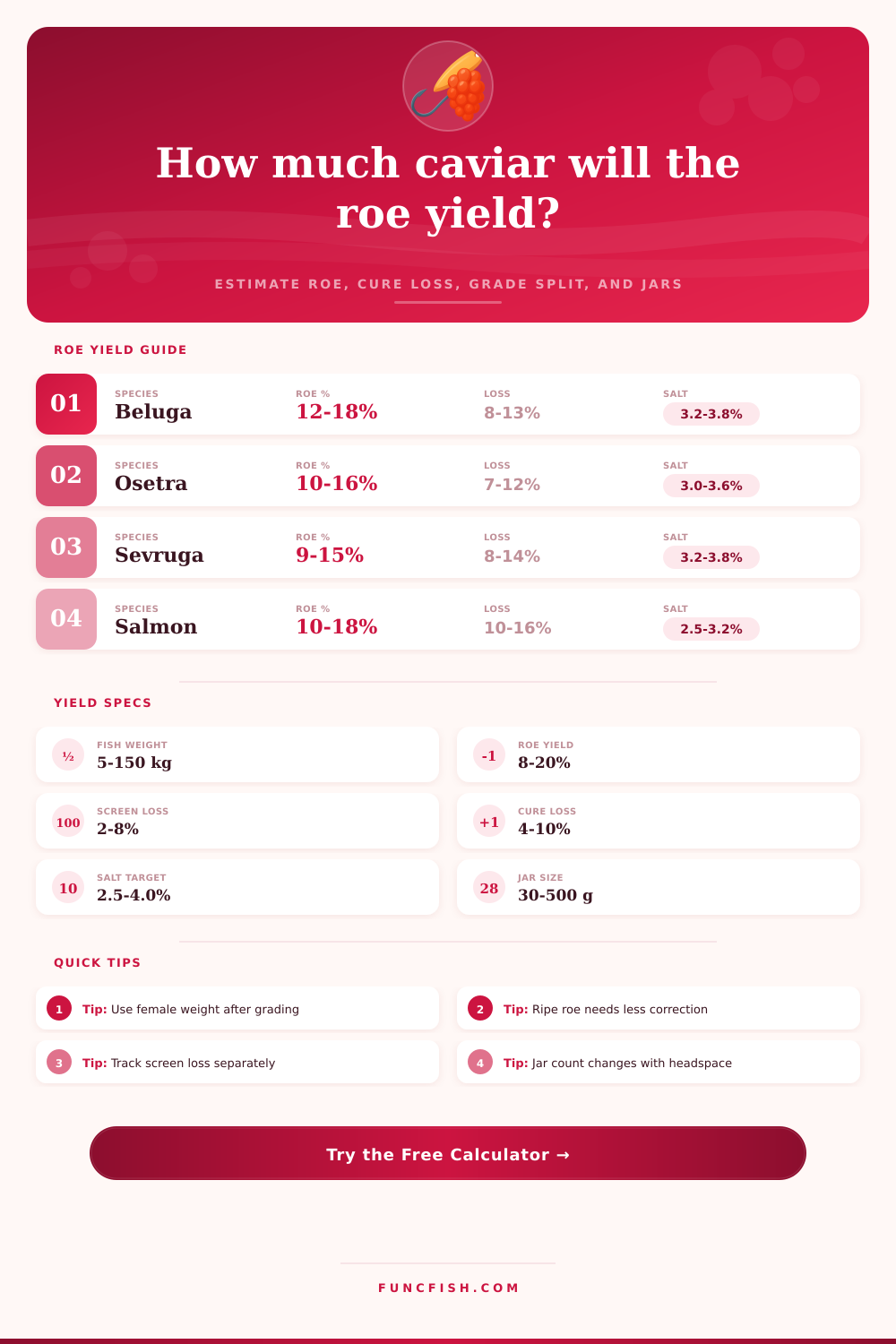
| Beluga sturgeon | 12-18% of fish weight | 8-13% | 3.2-3.8% | Large pearls, moderate screen loss |
| Osetra sturgeon | 10-16% of fish weight | 7-12% | 3.0-3.6% | Medium pearls, stable finished yield |
| Sevruga sturgeon | 9-15% of fish weight | 8-14% | 3.2-3.8% | Small pearls, more grade variation |
| Kaluga hybrid | 11-17% of fish weight | 7-12% | 3.0-3.5% | Large pearls and strong grade split |
| Siberian sturgeon | 9-15% of fish weight | 8-13% | 3.2-3.7% | Good standard batch baseline |
| White sturgeon | 8-14% of fish weight | 6-11% | 2.8-3.4% | Clean screening when mature |
| Paddlefish roe | 6-12% of fish weight | 9-16% | 3.3-4.0% | Smaller pearls and higher trim loss |
| Keta salmon roe | 10-18% of fish weight | 10-16% | 2.5-3.2% | Large roe with high membrane variation |
| Trout roe | 8-15% of fish weight | 10-17% | 2.4-3.1% | Small jar runs need reserve |
| Adjustment | Roe yield shift | Loss shift | Grade shift | Calculator treatment |
|---|---|---|---|---|
| Firm, tight membrane | -0.5% | +1.5% | -3% select | More broken egg risk in screening |
| Ripe, clean separation | +0.8% | -1.0% | +4% select | Best finished yield forecast |
| Soft, fragile roe | -1.2% | +3.5% | -7% select | Higher drainage and trim loss |
| Mixed maturity lot | -0.3% | +1.8% | -4% select | Use conservative jar count |
| Hand pick / regrade | 0.0% | -0.6% | +5% select | Less waste but slower throughput |
| Wide screen | +0.2% | -0.8% | -2% select | Fewer fines removed from batch |
| Pack format | Fill weight | Best for | Reserve impact | Counting rule |
|---|---|---|---|---|
| 30 g jar | 1.06 oz | Small finished lots | High | Round down after reserve |
| 50 g jar | 1.76 oz | Standard tasting jars | Moderate | Round down after reserve |
| 125 g tin | 4.41 oz | Medium batches | Moderate | Check partial tin remainder |
| 250 g tin | 8.82 oz | Large grade lots | Low | Track remainder separately |
| 500 g tray | 17.64 oz | Bulk pack planning | Low | Best for stable grade runs |
💡Practical yield checks
Tip: Keep green roe, screened roe, cured weight, and packed weight as separate checkpoints. Blending them into one loss number hides the step that needs correction.
Tip: When the pack count is close to a full jar, increase the reserve allowance instead of rounding finished weight upward.
When you harvest sturgeon or salmon you will need to determine how much finished caviar will land in your jars. The amount of finished caviar that you can produce is dependent upon a variety of factor, such as the maturity of the roe, the amount of membrane and bloodline that you remove from the roe during screening, the amount of moisture that is lost during the curing process, and the amount of salt that you add to the product. Each of these factors will impact the total amount of caviar that can be produced from the harvested fish.
The calculator located on this page will allow you to enter the count of the fish that will be harvested, the average weight of each fish, the species of each fish, the maturity of the roe of each fish, the percentage of the roe that is lost during screening, the amount of salt that is added to the roe, and the size of the jars in which you will pack your caviar. Based off these entries, the calculator will provide an estimation of the green roe weight that will be available for processing, the weight of the screened roe prior to curing, the salt that will be added to the roe, the finished weight of the caviar after the curing process and draining of excess moisture, the number of jars that can be filled with the finished caviar (after setting aside a portion for headspace in the jars), and the division of the finished caviar into top and standard grade portions, based upon the size of the pearls of the species of sturgeon or salmon from which the caviar will be produced. The maturity of the roe can have an impact upon the amount of caviar that is produced.
Estimate How Much Caviar You Will Get
Ripe roe readily separates from the membrane with minimal application of force, and the eggs of the ripe roe do not easily break apart during the processing of the sturgeon or salmon, allowing for the preservation of the pearls of the highest grade of caviar. Roe that is firm to the touch generally requires more force to free the eggs from the ovary of the sturgeon or salmon, and the potential for the eggs to be damaged during the process results in a lower portion of the total screened roe being comprised of pearls of the select grade of caviar. Soft roe contains moisture within the eggs that drains from the roe during the curing process.
Each of these factors will impact the outcome of the caviar production process and the numbers that is provided to the individual with the calculator. The method with which you screen your roe will also impact the outcome of the process. Applying a fine screen to the roe and rinsing it with water will remove debris, membrane, and bloodline from the roe.
The downside to this approach is that some good eggs will be removed from the roe during rinsing. A wider screen will remove fewer eggs from the roe during screening, but some membrane around the eggs may remain. Screening the roe by hand will allow for the best possible recovery of the most select caviar, but is more time consuming than using screening screens.
The calculator allows you to adjust for these factors. The salt levels that are added to the roe impact the final weight of the caviar in two different ways. Using higher percentages of salt than the weight of the screened roe will increase the final weight of the caviar.
However, salt draws moisture out of the roe during the curing process. The calculator will apply the salt percentage to the screened roe weight. The amount of moisture loss from the cure will be subtracted from the total weight of the roe and salt.
This algorithm to calculating the finished caviar weight is reflective of the actual process of adding salt to the roe. The size and type of containers in which you package your caviar will impact the total amount of caviar that can be sold. Small jars allow for more headspace for the caviar to be stored, as the surface-to-volume ratio is higher with small jars.
The amount of caviar that is sold in larger tins and trays requires less headspace, but it is more difficult to have small amounts of caviar remainder when packing the larger containers. The calculator provides for the portion of the finished caviar that is set aside for headspace, as well as indicates when the remainder of the portion of caviar that is produced may come close in size to one of the containers in which the caviar is to be sold. No batch of caviar will ever perfectly match the amount of caviar that is estimated in the calculator.
Though the female sturgeon or salmon that is harvested will contain the same amount of roe as the average for that species, there may be a variety of maturity levels in a batch of fish. The temperature at which the sturgeon or salmon is held after harvest, the time that elapses between harvest and screening of the roe, and the fat content of the fish will also impact the amount of caviar that is produced. The calculator provides a starting point for caviar production, but additional tracking of the weight of the green roe, screened roe, and cured caviar will allow adjustments to the process.
The tables located on this reference page include the yields, losses, and salt percentages for different species of sturgeon and salmon, maturity levels, and screening methods. These percentages can be used as a starting point to establish the variables in your calculations, especially if you have not yet processed any sturgeon or salmon for caviar production. As you produce caviar from your sturgeon and salmon batches, you can adjust the variables within the calculator to your own measurements and observations for best results.
The goal with this calculator is not to provide a perfect figure for the amount of caviar that will be produced from your sturgeon or salmon harvest. However, the calculator will allow you to understand the impact that each of the factors has upon the total amount of caviar that is produced. For instance, if you can determine that ripe roe will lead to increased yields of both the total amount of caviar as well as the amount of top grade caviar, you may want to adjust your holding time for the sturgeon or salmon to allow for the roe to reach its ripe stage.
Similarly, determining that a fine screen will result in a loss of the best-grade caviar may allow you to establish a standard for the quality of caviar that is to be produced. The calculator simply performs the calculations for you; you merely have to supply it with your parameters for the sturgeon or salmon caviar production process.