
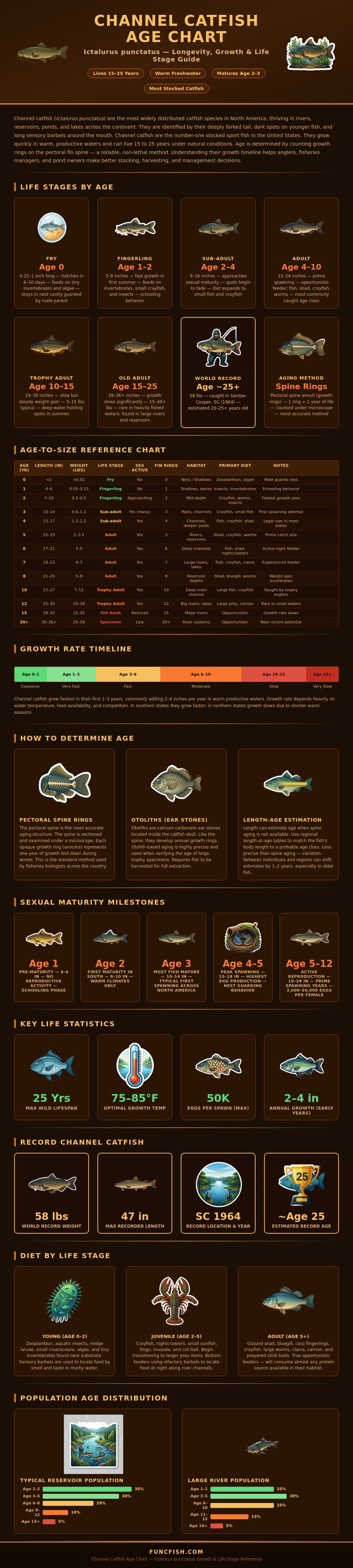
How old are most of those channel catfish we catch? Not many anglers has any idea. Maybe you’ll catch a two-pounder, thinking it’s a youngster. Maybe you’ll get one that weighs ten pounds, so he must be an old one. The truth lies somewhere in between.
The growth rate of *Ictalurus punctatus* affects your fishing strategy. It determines which type of bait to use and when to cull a limit. It also dictates what fish to keep versus what fish to let go, and how to read a lake. Knowing that will make random good luck into strategic informed success.
How Channel Catfish Grow
It’s all a matter of time. It’s not very complicated. There are predictable phases of life. The fry stage begins as babies cling to nest cavities provided by fathers who guard the young hatchlings. That care is unique for most freshwater species and sets channel catfish up for a head-start that makes a difference in the overall population stability.
As illustrated in the infographic, those early fry grow fast. Vertically more than horizontally. Though your six-inch yearling may not impress you much, it will have found its place within the food web. Age two through three represents their rapid growth window. When conditions are right (warm water, plenty of available food), these guys can absorbs multiple inches each year. This period is also the schooling stage. They spend time cruising shallow area and hanging around banks. Crayfish and insects make up their diet. Food is abundant and the fish are hungry and aggressive, which makes them fairly easy targets with basic presentations.
After about four or five years old, something changes. Weight will really start to increase while growth in length will level out. Fish go from sub-adult to adult, specifically prime spawning adults. As you’ll notice in the chart above, that fifteen inch fish at age five could turn into a twenty-five inch monster by age ten. You don’t think they’re much longer to the naked eye, but it’s not their length increasing, rather their girth. Which is what causes one fish to weigh so much different than another of equal length. Old fish just have more fat reserves and muscle mass. Particularly on a nutrient rich reservoir with an abundance of shad and big crayfish.
Age: This is where things get tricky because until you catch it and cut it open you never really know for sure. Biologists do know for sure using otoliths (ear stones) or pectoral spine rings. These are then counted as they have annual growth bands deposited on them while they sleep through the winter. There is one band per year. The banding pattern is an accurate calendar whereas a length estimate isn’t. Regional tables exists which give an idea based off size, but this is only an educated guess. A 10 inch catfish might be two years old in Florida but four years old up north in Minnesota due to colder water growing them slower. Size alone doesn’t tell the whole story.
The same geographical guidelines apply to maturity milestones: In general, fish in warmer water spawn at an earlier age (around two years), and fish in cooler water wait longer (three or four). The sweet spot for the most prolific spawning occurs from about age five to twelve. During this period, a single female may release tens of thousands of eggs each year. That’s plenty of offspring to sustain population levels despite heavy fishing pressure.
By comparison, trophy fish (the elusive 10-plus pounders) tend to hold on ledges in deeper water found in the main channel. There, they rest and waste minimal energy; they don’t spend all their time feeding. Instead, they’re opportunistic feeders when the moment is right. A good fishery will have lots of young fish but the age range skews very young. Most channel cats on most reservoirs are less than five years old. The key to finding bigger trophies is being willing to go deep and, more importantly, being patient.
These big ones survived decades of angling pressure and natural change. They are survivors. When you catch one you realize something different. You caught history. On the next big channel cat you put into the boat, look beyond its size and think about how many years it took for it to get there. It may just be a decade of summer nights in your hand.