
I have been there: I stripped a fish down only to discover that it wasn’t as big as my tackle box. Based off the fight you thought you had, you was expecting a monster of some sort. But reality struck hard. When it comes to chinook (king) salmon, we’ve all gotten our expectations scrambled thanks to there explosive power. These are renowned fish, after all.
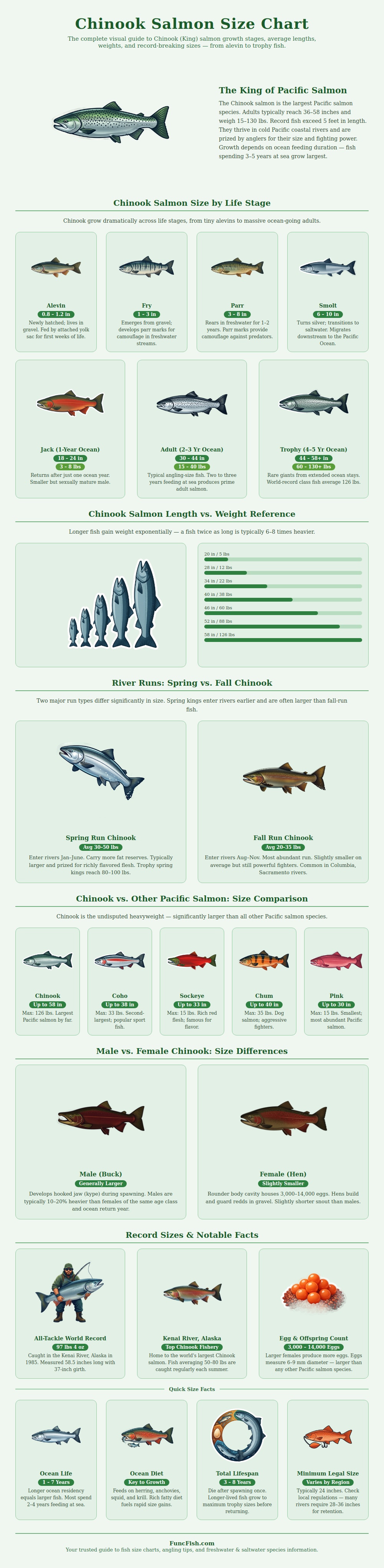
So how do they really develop? How does one go from a tiny egg in gravel, or an alevin, to a huge predator out in the ocean? See the chart above. It is a good way to break down size expectations across their various stages. By separating the biology from the hype, it helps you better understand what to expect before you even pick up a lure.
How Chinook Salmon Grow Big
But it all begins small. At birth, the Chinook salmon exists as an alevin, hidden within the safety of rocks along a river, relying on its yolk sac for food. It remains protected there until it develop into a fry with vertical parr marks. These marks provide naturaly camouflage against the surging water. Then it is ready to burst forth. Here, in fresh waters, everything takes shape: this stage set the foundation for what comes next.
For up to a couple of years, the salmon learns how to hunt and stay alive. It’s a test of strength. Only the strong will survive and proceed downstream. After they become silvery and smoltify, however, it’s all about the real growth spurt in the ocean. That’s when you can really see the distinction between a nice fish for dinner and one worthy of a trophy picture.
The one-year fish come back as jacks, smallish, but full-grown adults that is already ready to reproduce. Though only half the size of some 5-plus year old fish, they’re mean little buggers that will challenge your drag while trying to make up for lost time. But the big boys aren’t coming back home so soon. Three to five years in the ocean eating squid and herring makes them seriously chunky.
Even though they might seem equally long, a 2- or 3-year old will not weigh anywhere near as much than a 5-year old fish. This exponential increase in weight can be easily seen in the visual guide. A 20 inch fish could potentially weigh 5 pounds, whereas if doubled in size it’s around a hundred pound fish. That’s where a lot of folks mess up by assuming the growth is linear. If they have a longer rod, it catches them proportionately right? Well not so fast because as the animal matures, density changes everything. Know how this curve works, and you’ll rig out for what you really may be catching instead of what you hope to catch.
The other thing is that timing is everything when it comes to what’s coming into your boat or cooler. Typically, spring-run Kings will arrive in rivers sooner than fall runs and often with more fat reserves from having fed up in the ocean longer. They tend to be bigger on average as well since they had more time to fatten-up prior to heading inland. Conversely, fall runs are typically smaller but much more numerous and can create totally different fishing dynamics.
Now if you’re looking for pure size, spring tends to give you better odds at the big ones that make headlines. Alaska’s Kenai River continues to be the best place for this type of chase as it continue to produce fish that don’t comply with normal biological expectations.
Then there’s the sexual dimorphism. If you’re not careful, you’ll measure from nose to tail instead of mouth to tail and that will throw your length off for the males, who have developed a unique hook on their jaw called a kype. Because males spend energy fighting each other while females expend their energy producing eggs, males tend to be larger (though shorter overall) than female counterparts of equal age class. The females has thousands of eggs so they are somewhat smaller overall but rounder in the belly. Knowing which sex you’re after allows you to anticipate fight style and behavior, as bucks tend to get thrown around a little more aggressively during the spawn.
And lastly, let’s place these weight numbers into perspective with other Pacific species. Coho, Sockeye and Pink salmon all pale in comparison to Chinook; they’re just lighter hitting versions of the same fish. There is nothing wrong with those other species. Each has its own merit in terms of action and flavor, but none hold the raw mass that a mature King does. It’s rare indeed to see a fifty-pound Salmon with any other species but that’s just Tuesday afternoon where prime Chinook waters are concerned. Remembering the hierarchy will help keep your chin up if you’ve been comparing catch sizes from one trip to another.
When you’re going after the heavyweight champion of freshwater waters, you’re playing a completely different game. Instead of guessing based off past luck, look at the run timing and age structure of your next trip to see exactly what the data shows. Patience pays off in both quality and size. You may leave with a hundred-pound giant or perhaps a feisty jack, but knowing where he sits on the growth curve will help you appreciate him for what he is, instead of holding him up to impossible standards.
Ultimately, it is not just about what weighs on the scale. It’s about respecting his journey from that tiny grain of gravel into the ultimate predator of the Pacific.