Chub Weight Calculator
Estimate European chub weight from length, girth, body depth, river or canal habitat, flow class, condition factor, seasonal feeding index, measurement confidence, and units.
📌Named chub presets
⚙Chub measurements and water setting
Chub model: the calculator starts with a length x girth squared chub estimate, then checks body depth against chub build, flow, habitat, season, condition, and measurement confidence.
Chub weight estimate
Results update from your chub measurements and water setting.
Full calculation breakdown
📊Chub reference cards
Small River Chub
Good River Chub
Specimen Chub
Exceptional Build
Card figures use inches and pounds as quick angling references; switch the calculator to metric for centimeter and kilogram inputs.
🧮Chub and coarse-fish comparison grid
Chub
Long, thick-shouldered cyprinid with a rounded flank. Girth drives the estimate more than depth alone.
Dace
Slimmer coarse fish shape. Similar length can weigh far less because girth and depth stay modest.
Ide
Can look chub-like, but often carries a deeper, taller slab body at the same length.
River Roach
Shorter, deeper profile. A roach-style depth reading can overstate chub weight if girth is guessed.
📘Reference tables
| Chub length | Typical girth | Typical depth | Approximate weight | Reading note |
|---|---|---|---|---|
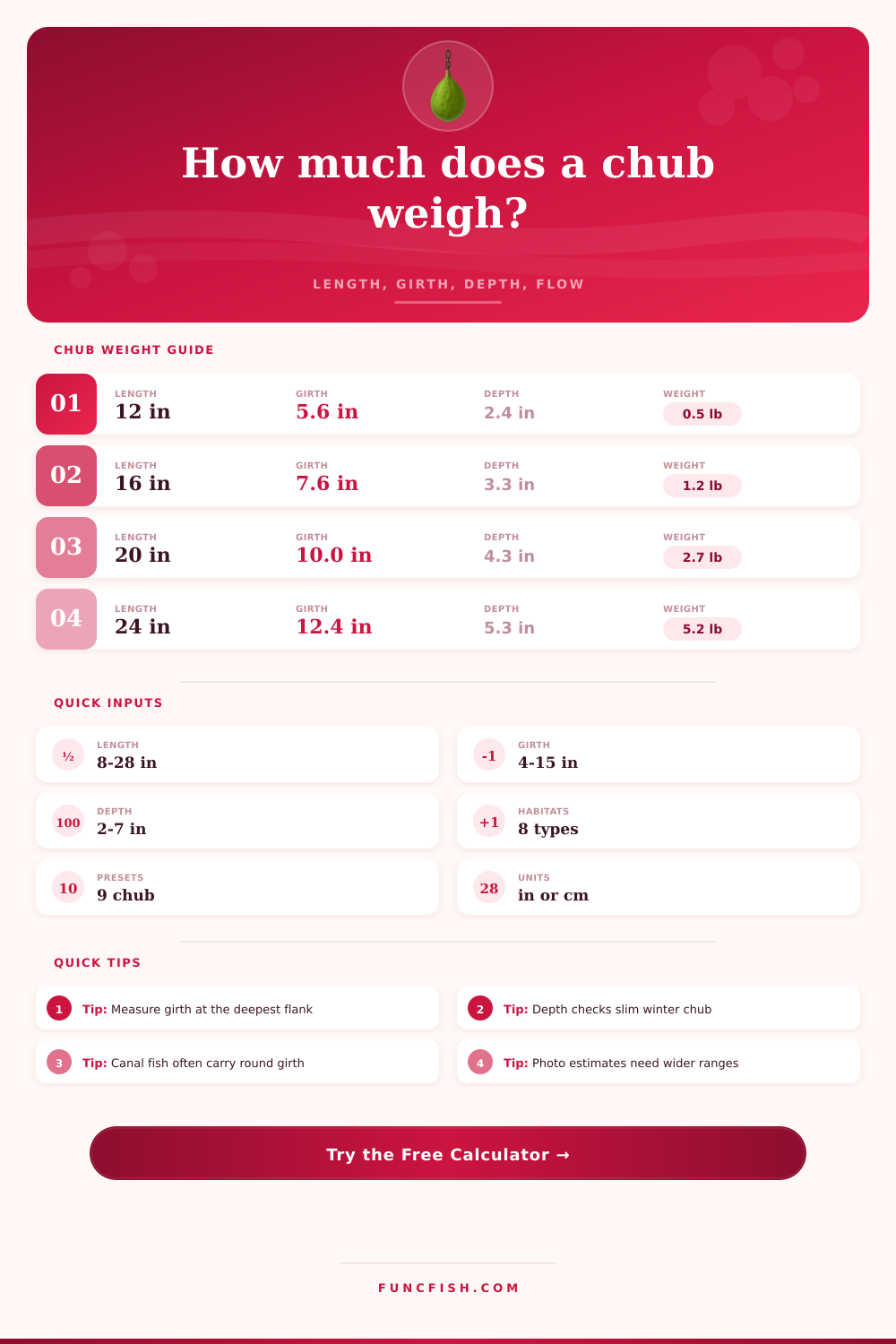
| 10-12 in / 25-30 cm | 4.5-5.8 in / 11-15 cm | 2.0-2.6 in / 5-7 cm | 0.3-0.6 lb / 0.14-0.27 kg | Young river chub or canal shoal fish |
| 13-16 in / 33-41 cm | 5.8-7.8 in / 15-20 cm | 2.6-3.5 in / 7-9 cm | 0.7-1.6 lb / 0.32-0.73 kg | Common adult chub range |
| 17-20 in / 43-51 cm | 8.0-10.2 in / 20-26 cm | 3.6-4.6 in / 9-12 cm | 1.8-3.2 lb / 0.82-1.45 kg | Good fish with girth now critical |
| 21-24 in / 53-61 cm | 10.5-12.8 in / 27-33 cm | 4.7-5.6 in / 12-14 cm | 3.5-6.0 lb / 1.59-2.72 kg | Specimen zone; measure girth carefully |
| 25-28 in / 64-71 cm | 13.0-15.2 in / 33-39 cm | 5.6-6.6 in / 14-17 cm | 6.2-9.0 lb / 2.81-4.08 kg | Exceptional chub build, range widens fast |
| Habitat setting | Model factor | Expected shape | When it helps |
|---|---|---|---|
| Upper river riffle and bend | 0.98 | Firm, slightly lean, longer flank | Cold tributary or narrow fast river chub |
| Clear chalk stream glide | 1.06 | Clean length, good shoulders, steady food | Measured chub from open glide or weed edge |
| Weirpool, crease, or apron | 1.08 | Powerful shoulders with varied gut fullness | Fish sitting near fast water and food lanes |
| Lowland river pool | 1.05 | Deep-bodied mature chub | Slower, warmer reaches with mixed forage |
| Straight canal pound | 0.99 | Rounded but often shorter-backed | Canal chub where flow is low and food is patchy |
| Canal basin or marina mouth | 1.03 | Fuller belly and steady loafing water | Bread-fed or boat-basin fish with visible girth |
| Flow class | Flow factor | Depth signal | Range effect |
|---|---|---|---|
| Still canal water | 0.98 | Round belly can mask lower muscle depth | Use careful girth and normal confidence |
| Slow glide | 1.02 | Balanced chub body shape | Good default for steady venues |
| Steady river run | 1.04 | Firm shoulders and reliable flank depth | Useful for classic river specimens |
| Fast crease or push | 0.99 | Long muscle, less belly reserve | May reduce heavy-looking photo estimates |
| Flood-coloured heavy water | 1.03 | Can include recent feeding fullness | Widen confidence if tape measurements are rushed |
| Intermittent boat wash | 1.00 | Mixed canal and river-like movement | Neutral factor unless girth is unusually round |
| Condition or season input | Factor range | Chub sign | Calculator effect |
|---|---|---|---|
| Thin, hollow, or spawned down | 0.90-0.93 | Flat belly, sharp shoulder break | Pulls the estimate below pure girth formula |
| Average chub condition | 1.00 | Rounded flank without a swollen belly | Leaves the measured shape as the main driver |
| Full flanks and shoulders | 1.07 | Deep shoulder, firm mid-body girth | Adds weight while keeping depth checked |
| Autumn heavy feeding | 1.09 | Thick body, high food reserve | Raises estimate when girth and depth agree |
| Photo or memory estimate | plus 28% | One or more measurements guessed | Does not raise weight; it widens the range |
💡Chub measurement tips
A long chub with a modest girth can weigh less than a shorter, thick fish. If only one measurement is uncertain, make it the girth and choose a lower confidence setting.
Body depth helps catch hollow winter fish and over-rounded photo estimates. It should support the girth reading, not replace a tape around the flank.
The chub weight calculator was created for anglers who dont have scale to weigh there catch, as it is common for the fish to return to the water prior to weigh on a scale. The estimate of the weight of a chub can help a fisherman decide whether or not they wants to attempt to catch the same fish again in the future, and will allow a club record book to use that estimate rather than a photograph of the fish to document the weight of the chub that was caught. To use the chub weight calculator, enter the length, the girth, and the depth of the fish.
The chub weight calculator will use those three measurements to calculate the weight of the fish, and will also adjust for the habitat in which the fish was located and the time of year in which the chub was caught. The girth of the fish is the most important measurement for the chub weight calculator. Chubs is known as thick-shouldered fish, so it is possible for a fish to have a long and slender body, but for the same fish to have a heavy flank.
How to Use the Chub Weight Calculator
The girth measurement should be taken at the deepest point behind the pectoral fins of the chub, and the tape should be square and snug around the fish. The depth of the chub is used as a cross-check for the weight of the chub, but it isnt a second means of measuring the weight of the fish. Chubs that are caught in the winter may appear to be long and thin in the photograph, but their bodies may be hollowly.
Similarly, a photograph of the fish from above may make the round canal chub appear to have a higher weight than the actual chub. If the depth of the chub that is entered into the calculator is lower than that of the habitat in which the chub was caught, the calculator will adjust the weight of the fish to reflect this. However, if the depth of the chub is higher than that of the habitat, the calculator will adjust the weight of the fish upward in the calculation.
The habitat in which the fish was caught and the water flow in that habitat are two factors that have the most impact on the weight of the chub. Chubs that live in areas with fast-moving water tend to have more muscle in their bodies and less of a belly, compared to chubs that live in slow moving glides and canals in their habitat. Therefore, the habitat setting for the chub weight calculator will use a multiplier to adjust for the difference in body shapes of chubs from different habitats, without requiring anglers to memorize the mathematical coefficient for each habitat setting.
Finally, the time of year that the chub was caught may also impact its weight. For instance, a chub that just spawned will have less body fat and weight than a chub that has been feeding on the aquatic insect and fry in its habitat throughout the autumn. These differences account for the difference in the body weight of chubs throughout the year.
The reference cards included with the chub weight calculator are examples of the weight and length of chubs of various sizes. The reference cards are not meant to serve as targets to which anglers must measure their chubs. For example, a fish that weighs less than the reference card ranges is not necessarily a thin fish, and a fish that weighs more than the reference card range is not necessarily a record chub.
However, the reference cards can help anglers understand the weight of most chubs that are caught in their habitat, and provide a means of understanding whether an anglers measurement of a particular chub is ordinary or unusual. One of the most overlooked settings for the chub weight calculator is the confidence with which the chub was measured. For instance, if an angler took the time to carefully measure the length and girth of the fish, the range of weights will be narrow.
However, if the angler guesses at the length and girth of the chub, the range for the weight will be large. Therefore, the spread of the weight of the chub within the calculator can help anglers understand the measurement confidence for that particular fish. Common mistakes when measuring chubs include incorrectly measuring the girth of the fish.
For instance, the full circumference of the chub may be measured instead of the deepest point behind the pectoral fins. In another example, the depth of the chub may be measured as the girth of the fish. In such a case, the weight that is calculated will not reflect the true weight of the chub in the net.
Therefore, the depth setting for the chub weight calculator is used to detect these potential error in measuring the chub, but is not a replacement for measuring the girth of the chub. If these two values do not agree with one another, the chub weight calculator will account for this discrepancy in the weight of the chub. Chubs change throughout the season in which they are caught.
For instance, a chub that has eaten throughout the summer will weigh more than a chub of the same length that has not be eating throughout the summer. Similarly, the flood water in a river will cause the chub to have a full gut of contents, but as the water level in the river drops, the gut will be empty of the contents of its diet. These changes throughout the season are accounted for by the inputs of the time of year and condition of the chub within the chub weight calculator.
The value of the chub weight calculator is not in the number that is provided as the weight of the chub. Instead, the value of the calculator is in the way in which it makes anglers think about the way in which they measure their chubs. If anglers treat the weight of the chub that is provided by the calculator as an estimate of the true weight of the fish, they will pay more attention to the chub that they catch, the habitat in which they live, and their measurement of the fish.
Thus, the calculator will enable anglers to transform their rough estimates of the weight of the chub to reliable estimate.