Clip Up Distance for Accuracy Calculator
Estimate the line clip setting, distance-stick wraps, bow allowance, stretch overrun, and realistic landing window for repeatable feeder, carp, surf, and specimen casting.
🎯Scenario presets
⚙Clip and cast inputs
Method feeder: the model sets a clip that reaches the target, then corrects for clip stretch, bow, depth drop, and a small accuracy buffer.
Clip-up result
Use this as a starting setting, then confirm with two controlled casts and mark the main line.
Calculation breakdown
🧵Line behavior data
Thin braid
Feeder mono
Shock leader
Distance sticks
📊Technique comparison
Method feeder
1-3 ydUse a modest buffer and feather the cast just before the clip. Depth drop matters more than stretch at close commercial-pool ranges.
Long range carp
3-7 ydBraid and shock leader setups need less stretch correction, but crosswind bow and firm clip hits can move the landing point.
River feeder
2-8 ydFlow adds line belly after splash-down. Add allowance when holding a bow upstream or when the feeder settles downstream.
Surf bait
5-12 ydWave setup, undertow, and heavy rigs make the clip setting a repeatable range marker rather than a pin-point landing number.
📐Clip-up reference tables
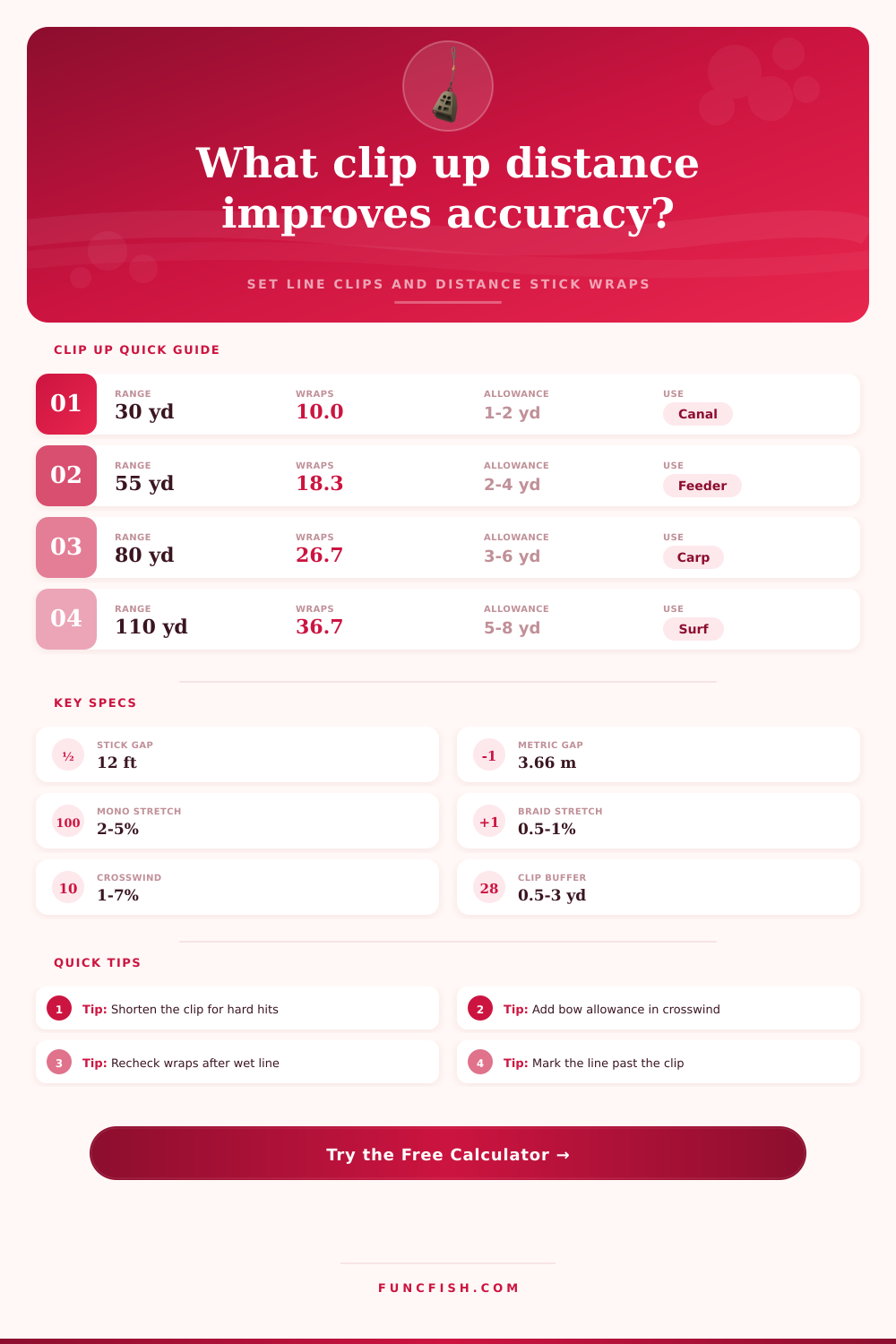
| Target range | 12 ft stick wraps | 3.66 m stick wraps | Typical buffer | Best use |
|---|---|---|---|---|
| 25 yd / 22.9 m | 6.25 wraps | 6.25 wraps | 0.5-1.5 yd | Canal, small lake, waggler |
| 40 yd / 36.6 m | 10.00 wraps | 10.00 wraps | 1-2.5 yd | Commercial feeder, light bomb |
| 60 yd / 54.9 m | 15.00 wraps | 15.00 wraps | 2-4 yd | Open lake feeder or carp |
| 80 yd / 73.2 m | 20.00 wraps | 20.00 wraps | 3-6 yd | Long feeder, carp lead |
| 100 yd / 91.4 m | 25.00 wraps | 25.00 wraps | 4-8 yd | Range carp and surf bait |
| Line type | Stretch model | Bow factor | Clip note | Accuracy effect |
|---|---|---|---|---|
| Thin 8-carrier braid | 0.7% at clip load | 0.7% | Small stretch, needs shock care | Very repeatable in calm air |
| Standard braid | 1.0% at clip load | 1.0% | Good range control | Minor bow in side wind |
| Nylon monofilament | 3.2% at clip load | 1.6% | Shorten for hard clip hits | Soft but less exact |
| Fluorocarbon main line | 2.4% at clip load | 1.4% | Dense line, moderate stretch | Stable below the surface |
| Surf braid and leader | 1.2% at clip load | 1.8% | Allow wave and wind drift | Range repeats, splash varies |
| Casting condition | Range change | Clip adjustment | Feathering cue | Best check |
|---|---|---|---|---|
| Calm open water | Base range | Use calculated wraps | Feather late | Two casts to the same marker |
| Light head wind | Short by 2-5% | Add 0.5-1 wrap | Feather earlier | Watch splash behind float |
| Strong side wind | Drifts 3-8% | Add bow allowance | Rod tip low | Check line angle at clip |
| Heavy feeder | Hard clip hit | Reduce buffer slightly | Feather firmly | Look for bounce-back |
| Soft bomb rig | Stable carry | Use normal buffer | Feather smoothly | Measure first wrap reset |
The calculator estimates line length at the clip. Actual splash-down also depends on release angle, rod recovery, feathering, rig aerodynamics, and how firmly the line meets the clip.
💡Practical clip checks
Clip-up math gives a controlled starting point. Make two casts with the same rig, feather both, then shift the clip by half a wrap if both land short or long.
After the clip is set, mark the line just beyond the reel with elastic marker or a small stop knot. That preserves the range if the clip pops free.
We’ve all been there: you have ’em figured out, yet can’t put the bait in the same spot over and over again. You set the hook and fight the fish up to boat. Then you realize your previous casts were off, too far left, right, long, or short, because you saw the line hit bottom differently each time.
Not bad luck. Bad math.
The Secret to Accurate Fishing Casts
Understanding connection between water’s edge, your reel seat and rod tip makes all the difference between a tight swim and a scattered mess. People often think clip distance is just horizontal measurement. Wrong. In reality, it combines environmental resistance, material physics, and geometry into one number. Now that we know what those variables are, it’s time to experiment with them to understand why they matter when fishing.
First, consider your bank setback. You can stand three feet out from water and make an angle of departure different than if you were to stand 10 feet away. This also affects amount of line released from the reel before you feel tension on clip.
Then there is rod tip height. If you throw a flat cast or a high loop, that will makes a big difference in effective length. This is where the calculator asks for your own set-up instead of making guesses about a standard, common one. Then it take all those variables into consideration and calculates for you so you don’t have to picture yourself standing in muddy water drawing triangles.
Finally there’s the additional wrinkle of line type that most casual anglers fail to consider. While braids don’t stretch much at all, that zero stretch means you get no forgiveness when you whack one hard on a clip. The energy has to go somewhere and will lead to either an overcast or breakage of more fragile rig. On the other hand monofilament absorbs that shock better but adds a degree of uncertainty to your casting length. For example: you think you’re casting 55-yards out, but then the line stretches out another couple as it loads up. That is where line profile comes into play on this calculator. Each line has its own recommended clip setting to make up for this stretch. It’s not necessarily about distance. It’s about consistent performance while under tension.
Then there’s the factor of wind. It will blow the bait at an angle. A consistent cross-wind also keeps the line held high for longer, causing a bow that shortens your cast unless you compensate for it. As the tables on page illustrate, different conditions requires different amounts of buffer. If air is calm, you can get by fine by feathering the clip precisely. When faced with gusty side wind, you must allow extra for the drag on your main line. That’s where measuring saves you and where your gut doesn’t help.
When the wind is blowing across lake and sun is in your face, you won’t feel the slightest bit of difference between stretching the lure out one-half yard versus three yards. Theoretical perfection isn’t as important as practical application. After calculating distance, make two controlled casts to confirm it. Don’t go hog wild on the cast. Ease the line out gently into the clip until it sits where it wants to sit. Mark that position down the line using a stop knot or some form of elastic. That physical marker becomes your backup if the clip slips or the reel mechanism wears. It makes it a repeatable process where you can go in and get ‘er done again.
A lot of anglers don’t realize that wet line doesn’t act like dry line. It will stretch a little bit more easy and run smoother through the guides. Soaking the line then rechecking your wraps is a small habit that pays off enormusly in accuracy.
In conclusion, it’s not so much about power as it is about control when it comes to accurate casts. Every time we make a cast, we’re attempting to recreate an exact mechanical position. Your technique is what adjusts the fine tune while the tool sets us up for success. Don’t guess at where you’ll place your bait. Learn the variables, learn how they work together and let math handle the rest. The next time you feel that familiar soft thud of your clip landing and see your rig fall right where you planned, you’ll know it wasn’t magic. It was simple physics done right.