Current Force on Wader Calculator
Estimate how hard moving water pushes on a standing angler, then compare that load with footwear traction, stance width, tipping moment, and a safer current-speed target.
📌Wading condition presets
⚙Current and wader inputs
Wader force results
Formula breakdown
🥾Footwear traction data
Low reserve when algae or polished stone reduces bite.
Reasonable gravel traction with careful foot placement.
Good contact on firm rock where felt is legal and clean.
Higher shear grip on mixed rock, cobble, and ledges.
🐟Gear and species wading comparison
Light pack, quartered stance, clean gravel, moderate reserve.
Studded soles, staff, colder water, higher force at each step.
Deep pockets and boulders push load toward tipping limits.
Saltwater density and surge raise peak force above steady flow.
Broad sandy flats usually have low force but variable footing.
Broken current adds turbulence around knees and shins.
Discharge pulses can double load faster than footing adjusts.
PFD, boat handling, and oblique stance increase drag area.
📊Reference tables
| Depth band | Typical body contact | Area multiplier | Stability note |
|---|---|---|---|
| Ankle to shin | Boots and lower shins | 0.35 to 0.45 | Usually sliding is more important than tipping. |
| Knee depth | Both lower legs | 0.45 to 0.55 | Force increases quickly on square stances. |
| Thigh depth | Legs plus lower waders | 0.58 to 0.70 | Footing reserve becomes the primary limit. |
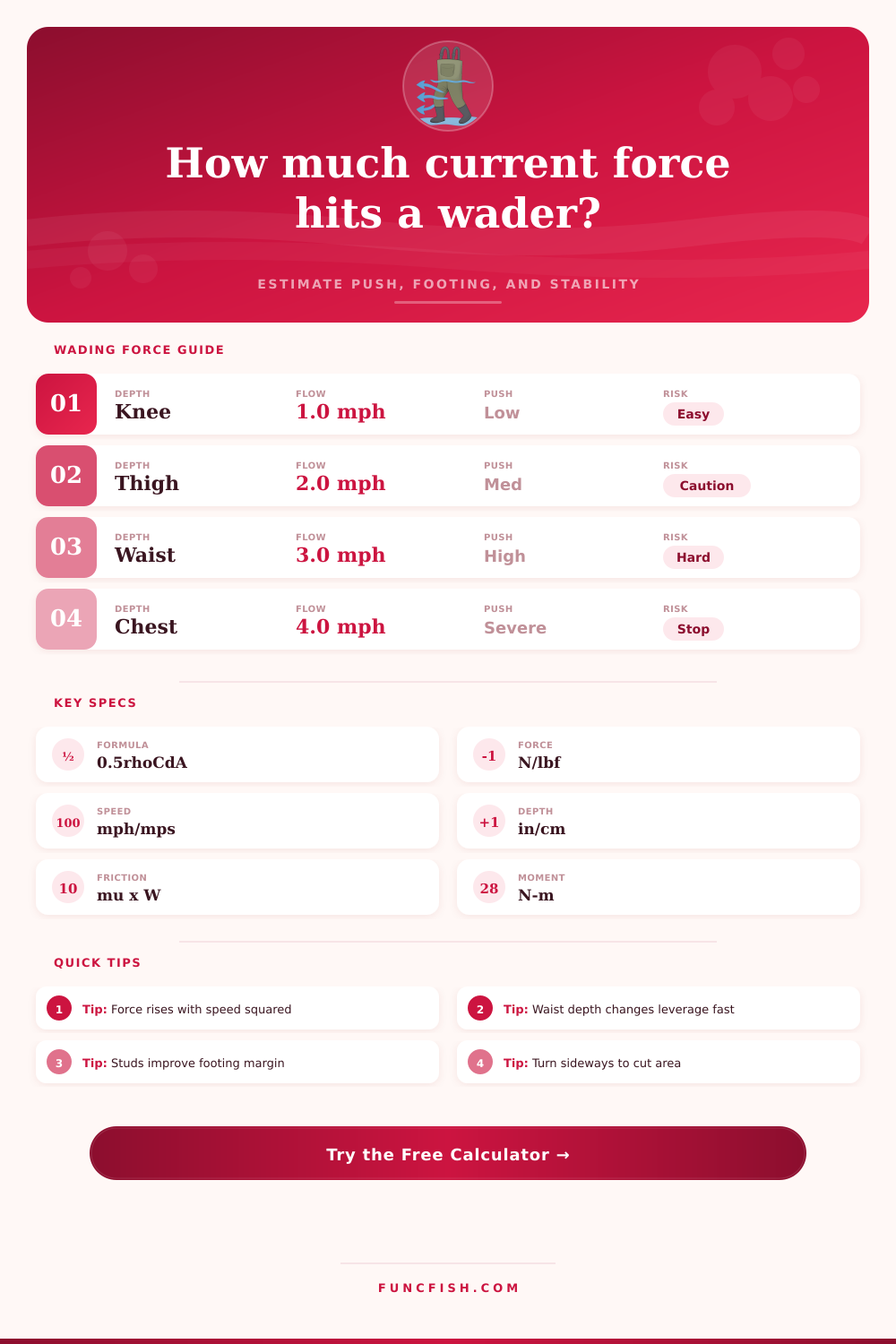
| Waist depth | Legs, hips, jacket hem | 0.72 to 0.88 | Overturning moment rises because force acts higher. |
| Chest depth | Torso and upper clothing | 0.88 to 1.05 | Small speed changes can exceed useful stability margin. |
| Current speed | Equivalent metric | Force behavior | Wading interpretation |
|---|---|---|---|
| 1.0 mph | 0.45 m/s | Reference load | Manageable in most shallow trout riffles. |
| 1.5 mph | 0.67 m/s | 2.25x the 1 mph force | Careful stepping matters at thigh depth. |
| 2.0 mph | 0.89 m/s | 4x the 1 mph force | Waist-depth crossings need strong reserve. |
| 3.0 mph | 1.34 m/s | 9x the 1 mph force | Often too much for deep, square stances. |
| 4.0 mph | 1.79 m/s | 16x the 1 mph force | High hazard unless shallow and firmly braced. |
| Footwear condition | Working grip coefficient | Best bottom match | Calculator use |
|---|---|---|---|
| Rubber on sand | 0.46 | Surf flats and soft bars | Good sliding friction, lower edge bite on rock. |
| Rubber on clean gravel | 0.42 | Rounded gravel and riffles | Baseline for modern rubber wading soles. |
| Felt on clean stone | 0.55 | Firm rock and ledges | Use only where allowed and biologically appropriate. |
| Studded rubber | 0.64 | Cobble, boulder, broken rock | Raises sliding capacity but does not remove tipping risk. |
| Algae-slick rock | 0.28 | Poor match for any sole | Models a sharply reduced grip margin. |
| Fishing scenario | Typical depth | Typical flow | Useful setup |
|---|---|---|---|
| Trout pocket water | 18 to 30 in / 46 to 76 cm | 1.0 to 2.2 mph / 0.45 to 0.98 m/s | Quartered stance, light vest, deliberate steps. |
| Steelhead winter run | 28 to 42 in / 71 to 107 cm | 1.4 to 2.8 mph / 0.63 to 1.25 m/s | Staff, studs, small step length, no loose pack straps. |
| Surf cut for stripers | 20 to 40 in / 51 to 102 cm | Surge 1.5 to 4.0 mph / 0.67 to 1.79 m/s | Side angle, surf belt, watch peak return flow. |
| Tailwater edge | 24 to 48 in / 61 to 122 cm | Release dependent | Recalculate after flow changes or water rises. |
| Flats and bay wading | 8 to 26 in / 20 to 66 cm | 0.3 to 1.5 mph / 0.13 to 0.67 m/s | Sand grip, light load, check channels before crossing. |
💡Calculation notes
Eventually, there comes a moment where you’re moving through the river, and it’s as though you’ve encountered a wall. You wade into a run deep enough to require thigh-high water; you convince yourself you know what’s happening. Your boots aren’t touching riverbed. Your boots have just lost their conversation with bottom. There’s still some kind of friction keeping you upright, but that friction is fading fast.
Here, physics and geometry comes into our discussion, and we learn about velocity squared and projected area. That relationship doesn’t forgive: Double the speed of the current, and the force won’t simply double… It’ll quadruple. A flow that feels manageable at one and a half miles per hour become a serious stability problem at three, even if water level hasn’t changed an inch. After plugging in your gear weight, your stance and your depth, the calculator does math. No need to guess whether your footing hold or is just an illusion.
How to Stay Safe in the River
Most anglers don’t pay enough attention to the body angle they enter. Standing square to current turns your torso into a sail. Turning that quarter turn to the side greatly decreases amount of body area pushing against water. That slight change in body position lead to much less horizontal load.
It is just as important to know how wide you stand. How far apart are your feet? Your stance determine the lever arm that resists tipping. Wider feet equal a longer lever arm, one that counters the overturning force of the water via your body weight.
If you have a heavy vest and daypack on your back while wading, the calculator consider the extra drag area those items provide. Not that they’re dead weight on your back. They’re real surface areas catching flow and increasing your center of gravity a bit, making you more tippy than your bodyweight alone suggest.
Where slippery reality meets theoretical footwear choice: On clean rock, you might have a grip coefficient of 0.68, but the second silt or algae enters the picture, it’s gone. To model this, the tool allows you to pick bottom conditions, slick stone or muddy. This reduces your traction reserve considerabley. Slime compromises the rock-to-sole connection and even good boots won’t help; you’ll still slip out.
Often, more valuable than the big name on your footgear is a quick glance at the bottom before committing your weight. Included with tool is a table showing typical grip numbers for different sole styles, helping you establish a starting point for comparison with what you find in the wild. For instance, it demonstrates how felt soles offers high friction on clean stone, but once littered with debris, they’re a liability. On the other hand, rubber studs works well on cobble and broken rock surfaces, but don’t eliminate the tipping moment if current exceeds your stance width.
“Most people who get knocked down on trips don’t go deep enough to realize how strong they are. A lot of those falls happen in water up to their thighs or knees. Instead of tipping over, you slide. It is the same thing; you lose control.
In shallow water, your feet does all the work to hold you in place. Your feet are doing all the pushing back. In deeper water, the current will grab you higher up and push you. This creates an overturning moment that try to turn you over on your side and rotate you downstream. That’s what makes crossing waist deep water so dicey, even though the speed may be moderate; because now force isn’t near your feet. It’s at some distance from them, and you’re a lever, wanting to rotate.
Turning around is all about wading safety. Knowing when the numbers has turned against you. About understanding the linear limits of friction and the square law of velocity. Trusting that margin between what the calculator says is your safe speed target and what you’re seeing on surface. The water doesn’t know how good of a balancer you think you are. It knows only three things: density, speed, and area.
Keep your footing honest. Get in there low and narrow. And don’t forget, it’s a fluid dynamic system that’s actively trying to move you. Most people would of forgotten that and only focus on catching those fish.