Downrigger Blowback by Speed Calculator
Estimate cable angle, true ball depth, horizontal setback, and extra cable from trolling speed, water movement, downrigger weight, cable type, and terminal drag.
📌Scenario presets
⚙Downrigger and speed inputs
Downrigger blowback estimate
Use these numbers as a starting point, then confirm with probe, sonar, or repeatable fish marks when precision matters.
Full breakdown
📋Downrigger weight and cable reference
Round Ball
Shark Weight
Stainless Cable
Rigger Braid
📊Reference tables
| Common setup | Speed range | Ball range | Likely angle | Planning note |
|---|---|---|---|---|
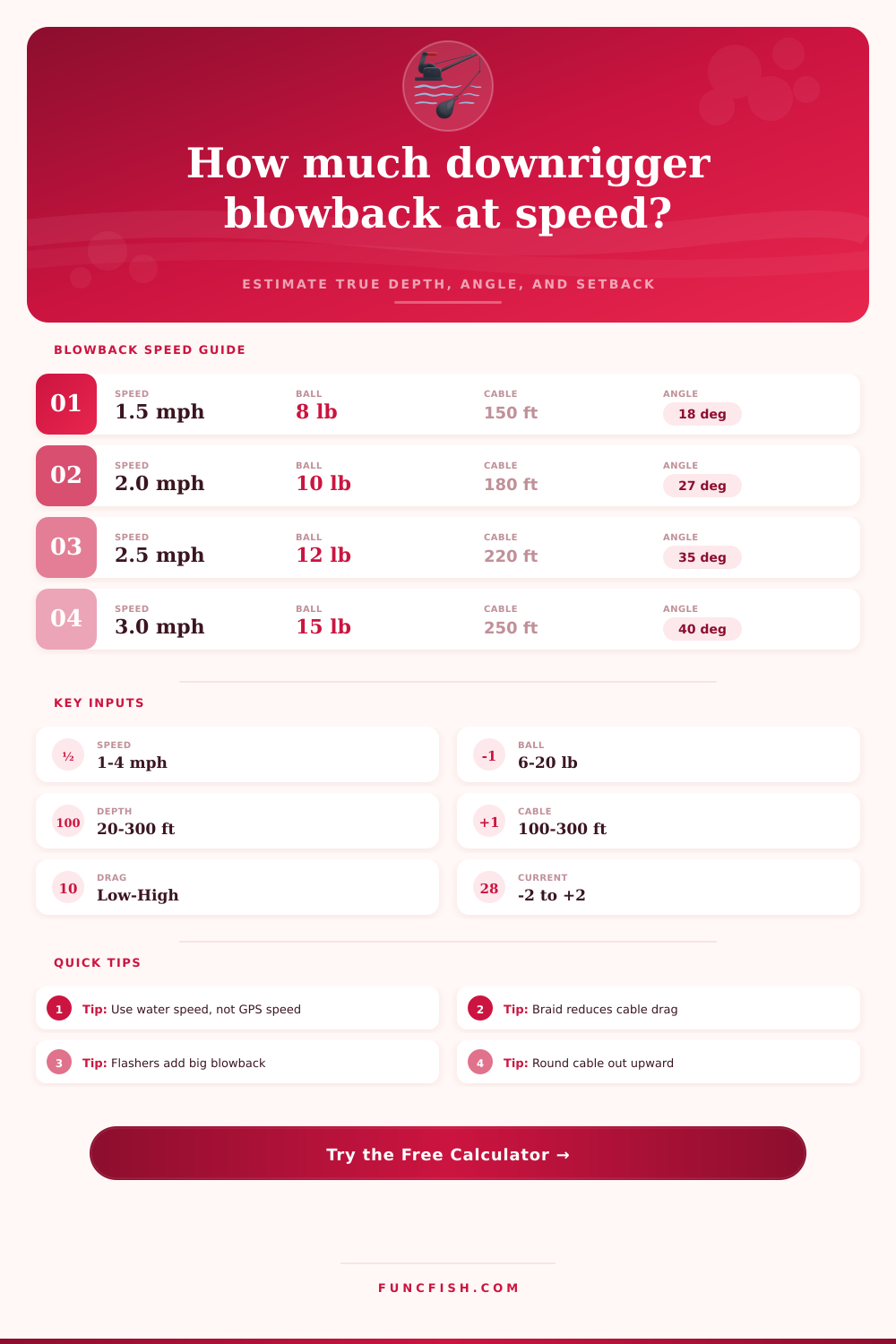
| Kokanee or small trout | 1.1-1.7 mph / 1.8-2.7 km/h | 6-10 lb / 2.7-4.5 kg | 12-24 degrees | Dodgers can add more drag than the lure. |
| Great Lakes salmon spoon | 2.0-2.6 mph / 3.2-4.2 km/h | 10-15 lb / 4.5-6.8 kg | 24-38 degrees | Probe speed is better than GPS when current layers stack. |
| Flasher and fly salmon | 2.2-3.0 mph / 3.5-4.8 km/h | 12-20 lb / 5.4-9.1 kg | 30-46 degrees | Large paddles can pull the cable angle several degrees wider. |
| Deep lake trout | 1.5-2.3 mph / 2.4-3.7 km/h | 12-16 lb / 5.4-7.3 kg | 20-35 degrees | Extra cable rises quickly past 150 ft of target depth. |
| Striped bass umbrella | 2.5-3.5 mph / 4.0-5.6 km/h | 15-20 lb / 6.8-9.1 kg | 34-50 degrees | Spreader rigs need a heavier ball or lower speed. |
| Cable angle | Depth from 100 ft cable | Setback from 100 ft cable | Extra cable for 100 ft depth | Interpretation |
|---|---|---|---|---|
| 15 degrees | 96.6 ft / 29.4 m | 25.9 ft / 7.9 m | 3.5 ft / 1.1 m | Minor blowback. |
| 25 degrees | 90.6 ft / 27.6 m | 42.3 ft / 12.9 m | 10.3 ft / 3.1 m | Typical moderate troll. |
| 35 degrees | 81.9 ft / 25.0 m | 57.4 ft / 17.5 m | 22.1 ft / 6.7 m | Depth loss becomes large. |
| 45 degrees | 70.7 ft / 21.6 m | 70.7 ft / 21.6 m | 41.4 ft / 12.6 m | Heavy drag or speed. |
| 55 degrees | 57.4 ft / 17.5 m | 81.9 ft / 25.0 m | 74.3 ft / 22.6 m | Use heavier weight or slow down. |
💡Calculation notes
Water speed matters: GPS speed can be misleading when current moves opposite or with the boat. Use a probe reading when you have one, or apply the current adjustment field.
Terminal drag matters: Flashers, meat rigs, and umbrella rigs can create enough pull to change true depth even when ball weight and boat speed stay the same.
Blowback is the phenomenon that occurs when a boat is moving through the waters. Blowback causes the downrigger cable and the downrigger weight to angle them in a direction that is opposite of the direction that the boat is moving. As a boat is moving through the water, the water creates drags against the downrigger cable and the downrigger weight.
As a result of the water creating drag against the downrigger gear and cable, the downrigger weight begin to rise higher in the water than the depth that is suggested by the length of the downrigger cable. The angle of the downrigger cable increase if the boat speed increases, if the downrigger weight that is being used is lighter, or if the terminal gear that is attached to the downrigger weight is heavier. The downrigger calculator require a person to input several different factors related to the fishing boat and the fishing gear that is being used.
How Blowback Affects Downrigger Depth
The factors that a person must enter into the downrigger calculator are the speed of the fishing boat, the weight of the downrigger weight, the type of downrigger cable that is being used, and the amount of drag that the terminal gear creates. Each of these factors is required because each of these factors can influence the angle of the downrigger cable. For instance, boat speed is one of the primary factors that influence blowback, but terminal drag is also one of the primary factors that influence blowback.
For example, the addition of a large flasher to the fishing gear can create more drag than the boat creating an additional mile per hour in speed. Similarly, the addition of a thin braid line to the downrigger cable create less drag than a thick stainless steel downrigger cable. Many individuals learn about blowback through the process of trial and error.
For instance, an individual may release 100 feet of downrigger cable while traveling at 2 miles per hour with a downrigger weight that has 12 pounds of weight. In this instance, however, the downrigger weight may land at a depth of only 90 feet due to blowback. If the same boat and downrigger cable setup is used with the addition of a large flasher, though, the downrigger weight may land at an even higher depth within the water column.
Thus, this difference in depth can help to determine whether the fishing lure is within the strike zone or above the strike zone. Thus, by using the downrigger calculator, an individual can determine in advance the relationship between the length of the downrigger cable that is released and the depth at which the downrigger weight will land. Current within the fishing waters can also impact the phenomenon of blowback.
Current can impact the speed at which the water moves past the downrigger gear. If an individual move into a current in the water, for example, the speed of the water increases. As a result of the increased speed of the water, blowback increases as well.
Current that moves into the downrigger gear will cause the angle of the downrigger cable to become tighter. The adjustment for current within the downrigger calculator allow for an individual to adjust for the potential impacts of current in the area where the fishing will occur. Thus, the adjustment for current ensures that the estimated depth of the downrigger weight remain accurate while the fishing boat is moving through areas with moving water.
The reference tables included in the downrigger calculator include examples of the speeds, depths, downrigger weights, and angles for various types of fishing. For instance, the tables include examples of the different angles for setups that fish for kokanee fish, salmon fish, and other fish species. An individual can use these tables to gain an understanding of the relationship between each of these factors, but the tables should not be used as rules for all fishing scenario.
For instance, when fishing for kokanee fish at speeds of 1.4 miles per hour using a downrigger weight that has 8 pounds of weight, the angle of the downrigger gear should typically be 25 degrees or less. In contrast, when fishing for salmon fish at speeds of 2.5 miles per hour with a downrigger weight that has 12 pounds of weight, the angle of the downrigger gear should typically be 35 degrees or more. These examples will help an individual understand the impact of each of these factors on the downrigger gear.
Another factor that can impact blowback is the shape of the downrigger weight. For example, a round downrigger weight, such as a cannonball, will create more drag within the water than a torpedo shaped downrigger weight. The streamlined shape of a torpedo-shaped downrigger weight allow the downrigger weight to move through the water with less resistance than a round downrigger weight.
Because of the way that the drag influences blowback, many anglers choose to use weights that are shaped like sharks or that have fins attached to the weights when they are fishing in deeper waters. The downrigger calculator allows for each of these different shapes to be compared to one another. Terminal gear also create drag within the water, which can impact blowback.
For instance, a small spoon will create less drag within the water than a large flasher. Furthermore, the drag that the terminal gear creates can impact the angle of the downrigger gear. For example, a small amount of drag created by a small spoon may cause the angle of the downrigger gear to change by a few degrees, but a large amount of drag created by a large flashers can impact the angle of the downrigger gear by many degrees.
Thus, while many individuals may believe that the downrigger weight is the only factor that impacts the angle of the downrigger gear, the impact of the terminal gear on that angle is actualy much larger. One of the main uses of the downrigger calculator is to determine how much downrigger cable to use to reach the desired depth. By knowing the expected angle of the downrigger gear, an individual can calculate the length of downrigger cable that should be released from the boat.
Thus, the individual can avoid having to guess at the length of the downrigger cable that should be released from the boat. The downrigger calculator can also be used to estimate the actual depth at which the downrigger gear will land if the individual already know how much downrigger cable is being used. Additionally, the downrigger calculator can estimate the setback of the fishing gear.
The setback is the distance that the lure will be behind the boat. By estimating the setback, an individual can better understand how to avoid having the lines of the fishing gear cross each other. The downrigger calculator provides a theoretical estimate of the depth at which the downrigger gear will land.
The conditions of the water, however, can change the results of the calculation. For instance, chop on the waters surface can impact the downrigger gear in a way that the calculation did not account for. Additionally, the downrigger gear may need to be adjusted due to turns in the water.
Thus, while the downrigger calculator can help to provide an individual with an estimate of the depth of the downrigger gear, the individual will need to make adjustments to the gear based off observations made with the sonar or fishing probe. Thus, the first instance that an individual uses the downrigger gear with a specific amount of downrigger cable released will be used to test the downriggers accuracy. If the depth at which the downrigger gear lands is too shallow, the individual can add more weight to the downrigger gear, use a cable that creates less drag, use terminal gear that creates less drag, or decrease the speed at which the fishing boat is traveling.
If the depth at which the downrigger gear lands is too deep, though, the individual can reduce the weight of the downrigger gear or increase the speed at which the fishing boat is traveling. After a while, though, the individual will become more familiar with how each of these factors can impact the angle of the downrigger gear.