Drop Shot Leader Length Calculator
Estimate the hook-to-sinker leader length, starting range, adjustment step, strike-zone match, and rig balance for finesse drop shot fishing in shallow cover, deep rock, grass, current, and suspended fish.
📌Drop shot presets
⚙Rig and water settings
Use the depth at the cast target or sonar mark, not the boat position if it is drifting.
For bottom-hugging fish, enter the height where you want the bait nose to hover.
Higher angles reduce true vertical bait height, so the calculator adds leader length.
Drop shot leader length forecast
Calculation breakdown
📊Leader system comparison grid
Vertical Sonar
10-20 inBest when marks are tight to bottom and boat control stays nearly vertical.
Cast And Drag
14-30 inExtra leader restores bait height lost to a shallow line angle.
Grass Edge
18-36 inStart above weed tops, then shorten until bites stay clean.
Suspended Fish
30-60 inLong leaders track sonar marks but need careful sinker control.
🧵Leader material data
Light Fluoro
Std Fluoro
Heavy Fluoro
Light Mono
📐Species and height reference
| Species | Common starting leader | Shorten when | Lengthen when | Useful note |
|---|---|---|---|---|
| Largemouth bass | 10-20 in / 25-51 cm | Cold front, dock posts, bottom bites | Grass tops, clear water, suspended bait | Often reacts well to 3-5 in retie steps. |
| Smallmouth bass | 14-28 in / 36-71 cm | Fast current or heavy rock snags | Clear water flats and goby forage | Rock fish usually tolerate a taller bait. |
| Spotted bass | 18-36 in / 46-91 cm | Fish pin bait tight to bottom | Sonar marks show bait above brush | Longer leaders help with suspended schools. |
| Walleye | 16-32 in / 41-81 cm | Current sweeps the rig downstream | Fish hold over clean sand or rock | Use enough sinker to keep the bait steady. |
| Trout | 8-20 in / 20-51 cm | Small pockets and seam edges | Clear pools or fish cruising higher | Fine steps keep the bait in the drift lane. |
| Panfish and perch | 6-18 in / 15-46 cm | Fish peck bait without loading rod | Vegetation or suspended crappie marks | Short leaders improve bite detection. |
🌊Condition adjustment table
| Condition | Typical adjustment | Why it changes length | Check on the water |
|---|---|---|---|
| Clear water and light line | Add 4-10 in / 10-25 cm | Keeps bait above the sinker and farther from bottom disturbance. | Watch if fish follow but do not eat. |
| Stained or low light | Subtract 2-6 in / 5-15 cm | Shorter height improves feel and keeps the bait in the near-bottom zone. | Check for bites during pauses. |
| Grass or soft silt | Add cover height plus 2-8 in | The bait needs to hover above the weed or silt cloud. | Inspect weeds on the hook and weight. |
| Moderate current | Subtract 2-8 in / 5-20 cm | Current bows the line and can lift the bait too far downstream. | Increase weight before adding leader. |
| Long cast pendulum | Add 10-25% | Line angle lowers true vertical bait height. | Keep bottom contact without dragging fast. |
| Suspended sonar marks | Add mark height minus bait rise | The leader should intersect the center of the marked fish band. | Drop to the bottom, then hold steady. |
⚖Sinker and control matching
| Sinker style | Best use | Leader effect | Control note |
|---|---|---|---|
| Cylinder | Rock, gravel, sparse grass | Allows medium to long leaders | Slides through cover with fewer hang-ups. |
| Teardrop | Clean bottom and vertical fishing | Stable with short to medium leaders | Good feel when the rig is held in place. |
| Round ball | Sand, clay, and light current | Works best with shorter leaders | Can wedge in chunk rock on long drags. |
| Pencil grass | Weeds, grass edges, silt | Supports taller leaders over vegetation | Comes through weeds while maintaining contact. |
| Compact tungsten | Deep finesse and sonar use | Improves feel on any length | Smaller profile transmits bottom detail. |
| Heavy cylinder | Current, wind, deep water | Lets you shorten without losing contact | Use when angle is the main problem. |
🔗Line material comparison
| Material | Sink rate | Leader behavior | Best leader window | Tradeoff |
|---|---|---|---|---|
| Light fluorocarbon | Fast | Subtle and direct | 6-24 in / 15-61 cm | Low abrasion margin near rock. |
| Standard fluorocarbon | Fast | Balanced control | 10-32 in / 25-81 cm | Default choice for most bass rigs. |
| Heavy fluorocarbon | Fast | Stiffer hook stand-off | 12-28 in / 30-71 cm | Can dampen tiny baits. |
| Light monofilament | Slow | Softer and slightly buoyant | 8-26 in / 20-66 cm | More stretch in deep water. |
| Braid to fluorocarbon | Mixed | High feel, visible main line | 10-36 in / 25-91 cm | Leader knot must stay above hook area. |
| Ice fluorocarbon | Fast | Cold-stable finesse control | 4-18 in / 10-46 cm | Short windows improve bite detection. |
💡Leader length tips
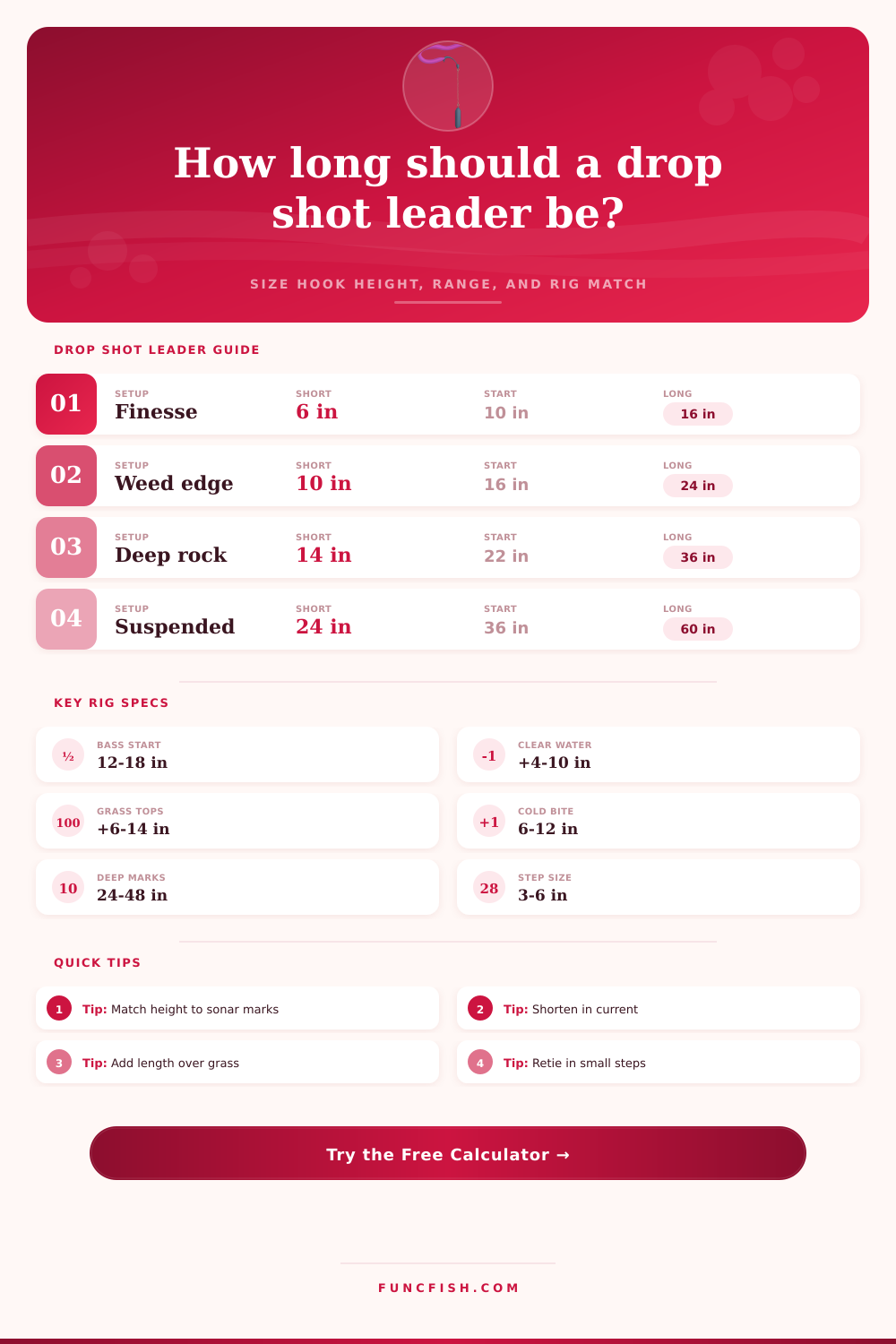
Match the measured height first. If sonar, grass, or rock gives you a real target height, enter that before adjusting for clarity or current. The calculator treats the fish-height entry as the core strike-zone number.
Change one variable at a time. After missed bites, adjust leader length by the suggested step before changing bait, hook, or sinker. That keeps the test tied to bait height instead of rig noise.
A unique sort of frustration comes from drop shot fishing, you sense the bite, your line goes limp… then what? Your bait wasn’t deep enough on the bottom for them to transfer enough energy through there careful little probing flicks. And so they investigates.
The leader you choose isn’t as much about how long as it is about the separation between your offering and the animal’s comfort zone. The closer you get this number correct, the more ghost bites will turn into hooked fish. The calculator above will do the math for you. Just describe your situation, and it calculate the geometry. You won’t have to guess what percentage of your vertical height is lost to the angled line.
How to Choose Leader Length
Leader length changes. It varys based off current, bottom structure, and water clarity. On most casts, when you throw your lure up there, it’s no longer dangling vertically; it’s hanging by itself at an angle from the line that pulled tight when you threw into a rock pile or grass edge. This angles your bait down. So if you have a twenty inch leader tied on the bank and you throw it out forty feet on a day with moderate wind, that bait could be sitting fifteen inches off the bottom. Instead of doing all that trigonometry, which I’m sure we’re all very familiar with, the tool does it for you automatically. Once you input your estimated line angle and depth, it tell you how much extra length to add to your leader or line to make up for the slant. It is a small thing but it is very important on the days when finesse fishing requires accuracy.
So you know which leader length is called for under what conditions. Not from a rule of thumb but how it looks when you see the fish. For example, bass get line shy in gin-clear water because they’re so visual and cautious. If you’re kicking up silt with that sinker and worm is right at their nose, it’s gonna spook ’em every time. But if you increase your leader to four to ten inches the bait stays up off the bottom where it’s out of the disturbed water column. On the other hand, when fish tuck tight to the bottom like during a cold front or on a stained lake, a shortened leader will put offering right in their face while helping you detect those bites better.
To do so, the tool has a series of reference tables that detail these situations based on both the type of cover and species, meaning, for example, you’ll see that while largemouth under docks can holds up to taller offerings, smallmouth bass on rock piles will often accommodate something taller. It’s less about what you think they’re around; it’s more about what they actualy feel comfortable with.
Beyond sink rate and no-stretch, other factors like line material are often overlooked, as fluorocarbon delivers a crisper feel of bottom structure and subtle bite than monofilament. But fluoro does have more density and tends to stiffen up the setup, making it more difficult to fish the bait naturaly if your hook size is really small and your plastic is micro. The calculator will estimate a leader length based off the strength of the line you select, but don’t forget current. It bows the line outward (sideways) and lifts the bait upward. Increasing weight keeps it glued to the bottom, while reducing the leader keep the rig within the strike zone. It’s all about balancing finesse with physics.
The recommended length is a good place to start when you get out there. It’s a baseline for where you want to be based on the conditions you’re fishing. But don’t always assume your size hook is wrong or that you need to change to a different bait if you’re not getting bit. Adjust your leader length in increments of three inches and you’ll be able to pin down the height variable. So try a short one, re-tie and see what happens, then re-tie a longer one and test that. What you’ll often discover is the fish are sitting at a very specific elevation, sometimes just inches away from the sweet spot. And they won’t give a hoot about your bait being moved up or down off that plane.
You should of used the tool as a starting point and use your rod tip and eyes to fill in the blanks. Respect the water color, match the sonar mark and let the leader length bridge the gap between your lure and their instincts.