Drop Shot Weight By Depth Calculator
Estimate drop shot sinker size from fishing depth, current, drift, line diameter, lure drag, bottom contact, sinker shape, cover, and target line angle.
📌Drop shot presets
⚙Rig and water inputs
Leave the value near the selected line diameter, or enter a measured main-line diameter when current bow is the main problem.
Drop shot weight results
Full calculation breakdown
🔗Weight style comparison grid
Round lead ball
Lead cylinder
Tungsten ball
Heavy bell
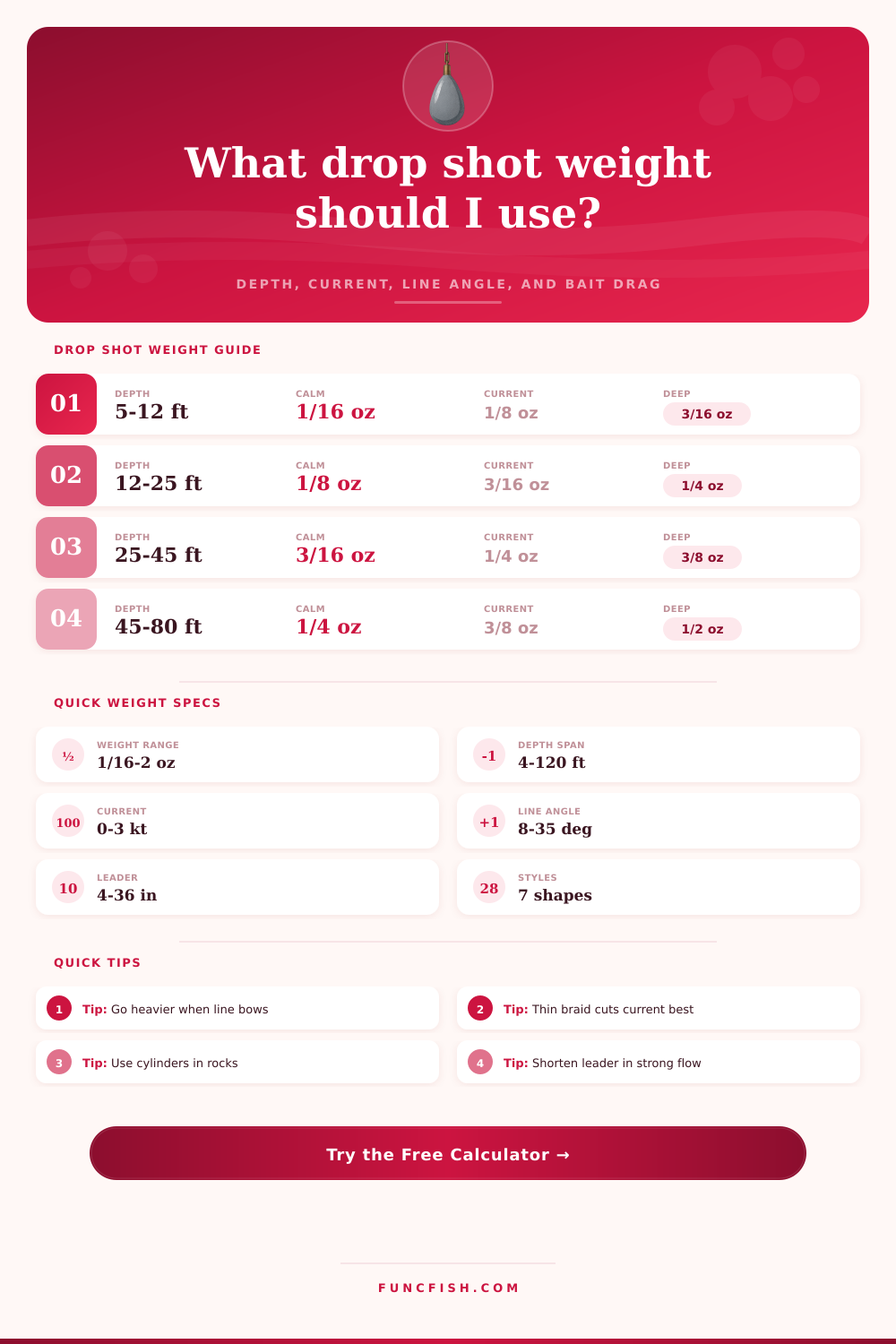
📏Depth and current starting weights
| Fishing depth | Calm vertical drop | Light current or drift | Moderate current | Strong current or wind |
|---|---|---|---|---|
| 4 to 10 ft | 1/16 oz / 1.8 g | 3/32 oz / 2.7 g | 1/8 oz / 3.5 g | 3/16 oz / 5.3 g |
| 10 to 20 ft | 3/32 oz / 2.7 g | 1/8 oz / 3.5 g | 3/16 oz / 5.3 g | 1/4 oz / 7 g |
| 20 to 35 ft | 1/8 oz / 3.5 g | 3/16 oz / 5.3 g | 1/4 oz / 7 g | 3/8 oz / 10.5 g |
| 35 to 55 ft | 3/16 oz / 5.3 g | 1/4 oz / 7 g | 3/8 oz / 10.5 g | 1/2 oz / 14 g |
| 55 to 80 ft | 1/4 oz / 7 g | 3/8 oz / 10.5 g | 1/2 oz / 14 g | 3/4 oz / 21 g |
| 80 to 120 ft | 3/8 oz / 10.5 g | 1/2 oz / 14 g | 3/4 oz / 21 g | 1 oz / 28 g plus |
🧵Line system drag reference
| Line system | Typical diameter | Stretch feel | Current bow | Weight effect |
|---|---|---|---|---|
| 6 lb fluorocarbon | 0.20 mm | Moderate | Medium | Baseline finesse control |
| 8 lb fluorocarbon | 0.24 mm | Moderate | Medium-high | Add weight in depth |
| 6 lb monofilament | 0.23 mm | High | High | Needs more contact mass |
| 8 lb braid to 6 lb fluoro | 0.12 mm | Low | Low | Can fish lighter weights |
| 10 lb braid to 8 lb fluoro | 0.15 mm | Low | Low-medium | Good deep-water control |
| PE 0.8 braid with leader | 0.14 mm | Low | Low | Clean current cut |
🐟Species and presentation matching
| Target pattern | Common depth | Line and bait profile | Weight style | Starting range |
|---|---|---|---|---|
| Largemouth on grass edges | 8 to 18 ft | Fluoro, 4 inch worm | Cylinder or teardrop | 1/8 to 1/4 oz |
| Smallmouth on rock humps | 20 to 55 ft | Braid leader, goby bait | Tungsten cylinder | 3/16 to 1/2 oz |
| Walleye in river seams | 12 to 35 ft | Braid leader, minnow bait | Cylinder or bell | 1/4 to 3/4 oz |
| Perch on deep flats | 35 to 75 ft | Thin braid, small minnow | Round or tungsten ball | 1/4 to 1/2 oz |
| Panfish vertical finesse | 5 to 18 ft | Light mono or fluoro, tiny bait | Finesse pinch | 1/16 to 1/8 oz |
| Spotted bass in tidal water | 10 to 30 ft | Braid leader, shad bait | Teardrop or cylinder | 3/16 to 3/8 oz |
🌊Bottom and snag adjustment table
| Bottom type | Feel through rod | Snag behavior | Preferred shape | Calculator adjustment |
|---|---|---|---|---|
| Sand or clean clay | Soft tick with steady drag | Low hang risk | Ball or teardrop | Baseline contact |
| Gravel and shell | High vibration and taps | Moderate wedge risk | Cylinder or tungsten | Small contact increase |
| Chunk rock | Sharp ticks and stalls | Crack wedge risk | Cylinder or pencil | Lower snag score |
| Sparse grass | Muffled contact | Stems catch round weights | Slim cylinder | Moderate weight increase |
| Brush or dock posts | Hard stop or sudden slack | High hang risk | Finesse pinch | Strong snag warning |
| Soft mud or silt | Dull pull and buried feel | Low snag but poor feedback | Teardrop or ball | Contact boost for feel |
💡Drop shot calculation tips
Depth tip: Add weight when the line angle grows past the target. A heavier sinker keeps the bait closer to the exact depth shown on sonar.
Cover tip: In rock, brush, or grass, shape can matter as much as mass. A slim cylinder often fishes cleaner than a heavier round weight.
It’s frustrating for anglers to be in position around some structure, knowing there are fish nearby but being unable to reach them with confidence. You drop the rig in, watch your line sink and then wait. The bait starts moving side to side as current or wind pull it out of position from where you dropped it. Do I need more weight? Less weight? Am I touching bottom, or am I just brushing against the tops of weeds?
More times than not it has nothing to do with how you’re fishing and everything to do with getting mass of your sinker and the water column resistance figured out. Knowing this math is more important then any cool retrieve pattern you’ve been working on. It’s all about presentation Enter this calculator to make physics easy while letting you focus on the presentation.
How to Use Sinker Weight Calculator
By entering several variables (like current speed, line diameter, sinker mass, leader length, and lure dynamics) which most folks thinks of independently, it produces an overall efficient weight. For the majority, we think about it in terms of depth. “Oh I’m going to fish 20-feet deep, so I need a quarter ounce.” Depth isn’t everything.
Current creates a pull or drag against your line which is force applied to your rig. Your main line needs to be light and cut through water easily without much resistance. That’s what makes lightweight sinker keep you at depth. But if you have a heavy fluorocarbon leader, it will create sail effect. This pulls your bait off station and also dulls your bite feel in current.
This is why calculating with line system as an input is so important. You’re not only fishing a weight; you’re fishing a line with a sinker, leader length and main line exposed to the current. That’s what the tool factors into the equation. It takes into account line angle to vertical.
You need enough weight to offset line bow if you want that sweet ninety-degree drop with the bait hovering right on top of sonar mark. Too great a lean back on the line diminishes your contact feel and you will miss the tentative taps on bottom. The calculator will tell you precisely how much weight to add to maintain tight angle. This guarantees vibration isn’t getting lost in the slack but traveling up the line to the rod tip.
There’s one more wrinkle, bottom composition, and physics simply aren’t enough to describe this variable. If you’re fishing sand, a round lead ball won’t be much of an issue. It’ll sit nicely, provide a good tactile feel, and won’t pose much resistance. Drop the same sphere on gravel or chunky rock, however, and it becomes a snare. It will wedge itself between rocks. This makes a heavier bait even harder to get out of trouble and dulls your feel.
Here again, then, form follows function. While mass remain important, the shape of your sinker play an equally important role. Cylindrical or pencil weights has a lower profile against the current and tend to roll over obstructions instead of getting caught on them. Because they are more streamlined, they may require bit less total weight. This means less water resistance, though you reap big dividends when it comes to clean-up and clarity.
So what’s the most volatile variable of each day? Perhaps it is current speed. Upstream releases or wind can change a morning of calm running water into an afternoon churning mess. And moving water changes your bait profile. A big bulk soft plastic with appendages has lots of drag on it. Just trying to keep it from floating away horizontally will require added weight. Those tiny minnow imitations are neutrally buoyant and slice through the water like a hot knife through butter. Less mass required to sit properly.
The calculator accounts for how those lures work. You will no longer overweight a small bait or underweight a large bait. There’s never one number; it’s about getting a starting point and tweaking from there. Run that formula for your depth and conditions. Then if you’re noticing too much bow in your line, put a little more weight by going up 1/8-ounce. And if you’re snagging each rock but not feeling anything while you’re doing so, then go down to a tighter shape sinker instead of more lead.
Control is key. It should of be heavy enough to hold the bottom and give you feel, yet light enough to allow the fish to steal the bait without resistance. To conclude. Drop shot fishing is a precise game. Patience pays while guessing doesn’t. When you get dialed into your line size, bottom structure and current speed, you work with environment rather than fight against it. The fish stays confused longer, the connection is solid, and the rig never leaves the strike zone. Then, the bite occurs.