Dropper Loop Spacing Calculator
Calculate loop-to-loop spacing, trace span, safe tag length, and hook count for high-low, paternoster, sabiki, and deep-water dropper rigs.
🐟Preset rig scenarios
⚙️Rig inputs
Surf high-low rigs need enough pitch for bait swing during the cast and enough lower margin so the bottom hook does not clip the sinker.
Calculated dropper loop layout
🧵Branch material comparison grid
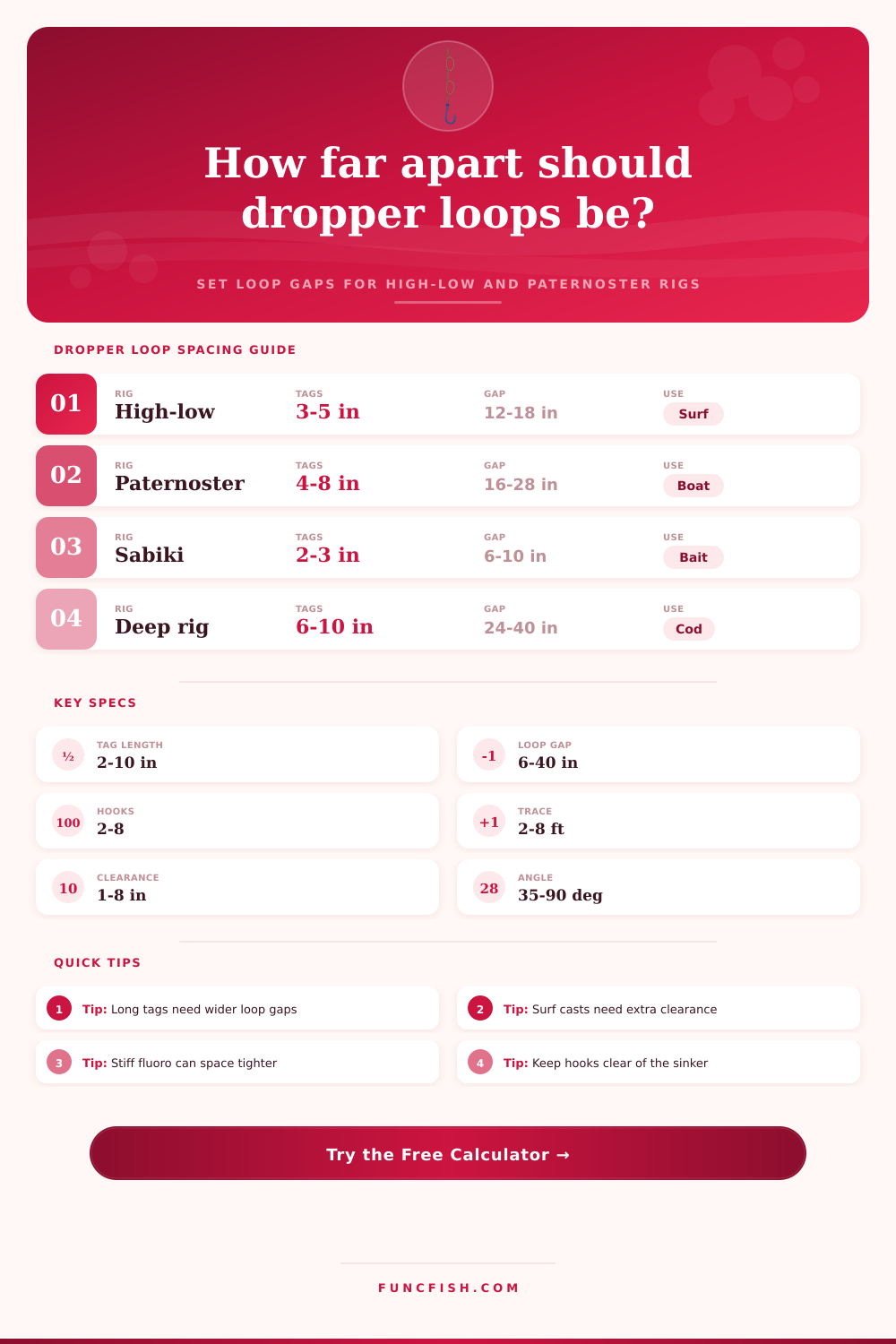
📏Dropper loop spacing reference
| Rig style | Typical tag length | Common loop spacing | Best use |
|---|---|---|---|
| Surf high-low | 3-5 in / 8-13 cm | 12-20 in / 30-51 cm | Two baited hooks cast from beach or jetty |
| Boat paternoster | 4-8 in / 10-20 cm | 16-30 in / 41-76 cm | Vertical bottom fishing with sinker below hooks |
| Sabiki bait rig | 2-3 in / 5-8 cm | 6-10 in / 15-25 cm | Small feathered hooks for baitfish and panfish |
| Catfish Santee | 6-12 in / 15-30 cm | 24-42 in / 61-107 cm | Longer bait swing behind float or leader |
| Deep drop | 6-10 in / 15-25 cm | 24-40 in / 61-102 cm | Heavy leaders, large hooks, and vertical pressure |
| Stream two-dropper | 2-5 in / 5-13 cm | 10-18 in / 25-46 cm | Compact nymph or wet-fly droppers |
🎣Species and gear comparison grid
| Species group | Common branch line | Hook profile | Spacing target |
|---|---|---|---|
| Panfish / baitfish | 4-8 lb / 1.8-3.6 kg | Sabiki or size 8 bait hook | 6-12 in / 15-30 cm |
| Trout / grayling | 4-8 lb / 1.8-3.6 kg | Small wet fly or Aberdeen | 10-18 in / 25-46 cm |
| Surfperch / pompano | 10-20 lb / 4.5-9.1 kg | Baitholder or circle 1/0 | 14-22 in / 36-56 cm |
| Walleye / sauger | 8-15 lb / 3.6-6.8 kg | Octopus or Aberdeen | 14-24 in / 36-61 cm |
| Sea bass / porgy | 20-40 lb / 9.1-18.1 kg | Octopus or baitholder | 18-30 in / 46-76 cm |
| Snapper / reef fish | 30-80 lb / 13.6-36.3 kg | Circle 3/0-8/0 | 24-42 in / 61-107 cm |
🪢Hook, bait, and clearance table
| Hook or bait profile | Estimated hook length | Bait swing allowance | Clearance note |
|---|---|---|---|
| Sabiki fly size 6 | 0.45 in / 1.1 cm | 0.2-0.5 in / 0.5-1.3 cm | Short tags keep the rig compact |
| Baitholder size 8-6 | 0.65 in / 1.7 cm | 0.5-1.0 in / 1.3-2.5 cm | Good for small worm or shrimp pieces |
| Aberdeen size 4-2 | 0.95 in / 2.4 cm | 0.7-1.5 in / 1.8-3.8 cm | Long shank needs extra crossing room |
| Octopus size 1-1/0 | 0.85 in / 2.2 cm | 1.0-2.0 in / 2.5-5.1 cm | Common for bait strips and minnows |
| Circle hook 3/0 | 1.25 in / 3.2 cm | 1.5-3.0 in / 3.8-7.6 cm | Leave room for bait roll in surge |
| Cod hook 8/0 | 2.25 in / 5.7 cm | 2.5-5.0 in / 6.4-12.7 cm | Wide pitch prevents large bait overlap |
🌊Condition adjustment table
| Condition | Multiplier | Spacing effect | When to use it |
|---|---|---|---|
| Calm vertical drop | 0.94x | Shortest practical spacing | Boat, pier, or ice fishing straight below |
| Moderate drift | 1.00x | Baseline spacing | Most paternoster and high-low rigs |
| Surf surge | 1.15x | Adds hook-to-hook room | Beach, jetty, or wash with moving bait |
| Heavy current | 1.28x | Maximum anti-tangle spacing | Rolling sinkers, strong tide, deep flow |
ℹ️Spacing calculation tips
Frustration sets in when you reel up a bird’s nest of knots rather then a set of straight hooks after a miscast. More times than not, it’s not just bad luck. It’s a geometry issue. On paper, dropper loop rigs appear easy; in water, however, it’s all about the right spots. Too near together and your bait will catch one another. Too distant and the rig will lose its straightness making it unwieldy and hard to manage.
The calculator converts unclear rules into real-world numbers based off your own system. How many hooks are there? This is the easy part for most people; I know because it’s the first question I ask anyone asking about their rig design. Generally speaking, two or three hook are common in surf applications, and deeper water rigs might carry more. But that is only part of it.
How to Stop Fishing Lines from Tangling
The second part of the equation is what we call tag length… The distance from the main line to each hook. An eight-inch tag differs greatly from a four-inch tag. A longer tag has a greater swing radius. It requires larger spaces between each loop so they does not overlap. If you ignore this relationship, you are essentially asking for tangles every time you cast or drift. This tool asks you for the tag length that you want and then figures out how far apart the center of each loop should be to ensure that those swinging circles stays separate.
Another point often overlooked is material selection. Braid is flaccid. It has very little structure. This means you have to use larger pitches on your main trace. Braids simply roll into each other easily and resist separation from the current. Harder lines like fluorocarbon or even mono keep their shape better so you can position loops closer together then you would if you were using braid. The calculator accounts for this with a stiffer material factor based on what you select. Selecting braid? You’ll see that it needs a bigger pitch spacing between hooks due to the lack of structure in the branch line. A minor tweak, but it’s the difference between getting a good presentation or a snarl.
So there are these rules on space, but how do you know when to follow them? Well, it depends on water conditions. When the water is calm, the rig falls straight down. Tight spacing may be perfectly acceptable. The bait will hang straight down and remain stationary. But what about the current? That changes things. Current pushes the tags laterally, horizontally. That vertical line becomes a diagonal fan. So if you’ve been tying your loops for still water, guess what? They’re overlapping in the current. Add some side-to-side clearance to make up for the lateral push of current. And then there’s surf. With surf fishing, we face another obstacle: the surge. Each wave that rolls over the rig makes the bait go haywire, swinging from one side to the other. Tight knots won’t combat the ocean’s motion. Give the rig some breathing room. Your water conditions goes into the calculator. The math accounts for strong currents or surges in the surf so it isn’t based on an idealized still tank.
Intensity of casting also plays a role. As that big spool of line unravels off the reel in a power surf cast, there’s massive force placed on the leader. The loops rapidly accelerate and wrap and twist on themselves. Small spacing at rest becomes a failure under launch pressure. The lob cast is more gentle. This allows for tighter tolerances. Knowing this helps you decide how much to trade length for durability. You must also weigh that against the risk of a tangle if you want more bait separation. Some days you’ll just have to go with a longer trace to accommodate all your hooks with some safety clearance. Other times you’ll shorten the tags so the rig remains compact enough to make an effective cast.
On this page, they lay out the typical range for common scenarios in those reference tables. It’s a good way to check what you calculated. If the calculator tells you that your surf pompano rig should be eighteen inches between loops and the table indicates that twelve to twenty is normal, then you know you’re in the ballpark. But don’t just rely on the average. Each angler has his own preference when it comes to hook size and bait presentation. A tiny little sabiki fly takes up less space than a large circle hook. Don’t try to nail down a chart exactly; instead, use it to understand the trade-offs at play here.
There are more hooks for a set amount of length with tighter spacing. There are fewer hooks for a set amount of length with wider spacing. Shorter tags for a fixed number of hooks. Less freedom of movement.
At the end of the day, this all boils down to preparation and controlling the chaos. You can’t know how the current will affect your bait an hour from now. However, you COULD take control of the geometry before leaving the dock. Calculating the proper pitch based on your specific gear takes the guessing out of the knot-tying process. Stop hoping for separation; start engineering it. Your ears hear better silence after a good cast than they do the noise of your knots trying to untangle a mess. Carefully plan the space. Tie those loops confidently. Trust the rig to do its thing.