
Have you had one of those days where you are fishing for a suspended bait and a bass is sitting on top of it but won’t bite? You twitch it, drag it, give it a pause and still nothing. It sees it but doesn’t want it. More times than not this isn’t a skill issue but more of a gear issue.
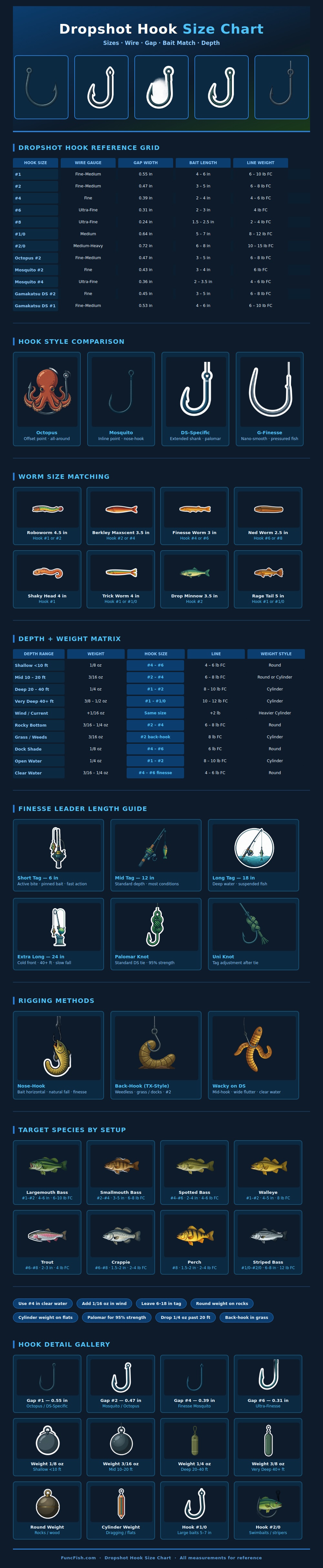
The drop shot rig are very sensitive to your choice of gear. If your hook is too big it will sink fast which kills the finesse fall. Too small and even a good run by a big bass could cause it to flex. This is why we have the chart. “Suspension is key for the dropshot; your bait has to suspend in a certain position while hanging there. It can’t sink to the bottom and get stuck in the muck, and if you have too big of a hook or a tiny little worm on an oversized hook, then that bait slides around and looks funny.”
How to Choose the Right Drop Shot Hook
Find out which hooks works with which baits. So when pairing a hook and bait together, they must be equally sized. For instance, putting a big hook on a small bait won’t work because the bait won’t stay on the hook proper, nor will a giant swimbait fit on a tiny hook. And of course, all those combinations are explained well by this visual reference where you don’t have to guess if a four inch worm is going on a number two hook or not. Because if it’s paired correctly, the bait hangs suspended naturaly, not forced. You’ll want your worm to hang.
Your selection is also based off fish pressure and water clarity. Clear water means wary bass pick apart any shadow they see, so you want as light a wire as possible. The ultra-fine wire give them an even smaller profile that cuts through the water with less disturbance and appears more attractive to the eye. Downgrading your hook size from say a two to a four or even a six when fishing gets tough can open up bites. So the small details of having an ultra fine wire profile is something we highlight in the infographic so you know exactly what you’re tying on.
The other factor that weighs into the decision is depth. In shallow water, you can get by with lighter line, smaller hooks and don’t need much weight. As you dive below twenty feet, gravity starts to be an issue. You want to counter the wind and current by using more weight to help maintain your position. This adds another layer of stress to the system which calls for a beefier hook to ensure your knot stays solid. The top half of graphic shows heavier hooks in deep water.
The hook is only half the battle. Knot selection are equally important. A Palomar knot holds up better on fluorocarbon leaders than a uni knot does. In this style of fishing, every bit of knot strength matter when you are playing fish from a distance.
The drop shot allows you to have a 6-18 inch tag between your hook and weight where you can keep the weight secured and let the bait move freely. Shorten or lengthen your tag depending on whether the bite is fast or more deliberate. No one size fits all when it comes to fishing, you need to adapt your rig for the time of year and body of water.
The chart is a starting point but trust your gut on the last tweak. Begin with the suggested weight and bait size and tweak from there according to the response from fish. If they won’t hit it, go lighter or smaller. If you lose some fish, try being more aggressive. Match the hook to the moment not just the menu.
Present naturaly and tie good knots. Always have a few alternatives in your hands. You should of get the hook right and the rest falls into place.