
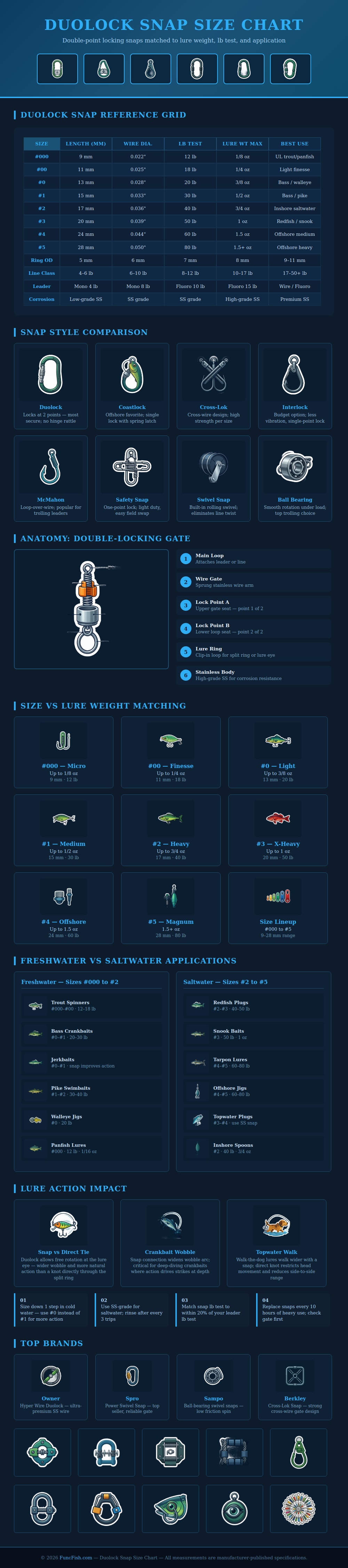
To keep your lures tied on, double-point locking snaps reinforces the connection point. With regular snaps, you’ve got one point of failure. These has backup parts built in. When a fish bites, knowing what they do will help hold your lures in place.
Snap sizing is shown in chart from small for trout lures to heavy duty for offshore fish. Rather than using biggest snap just because it’s there, find the correct size for what you are doing. For instance, a #000 snap (rated up to 12 pound test) measure a mere nine millimeters. Though tiny in overall length, it provides good frame for more dainty panfish lures. Bulky snaps is a turnoff for a lot of presentations. We like ’em big in our hands but that’s not always the best fit.
Why Choosing the Right Fishing Snaps Matters
The snap chart also displays relationship between lure weight and both wire size and length. Note the progression. Anglers often chooses a bigger snap for a finesse offering because it “feels right” in their hand. Wrong! Too much bulk hinders lure movement and dampens vibration which kills action that gets bit.
The weak part of most snaps are the hinge. A classic snap gate pivots on one spot. Repeated use or saltwater corrosion will eventually weaken pivot point. Duolock style snaps disperse the load between two different lock locations. The bottom hook bend locks into lower loop. There’s also a lockup on the upper gate seat. Basically you have a block against force rather than just flexing latch. It’s like replacing a loose connection with something more moddern. The diagram shows how the wire arm grabs both top and bottom seats. So if a bass swims sideways on your lure in the weeds, it’s staying put.
Size matter just as much as material selection. For salt water applications only stainless steel and higher grades will do, which have good resistance to pitting. In freshwater, you can get away with regular stainless steel snaps. However, cleaning your equipment after each outing realy lengthens their lifespan. The chart helps with determining correct size based off the environment, such as a walleye creek or perhaps a redfish flat. It gives you both the tensile strength required as well as the correct corrosion resistance. Don’t scrimp here; a corroded snap is still a weak snap, no matter what it’s rated for.
According to the reference section, you should of match your snap size to your line class. Small snaps is used with thin line, while large snaps will balance heavy diameter lines such as braid or fluoro. Going back to my example of using 4-pound mono when targeting light trout, a huge snap for offshore fishing would sink the bait and change its depth characteristic. And if you’re using a heavy leader like fluorocarbon, make sure your snap can handle stiff resistance of the line without bending during hookset. It is a fine balance between being subtle and being more durabel than you think.
Snaps are certainly not one-size-fits-all items and anglers shouldn’t consider them disposable afterthoughts. Check the action of the gate prior to each outing. If it’s loose or gritty, swap it out at once. If the spring is worn, the lock won’t seat correctly and what was once a double-lock snaps back into a single-point failure. This visual reminder shows that even heavy duty hardware have its limitations. After about ten hours of hardcore use, replace the snaps. Particularly when fighting big ones.
Fishing is an art; a game of trust with nature, that trust gets shattered when your tackle lets you down just when you need it most. The right snap size doesn’t matter as much as your ability and line strength, which should connect you to the catch. Go strong when necessary, start small if necessary. Always check that gate twice. This simple ritual means more fish is kept.