
Ever join a couple section of a high-end fishing rod? Hear it lock into place? That snap, a distinct click indicating everything lined up right, is what separates confidence in your tool from uncertainty. And for multi-piece rods, those joints called ferrules are essential to the process but often forgotten until failure occur. Knowing about ’em will transform your rod building, buying and care.
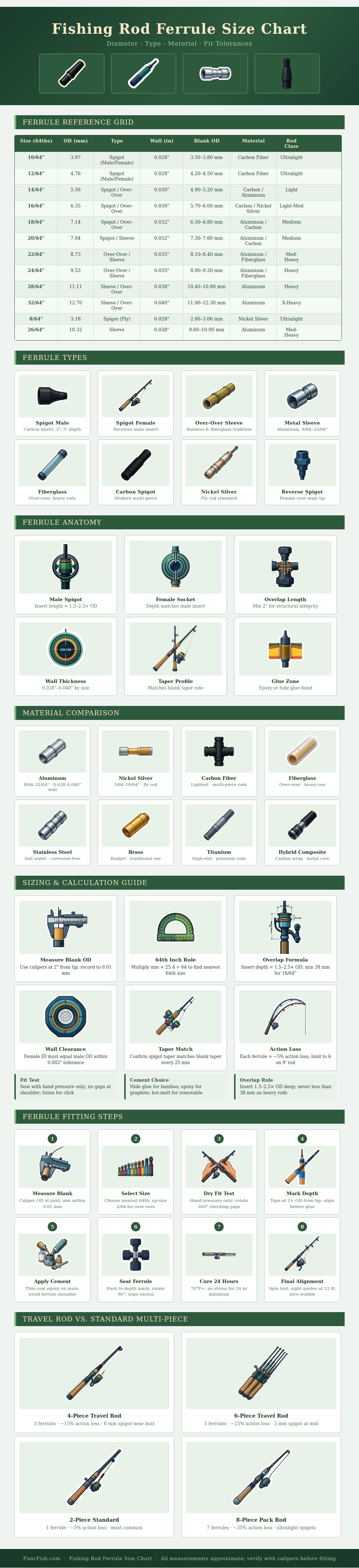
Performance depend on material and size. At the ultralight end of the range, a small rod will use carbon fiber spigots due to their strength relative to weight. Middle weight rods feature nickel silver and aluminum as they can absorbs more stress and weigh less. Sleeves and overlap joints is used in heavier rods, where wall thickness are increased to keep the joint from collapsing under the load. Wall thickness goes up from light to extra-heavys on this chart, so if you think your heavy trout rod’s spigot is flimsy, it just doesn’t have enough wall thickness to support that amount of force. That’s what it’s designed for.
Understanding Fishing Rod Ferrules
Durability, feel, and strength are all related to material selection. For ultra-sensitive tip sections, carbon fiber is the lightest but it’s brittle so avoid overtightening it. For most medium duty applications aluminum provide a good blend of strength and weight reduction. The old standby nickel silver resists wear in assembly, seals beautifully with hide glue, and is still used on most fly rods. And stainless steel is uncommon but great for saltwater use where corrosion ruins less expensive alloys fastly.
This is where many custom builds fail in regards to sizing. You don’t get to guess on these sizes. A sixteenth off, or even an eighth can be the difference between a rock solid joint and one that may jam or wobble. At this level, precision counts so use calipers not a tape measure to get an exact measurement of the OD of your blank. Then simply convert that to determine what standard ferrule would work best. If it is too large, you run the risk of cracking your blank when inserting it. Undersize and you’ll end up with a loose joint. It’s a tight tolerance game and mistakes typically result in losing the section of rod.
Most builders also fail to consider depth of overlap. If it’s too shallow, your connection will be a weak spot in the rod and likely break with first instance of big fish load. As a good rule of thumb, you should of embed the male spigot at least 1 ½ times his diameter into the female socket. The deeper the better especially for thicker rods. More overlap means more stress is spread out over a larger surface area. In other words, the joint becomes part of the rod and not a potential separate weak spot. Proper overlap hold the structure together.
There are compromises with travel rods too. The more pieces a rod has, the less sensitive it is and the more points there is where something could fail. So a two piece rod has one joint and action loss will be kept to a minimum. An 8-piece pack rod has 7 joints, which can deaden vibration and make it harder to feel subtle bites. But most anglers find that having to carry it in a back pack is worth a little compromise on performance. Pure sensitivity versus accessibility when you need to take it on an airplane and carry it around. It is a valid tradeoff if it gets you fishing more.
The bottom line is that a quality ferrule shouldn’t be something you’re even thinking about during your day on the water. If applied properly, it is just supposed to feel like one seamless fiberglass or graphite rod. Measure appropriately and use the right material for the fish you’re targeting. Make sure there is enough overlap, and you’ll get that nice click that tells you you did it right, just like when you pull a new rod out of its packaging.