Fishing Rod Butt Diameter Calculator
Estimate blank butt outside diameter, grip core ID, reel seat bore, rear handle circumference, and taper reserve from rod length, line class, drag, blank family, and fishing style.
📌Scenario presets
⚙Rod blank and handle inputs
Use the measurement point where the rear of the reel seat or front of the rear grip will sit. For a butt cap or gimbal, use 0.
Rod butt diameter estimate
Calculation breakdown
📊Blank family reference
High Graphite
Composite
Surf Graphite
Offshore
📏Reel seat and grip sizing tables
| Seat size | Common bore range | Typical blank OD | Rod examples |
|---|---|---|---|
| Size 16 | 15.0-16.5 mm | 6-11 mm with arbors | Trout, finesse bass, light spinning |
| Size 17 | 16.5-17.5 mm | 9-13 mm | Medium spinning, light casting |
| Size 18 | 17.5-18.8 mm | 11-15 mm | Bass casting, walleye, inshore |
| Size 20 | 19.0-20.8 mm | 14-18 mm | Heavy bass, catfish, light surf |
| Size 22 | 21.0-22.8 mm | 17-21 mm | Surf, pike, salmon, boat rods |
| Size 24 | 23.0-24.8 mm | 20-24 mm | Heavy surf, trolling, offshore |
| Size 26 | 25.0-27.0 mm | 23-27 mm | Stand-up, heavy boat, gimbal rods |
| Size 30 | 29.0-31.5 mm | 27-32 mm | Big game, bent-butt, roller rods |
| Grip material | Ream clearance | Finished OD guide | Best use |
|---|---|---|---|
| Cork rings | 0.2-0.4 mm | 20-28 mm | Fly, trout, bass, walleye |
| EVA foam | 0.4-0.8 mm | 22-34 mm | Spinning, casting, inshore |
| Carbon sleeve | 0.5-0.9 mm | 22-32 mm | Light, crisp custom handles |
| Heat shrink | 0.8-1.4 mm | 24-38 mm | Surf, boat, saltwater rods |
| Hypalon | 0.8-1.5 mm | 28-42 mm | Offshore and heavy trolling |
| Gimbal butt | 1.0-2.0 mm | 25-38 mm | Stand-up and fighting belt rods |
🐟Species and power reference
| Rod class | Line range | Drag range | Butt OD guide |
|---|---|---|---|
| Ultralight panfish | 2-6 lb / 1-3 kg | 0.5-2 lb / 0.2-0.9 kg | 6-8 mm / 0.24-0.31 in |
| Trout and finesse bass | 4-10 lb / 2-5 kg | 1-3 lb / 0.5-1.4 kg | 7-10 mm / 0.28-0.39 in |
| General bass and walleye | 8-17 lb / 4-8 kg | 2-6 lb / 0.9-2.7 kg | 10-14 mm / 0.39-0.55 in |
| Heavy bass, pike, catfish | 17-40 lb / 8-18 kg | 5-12 lb / 2-5 kg | 14-20 mm / 0.55-0.79 in |
| Surf casting | 20-50 lb / 9-23 kg | 6-15 lb / 3-7 kg | 18-28 mm / 0.71-1.10 in |
| Offshore trolling | 30-80 lb / 14-36 kg | 10-28 lb / 5-13 kg | 22-34 mm / 0.87-1.34 in |
| Blank family | Taper rate | Reserve behavior | Component note |
|---|---|---|---|
| High-modulus graphite | 1.25-1.60 mm/ft | Thin and crisp | Often needs seat arbors |
| Mid-modulus graphite | 1.45-1.85 mm/ft | Balanced wall | Common size 16-18 seats |
| Graphite composite | 1.65-2.20 mm/ft | More crush reserve | Check grip ID before reaming |
| S-glass | 1.80-2.40 mm/ft | Durable and flexible | Usually larger rear grips |
| Surf graphite | 1.85-2.55 mm/ft | Shock casting reserve | Long handles often use 22-30 seats |
| Offshore composite | 2.20-3.10 mm/ft | High lift reserve | Gimbals need extra bore clearance |
Builder note: Blank catalogs often list butt diameter at the very rear. If your reel seat sits 8-14 inches forward, the blank can be 1-3 mm smaller at that exact component position.
Fit note: A reel seat bore that is much larger than the blank is not automatically wrong. Use arbors or tape bushings when the gap is even and the blank is centered.
Getting the butt diameters of your rod components correct is a necessary step in the process of building a rod. The butt diameter of the components have a bearing on whether the components will correctly fit onto the rod blank or whether the components will fight against the rod blank. For example, the rod blank must be able to carry the load that is applied to it without the reel seat crushing the rod blank, the grip must ream cleanly onto the rod blank to ensure that it does not spin later when casting, and the rod builders hand must be balanced in the rear handle so that the rear handle does not feel bulky or weak when gripping the rod.
If the butt diameter of the components are not correct, extra epoxy may have to be used to ensure proper fit of the components on the rod blank, or you may have to force the reel seat onto the rod blank. In either instance, forcing the reel seat onto the rod blank may result in the rod blank becoming out of round. The butt diameter calculator will perform the mathematical calculations for you once you enter your specific inputs.
How to Calculate Butt Diameter for Your Fishing Rod
These inputs will include the length of your rod, the line class that you will use in the rod, the drag that you want to use in the rod, the family of rod blank that you will use, and the specific location along the rod blank (in inches) where either the reel seat or rear grip will be located. Each of these inputs will have a bearing on the calculated butt diameter of the components. For instance, the diameter of a seven-foot medium spinning rod measured nine inches from the butt is going to differ than that of an eleven-foot surf rod measured twenty-seven inches from the butt.
Each of these rods has different tapers and drag loads that will impact the butt diameter calculation. Factors that will impact the butt diameter of the rod include the power of the rod and the material of the rod blank. For instance, high-modulus graphite blanks will have a smaller diameter than E-glass trolling rod blanks due to the fact that the high-modulus graphite blanks will begin thinner and have more aggressive tapers.
The type of fish that you will target with the rod will also impact the required thickness of the rod blank. For instance, a pike rod will have more wall thickness to the blank than a trout rod because the pike rod may need to pull fish out of weeds, but the trout rod doesnt have to exert those same forces. The condition in which the rod will be used will impact the required diameter, as well.
For instance, a rod that is to be used in rocky jetty areas may require a different diameter than a rod that is to be used in a lake with no rocks. These factors will change the calculated butt diameter, which in turn will change the size of the reel seat that you will have to use with the rod. The style of the handle will impact the diameter of the grip that will be used.
For instance, cork rings will have a tighter fit to the rod blank than EVA foam rings. Additionally, long surf rods will have a different diameter to the grip than a rod that has a gimbal butt. These differences in diameter are accounted for in the calculation of the internal diameter of the grip and the finished circumference of the grip.
The butt diameter calculator will also provide an output that tells you the reserve rating of the rod. The reserve rating will tell you whether the butt section of the rod blank can handle the drag that will be applied to the rod after subtracting the drag that is accounted for in the rod and the shock loads that may act upon the rod when fishing. While it may seem to most rod builders that the ranges of butt diameters for certain types of rods are standard throughout the industry, these ranges are only starting points.
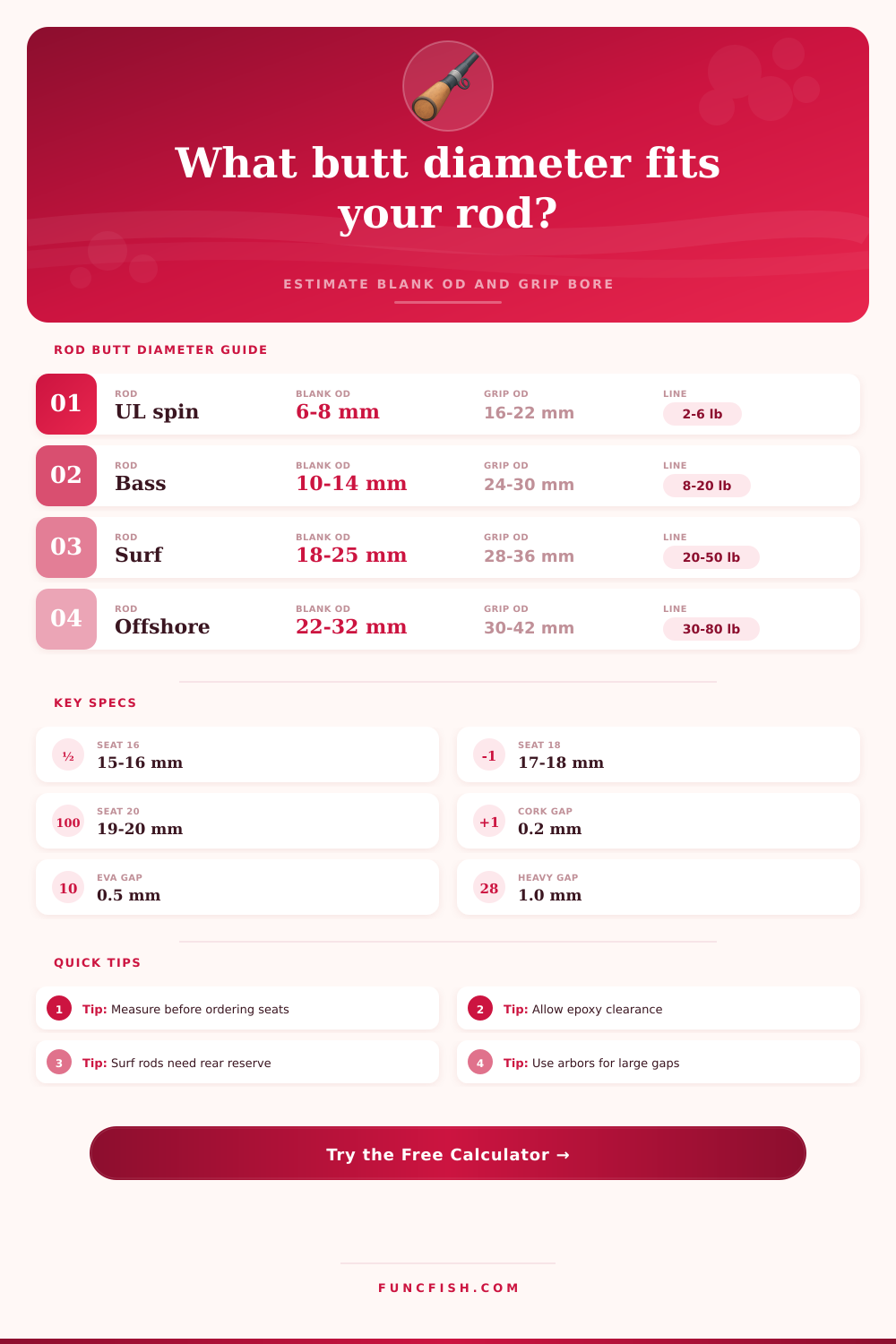
For instance, ultralight spinning rods may have a butt diameter that ranges from six to eight millimeters, but bass rods may range from ten to fourteen millimeters in diameter. Surf rods and offshore rods tend to have a butt diameter that is twenty millimeters or larger in diameter. These ranges are not rules that cannot be broken, however.
For instance, the diameter of a surf rod that is designed for long casts may be different than that of a rod that is to be used in a short boat rod, even if each rod is using the same line class. Small decisions may cause your rod build to fail, and some of those small decisions may not even be considered by most rod builders. For instance, it is possible that your measurement point for the butt diameter of the rod components may be incorrect, or you may have ignored the need to provide clearance for the components to account for heavy saltwater fishing conditions.
It is also possible that you may have made a mistake in assuming that the diameter of the rod components catalog is the same as the diameter where the reel seat will be located. However, by utilizing the butt diameter calculator, you must make these decisions prior to ordering the components that will be used in your rod build. By making these decisions prior to purchasing the rod components, you will save yourself time later in the build process if fixing these mistakes.