Fish Activity Level Index Calculator
Score water temperature, oxygen, pressure trend, light, clarity, forage, fishing pressure, and current to estimate the day's feeding mood.
🎯Scenario presets
⚙Activity inputs
Activity forecast
Formula breakdown
📊Gear and species comparison grid
Bass
Trout
Walleye
Redfish
📋Activity index bands
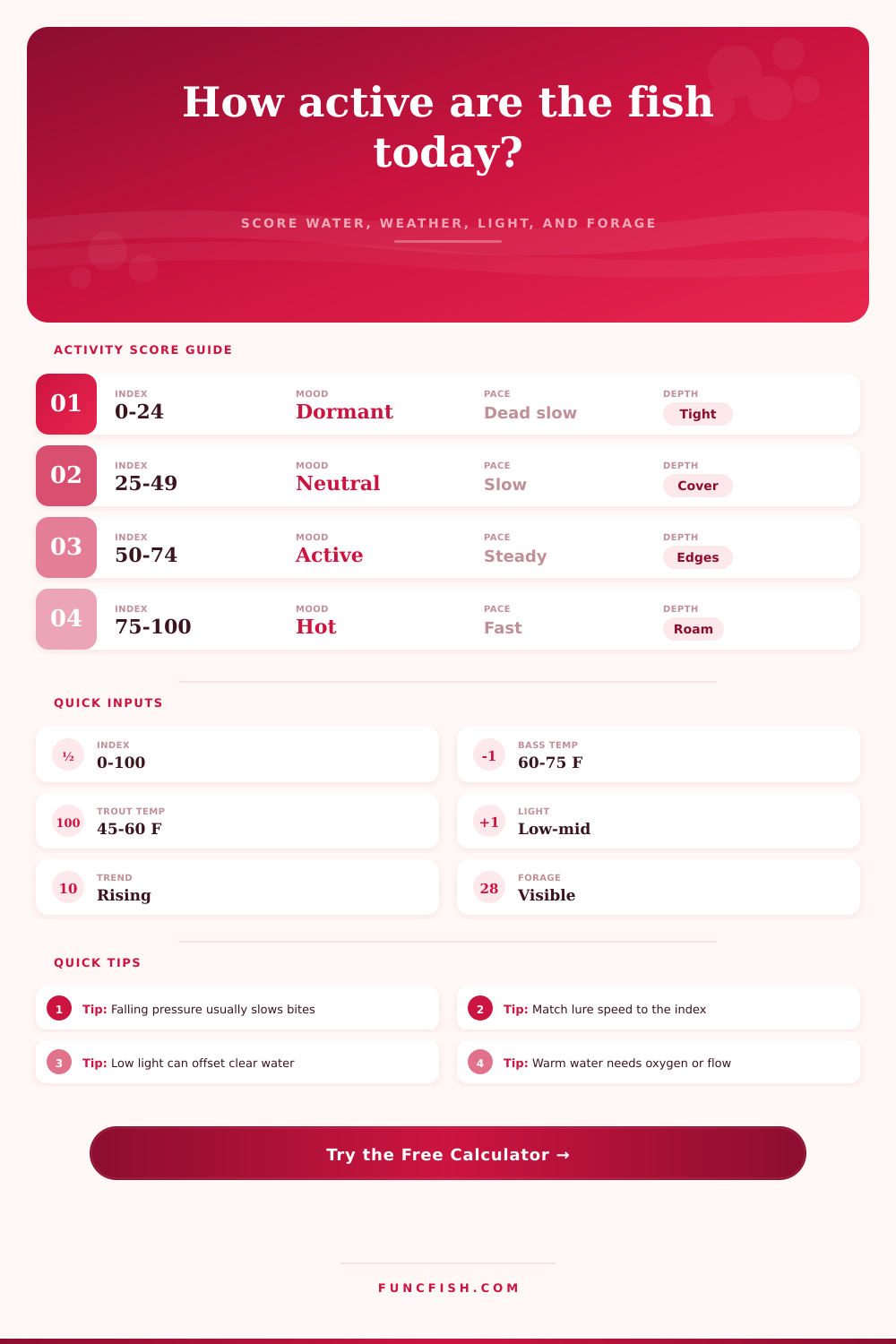
| Index range | Fish mood | Best presentation | Common adjustment |
|---|---|---|---|
| 0-24 | Dormant or shocked | Soak bait or dead-stick | Tight to bottom, shade, or cover |
| 25-49 | Negative to neutral | Slow crawls, pauses, short drifts | Downsize, use natural colors |
| 50-74 | Active feeding windows | Steady retrieve, jig, drift, or troll | Fish edges and current breaks |
| 75-100 | Aggressive and roaming | Cover water with reaction baits | Search wider and speed up |
🌡Species temperature references
| Species | Comfort zone | Prime activity | Cold or heat warning |
|---|---|---|---|
| Largemouth bass | 55-82°F / 13-28°C | 62-75°F / 17-24°C | Slow below 50°F or above 86°F |
| Trout | 40-68°F / 4-20°C | 48-58°F / 9-14°C | Stress rises above 68°F |
| Walleye | 45-75°F / 7-24°C | 55-68°F / 13-20°C | Bright heat pushes them deeper |
| Catfish | 58-88°F / 14-31°C | 70-84°F / 21-29°C | Needs oxygen in warm water |
| Pike and musky | 45-72°F / 7-22°C | 52-65°F / 11-18°C | Handle cold better than heat |
| Redfish and striped bass | 55-82°F / 13-28°C | 62-76°F / 17-24°C | Tide and bait can outweigh small temp gaps |
🌬Weather and water modifiers
| Condition | Index effect | Why it matters | Presentation cue |
|---|---|---|---|
| Pre-front slow pressure drop | Positive | Often encourages short feeding bursts | Move faster until bites fade |
| Fast pressure fall | Negative | Can scatter bait and make fish unsettled | Fish cover, slow down |
| Dawn, dusk, or overcast | Positive | Predators feed with less light penalty | Use moving baits near edges |
| Post-front blue sky | Negative | Fish often pin tighter to structure | Go vertical or finesse |
| Moderate wind or current | Positive | Positions bait and improves oxygen | Cast into seams and breaks |
🎣Index to gear matching table
| Activity band | Line and leader feel | Lure or bait size | Rod action choice |
|---|---|---|---|
| Low, 0-24 | Light, subtle, low visibility | Small or natural profile | Moderate or soft tip |
| Fair, 25-49 | Normal strength, longer leader | One size down from search bait | Medium with controlled cadence |
| Good, 50-74 | Match cover and expected fish size | Standard profile for the species | Medium to medium-heavy |
| Hot, 75-100 | Stronger line for reaction strikes | Full-size or noisy profile | Fast enough for solid hooksets |
The calculator estimates behavior from fishing-relevant signals. Local forage, exact water body, and recent pressure can move the result.
💡Calculation tips
Tip: Treat the index as a presentation guide. A score in the 40s does not mean fish cannot be caught; it means accuracy, slower cadence, and tighter target selection matter more.
Tip: If temperature is excellent but oxygen is poor, favor moving water, wind-blown banks, shade, vegetation edges, or surf wash before changing lures.
Have you ever been fishing on the shoreline or on a boat deck and asked yourself “why aren’t the fish biting?”. Everything seems to check out; the temperature is right, the water is good, etc. But it never happen. Usually we get frustrated because there’s something unseen. It is something that changes constantly. It’s called the activity level.
The activity level can be measured in terms of forage, oxygen, pressure, and light, which all combine to create a changing situation. Know how those variable line up on a particular day and you’re not fighting against luck. Essentially, this calculator takes all those signals into account and weighs them to give one score, which then tells you what the fish are most likely doing at the present time. Based off water clarity and barometric trends, it eliminates any guesswork and predicts that the fish will be either hot, active, neutral or dormant.
How to Use the Fishing Activity Calculator
Why’s that important? It prevents you from throwing a reaction bait if the fish is dormant. You can adjust your expectations before ever casting your first line.
It starts with temperature, that’s the most obvious place. But that’s not always everything. Sure a largemouth bass might feel right at home in water ranging from 65-75 degrees Fahrenheit, but he won’t eat if there isn’t much oxygen. Or maybe the water is just so clear that he won’t come out in bright sunlight during the day. To account for this, the tool lets you put down the oxygen level and clarity of the water. And those factors matter just as much as, or even more than, the water temperature.
In clear water with high pressure, they gets spooky and shallow. And in stained water with bright sunny days they can move around in the open. The calculator will mix all this up for you. But that changes when the light changes. For instance, walleye and even striped bass will feed heavily in low light conditions. They’re more comfortabley getting closer to food in early morning hours, late evening hours and on cloudy days. That’s why the recommended retrieve speeds adjusts accordingly in the reference tables.
If the index is low (the fish are negative or neutral), then slow things down. A hard retrieve usually won’t work in calm water with good clarity and a lot of sun. The fish gets a great view of your lure. And they’ll pass on it. Match the presentation to their comfort zone.
Another driving force most anglers ignore is barometric pressure. When it’s dropping quickly, fish tend to get knocked off their game. Not only will they not feed, but they’ll go deep sometimes and hole up under something. The calculator accounts for this so you don’t waste time and gas searching open water. They’re usually holding tight to some piece of structure.
But a slow drop pre-frontal often turns the lights back on. Fish knows it’s coming and get frisky feeding. Knowing that window is the difference between catching a limit and no bites at all.
Weather conditions Fishing pressure also matters in popular local waters. Even with perfect fishing weather, those fish may not come out if it’s been hammered by boat traffic all week. Adjusting for high traffic lets you include that with the tool. This lowers expected activity score. For someone who wants to go fish some hot spot they know about, this gives them a reality check. In some cases, moving to a more quiet cove is just the best play.
Ultimately, that’s what the index is. It is a starting point for your gameplan. It is your default strategy. And it’s up to you if you’re going to throw a topwater plug, or keep that jig on the bottom and dead stick it.
You should of known how to use this earlier. When you know the puzzle, when you get all the pieces fitting in place, you quit running around trying to catch fish. You quit chasing them. You begin to invite them to bite. You read the day before you ever pull out of the driveway. You go from a random guessing game to a calculated one. Actually, it’s much more better than just guessing.