Fish Brining Time by Thickness Calculator
Estimate fish brining time from the thickest section, species texture, cut style, salt percentage, sugar level, batch size, refrigerator temperature, and the final cure goal.
1 Presets
Choose a starting case, then adjust the fields to match your actual fish. Times assume refrigerated wet brining and should be checked by texture, not the clock alone.
2 Brine Inputs
Brine Plan
Calculation Breakdown
3 Species and Material Grid
Salmon
Trout
White Fish
Dense Steak
Oily Fish
Whole Fish
Catfish
Shellfish
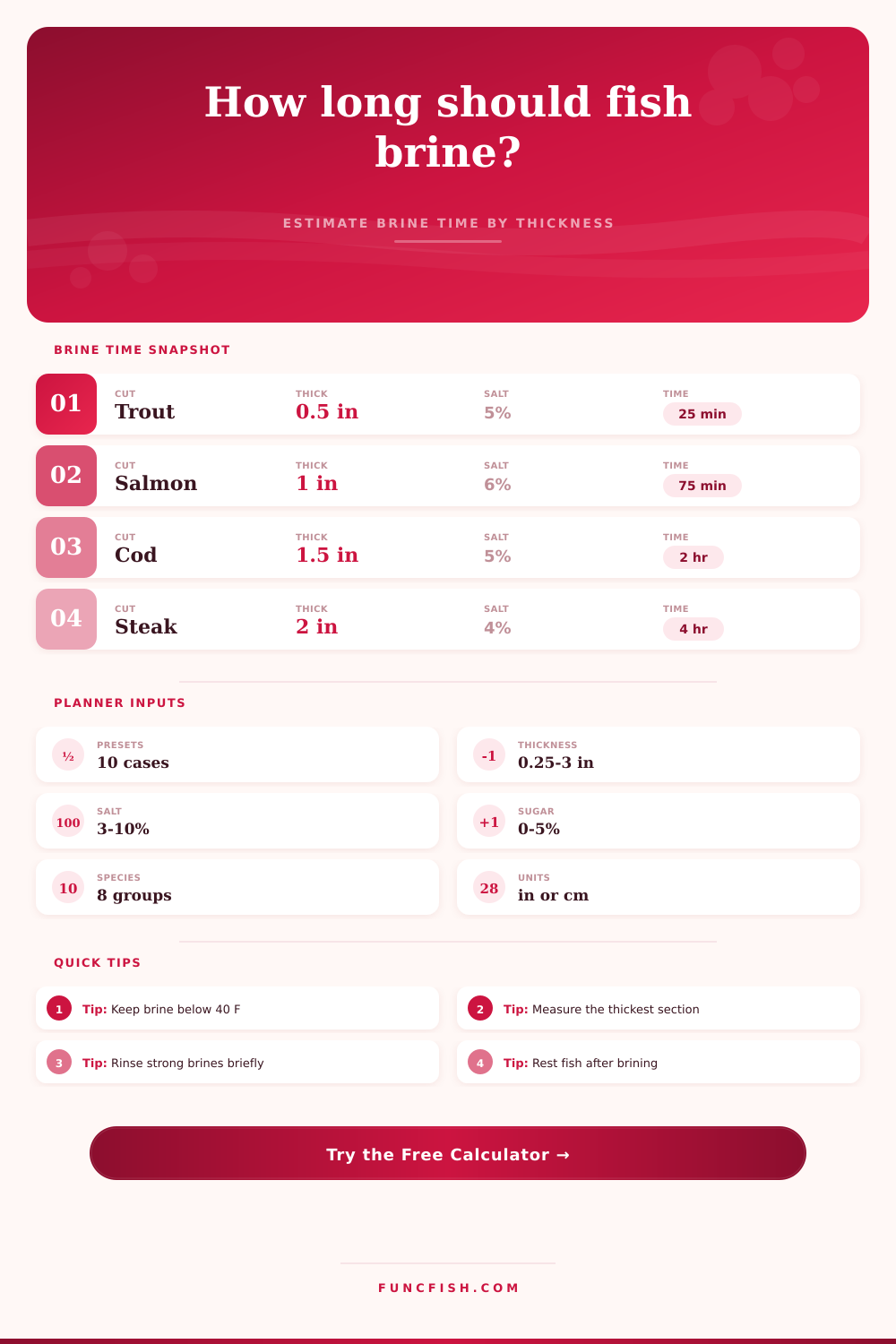
4 Thickness Time Table
| Thickest point | Metric equivalent | Light 4% brine | Balanced 6% brine | Firm 8% brine |
|---|---|---|---|---|
| 1/4 in | 0.6 cm | 10-18 min | 8-14 min | 6-10 min |
| 1/2 in | 1.3 cm | 25-40 min | 18-32 min | 15-25 min |
| 3/4 in | 1.9 cm | 45-70 min | 35-55 min | 28-45 min |
| 1 in | 2.5 cm | 70-105 min | 55-85 min | 45-70 min |
| 1 1/2 in | 3.8 cm | 2-3.2 hr | 1.6-2.6 hr | 1.3-2.1 hr |
| 2 in | 5.1 cm | 3.3-5 hr | 2.6-4 hr | 2.1-3.3 hr |
5 Brine Strength Reference
| Salt percent | Salt per liter | Salt per quart | Typical use | Timing effect |
|---|---|---|---|---|
| 3% | 30 g | 28 g | Delicate shellfish | Slow, gentle |
| 4% | 40 g | 38 g | White fillets | Light seasoning |
| 5% | 50 g | 47 g | Trout and cod | Standard |
| 6% | 60 g | 57 g | Salmon portions | Balanced |
| 8% | 80 g | 76 g | Firm smoked prep | Faster uptake |
| 10% | 100 g | 95 g | Short strong brine | Check early |
6 Cut and Species Adjustment Table
| Fish or cut | Adjustment | Why it changes | Best check | Common range |
|---|---|---|---|---|
| Thin trout fillet | Reduce 10-20% | Open surface and fine flake | Edge firmness | 20-45 min |
| Skin-on salmon side | Add 10-20% | One side absorbs slowly | Center spring | 1-3 hr |
| Cod or haddock loin | Reduce 5-15% | Lean flakes take salt quickly | Flake resistance | 45 min-3 hr |
| Tuna or swordfish steak | Add 15-30% | Dense muscle slows diffusion | Core seasoning | 1.5-5 hr |
| Whole small fish | Add 25-45% | Cavity and skin reduce exposure | Cavity taste | 1-4 hr |
| Shrimp or scallops | Reduce 45-60% | Small pieces over-salt quickly | Surface snap | 5-20 min |
7 Finish and Rest Table
| Finish choice | Rest time | Use when | Texture target | Watch for |
|---|---|---|---|---|
| No rinse | 5-10 min | Very weak brines | Light seasoning | Salty surface |
| Brief rinse | 10-20 min | 4-6% brines | Even surface | Waterlogged edges |
| Rinse and rest | 20-40 min | Most fillets | Balanced center | Loose moisture |
| Air-dry surface | 45-90 min | Smoking prep | Tacky surface | Warm room exposure |
| Long equalize | 1-3 hr | Thick blocks | Even salt | Dry exterior |
8 Brining Tips
Measure salt by weight. Salt grain size changes tablespoon volume, but grams keep a 4%, 6%, or 8% brine consistent from batch to batch.
Use the smallest piece as the alarm. Mixed-thickness batches should be checked early so thin tails can leave the brine before thick centers finish.
So what does that mean? It means the calculator will give you a beginning estimate of how long to brine based off the size of the fish (thicker fish takes longer) and the type of fish. It removes the guesswork of when it is safe and accounts for how much time it take for salt to soak into meat. But you’ll have to use your own judgment too. After all, you’re tasting with your nose and fingers; they are the ultimate judges of success. Think of the calculator as an aid, not a law.
First, measure the largest piece. That’s important because fat and water both soak up salt different. Water does it faster, and fat do it slower. Since middle of your big piece is denser, it will take the longest there. A big cut of meat will have some bland middle surrounded by tasty outer edges if you go by an average number. Check out the chart; a two inch steak requires hours but a quarter inch fillet can be done in minutes.
How to Use the Brining Calculator
That is the danger with mixed batches. You’ll have your nice little pieces ruined before long, pull them off early. Keep the big guys going for awhile longer. Avoid wasting money on a bad meal.
The rate of brining depend on the temperature. On one hand, cold brine slows down the process. But it will also keep your fish safe from bacteria at those lower temperatures. Brining in a fridge that’s kept very close to freezing point means you can leave the fish in there for hours before any harm occurs. And time on the calculator takes into account your fridge’s temperature. This makes it safer.
Want to speed things up? Add more salt. Yep, but there’s a catch. Higher sodium brines absorbs quicker. They’ll also extract water more quickly. If you’re not careful, the result is a dry, tough piece of meat. Balance tends to be better here. With 6% salt, most fish gets plenty of flavor, without overpowering their naturaly taste.
Besides sweetening, what’s sugar for? Well, it goes with the saltiness and also helps in browning (if you’re going to smoke the fish). If there’s no sugar, the fish will look flat and possibly even gray. A little sugar make the surface go darker and rounds out the flavors. You don’t have to get the proportions exactly right, but you definitely want some. Home cooks typicaly use only half as much sugar as they do salt. That’s a good starting place; go up or down according to your own liking.
Remove from the brine and rinse well. There will be a layer of excess salt on the surface that will cause the outside to be harsh. Rinsing quickly under cold water gets rid of that outer layer, it won’t remove the internal flavor. Dry the fish thoroughly with paper towels. Water will inhibit good cooking. Steam occurs when fish are wet; it does not get a good sear. For smoked fish, allow surface to air dry until slightly tacky. That pellicle helps smoke stick to flesh. Failure here mean pale and bland meat.
Fish vary in their response to brine. Fat-rich salmon takes salt well. White, lean fish such as cod will also take on salt fast but may go chalky if overdone. Meaty steaks such as tuna has tightly packed muscles that resist salt penetration; they require longer exposure. These variations are reflected in the calculator. Rather than some one-size-fits-all guideline, it offers a personalized guess.
Rely on the number-crunching, but rely even more on your own sensory input. Gently squeeze the fish, does it feel firm yet? Mushy would of been a no-go. Can you taste-test a small sample? If so, stop when done. Wait if the flavor is still flat. If it tastes zippy, rinse it, then wait.
So brining is a process of time and physics, not magic. It takes time but is worth your attention. Be careful in measuring the thickness, maintain the cold temperature and inspect early. The fish will tell you when it’s ready. Be careful.