Fish Calorie Calculator
Estimate calories from fish species, portion weight, edible yield, fat level, reference state, serving count, and gram or ounce units using data-centered fish nutrition references.
1 Species Presets
2 Portion Data
Fish calorie estimate
Calculation breakdown
3 Species Data Cards
White Fish
Salmonids
Pelagic Fish
Yield Range
4 Reference Tables
| Species | Raw kcal per 100 g | Prepared kcal per 100 g | Typical fat level |
|---|---|---|---|
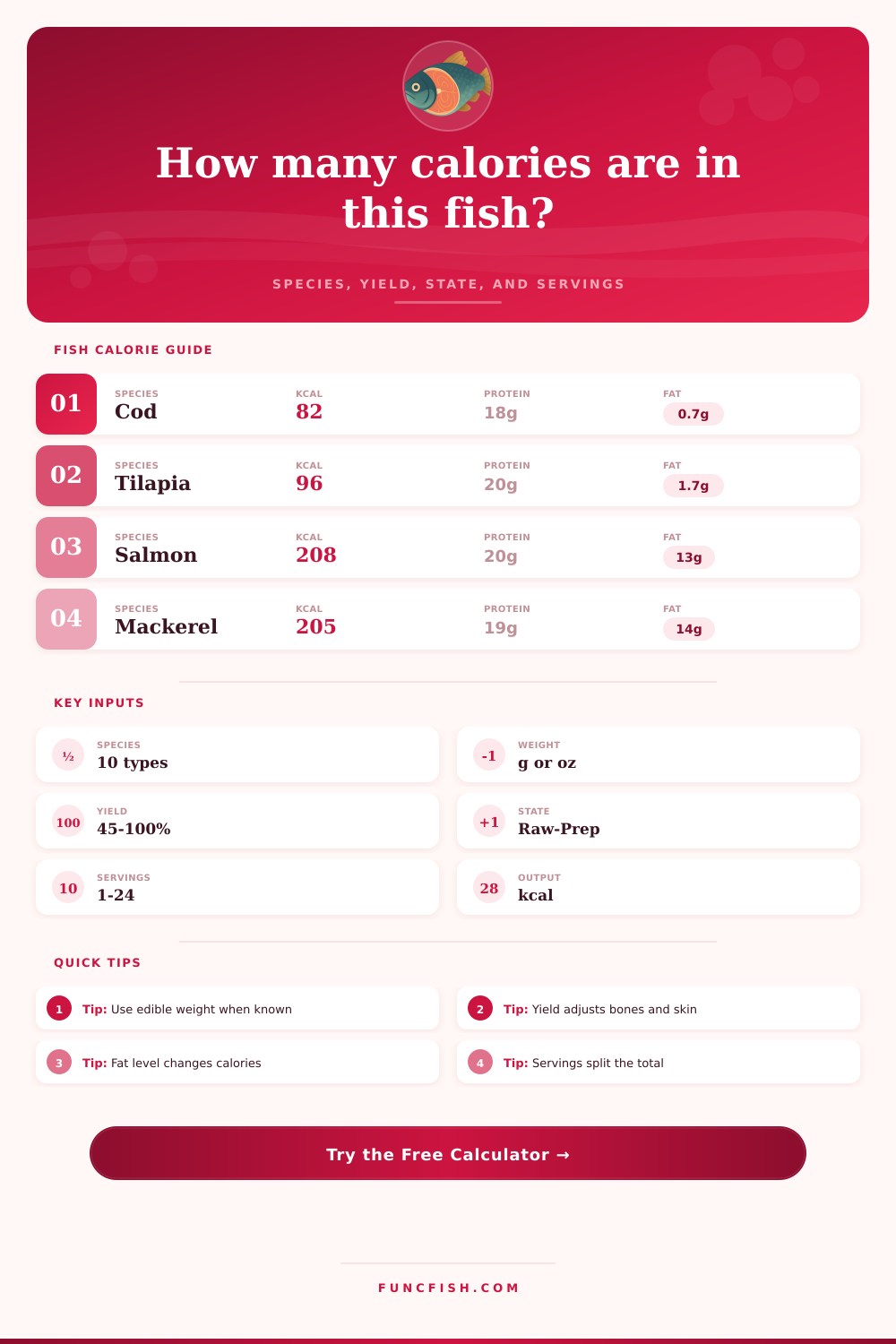
| Atlantic cod | 82 kcal | 105 kcal | Very lean |
| Tilapia | 96 kcal | 128 kcal | Lean |
| Atlantic salmon | 208 kcal | 232 kcal | Higher fat |
| Yellowfin tuna | 109 kcal | 130 kcal | Lean |
| Rainbow trout | 119 kcal | 168 kcal | Medium fat |
| Atlantic mackerel | 205 kcal | 262 kcal | Higher fat |
| Portion type | Default yield | Entered basis | Calculator effect |
|---|---|---|---|
| Boneless skinless fillet | 100% | Edible only | No yield loss applied |
| Skin-on fillet | 92% | As entered | Edible grams reduce slightly |
| Cross-cut fish steak | 78% | As entered | Bone share is removed |
| Headed dressed fish | 68% | As entered | Frame and skin reduce edible weight |
| Whole round fish | 55% | As entered | Head, frame, and viscera removed |
| Reference state | Data basis | Water concentration factor | Use in calculator |
|---|---|---|---|
| Raw reference data | Raw edible fish | 1.00 | Uses raw kcal, protein, and fat per 100 g |
| Prepared reference data | Prepared edible fish | Species-specific | Uses stored prepared values per 100 g |
| Drained or packed reference data | Drained edible fish | Species-specific | Uses packed or drained-style reference values |
| Fat level adjustment | Selected sample type | 0.90 to 1.18 kcal | Adjusts calorie density and fat grams |
| Serving split | Total edible fish | Per serving weight | Displayed result |
|---|---|---|---|
| 1 serving | 170 g / 6 oz | 170 g / 6 oz | Total equals serving value |
| 2 servings | 340 g / 12 oz | 170 g / 6 oz | Calories divide by 2 |
| 4 servings | 680 g / 24 oz | 170 g / 6 oz | Calories divide by 4 |
| 8 servings | 1360 g / 48 oz | 170 g / 6 oz | Calories divide by 8 |
All reference rows are calculator data points only. The tool does not provide preparation directions, diet plans, or medical guidance.
5 Species Comparison Grid
Atlantic Cod
Lean white fish baseline for low fat calorie estimates.
Tilapia
Common mild fillet with a lean but slightly higher calorie density.
Atlantic Salmon
Higher-fat species with more calories per edible gram.
Yellowfin Tuna
Dense protein context with a lean raw calorie reference.
Rainbow Trout
Mid-fat freshwater species with moderate calorie density.
Sardine
Small oily fish with packed-state data available in the calculator.
Mackerel
Higher-fat pelagic fish with a high calorie reference value.
Halibut
Firm white fish with a moderate lean-species calorie base.
6 Calculator Tips
Yield tip: If the scale weight includes skin, bone, head, or frame, leave the weight basis as entered weight and set edible yield to the matching reference style.
Serving tip: Use serving count only to split the same calculated total. It does not change the species, yield, fat level, or reference-state data.
To calculate the calories in fish, there are several specific variable that must be taken into account in order to ensure the accuracy of the calculations. The calories in fish can change based off the species of the fish, the portion weights of the fish, the preparation of the fish, and the fat content of the fish. The species of the fish is the first of these variables that must be accounted for.
Different species of fish contains different amount of fat. For instance, cod contains approximately 82 calories per 100 gram of raw cod. However, mackerel have more fat within it’s body, and thus contains more calories then cod.
Four Things That Change Fish Calories
Similarly, fatty fish like salmon and sardines contain significant amounts of omega-3 fatty acids, which increase the calories of those species of fish. Therefore, the identity of the species of the fish can impact the caloric count of the fish. The portion weight of the fish is the second of these variables.
However, the portion weight is not the total weight of the fish, but the edible weight of the fish. The edible weight of the fish is the weight of the fish that an individual will consume. The total weight of the fish may include the bones, the skin, and other features of the fish that will not be eat.
The ratio of the edible weight to the total weight of the fish is referred to as the edible yield of the fish. If you dont account for the edible yield of the fish, the portion weight of the fish can lead to inaccurate calculation of the total calories of that portion of fish. For instance, the edible yield of snapper is more lower than that of a fillet of snapper.
The preparation of the fish is the third of these variables. The calories of raw fish are different than the calories of cooked fish. When fish is cooked, water molecules leaves the flesh of the fish.
Thus, the ratio of calories to the gram of cooked fish will be higher than that of raw fish. Furthermore, the way in which the cook prepares the fish may also impact the total calories of the fish. For instance, canned fish in oil contain oil, which increases the total number of calories of that type of fish.
Thus, oil content in canned fish must be accounted for in calculating the total calories of canned fish. The fat content of the fish is the fourth of these variables. The fat content of the fish is related to the species of the fish.
Lean fish, like tilapia or cod, will contain less calories than fatty fish, like salmon or mackerel. Thus, those who wish to eat fish high in fat content will consume more calories from that type of fish consumption. Furthermore, you can account for fat content within fish in the calculation of the total calories of fish.
Fat content may differ within the same species of fish, though. These different variable can be used to make better choices about the type of fish that is consumed. For instance, those who require more protein but fewer calories than others should select lean fish species.
Conversely, those who wish to increase their fat and energy intake should select fatty fish species. Furthermore, the protein content of fish is relatively consistent; most types of fish contain between 18 and 24 gram of protein per 100 grams of fish. Finally, in order to calculate the calories of the fish accurately, the fish should be weigh.
A kitchen scale can determine the total weight of the fish. Furthermore, you can calculate the edible yield of the fish from the total weight of the fish. Thus, by taking into account each of these four variables, it is possible to calculate the number of calories that is contained in any portion of fish.