Fish Cold Shock Risk Calculator
Estimate cold shock risk from a temperature drop, fish sensitivity, size, exposure time, and acclimation method before moving fish, stocking, or changing water.
📌Scenario presets
⚙Risk settings
Cold shock risk forecast
Formula breakdown
🧪Species comparison grid
Goldfish / Carp
Koi
Bass / Sunfish
Catfish
Trout / Char
Tilapia
Tropical Fish
Marine Reef
📊Cold shock reference tables
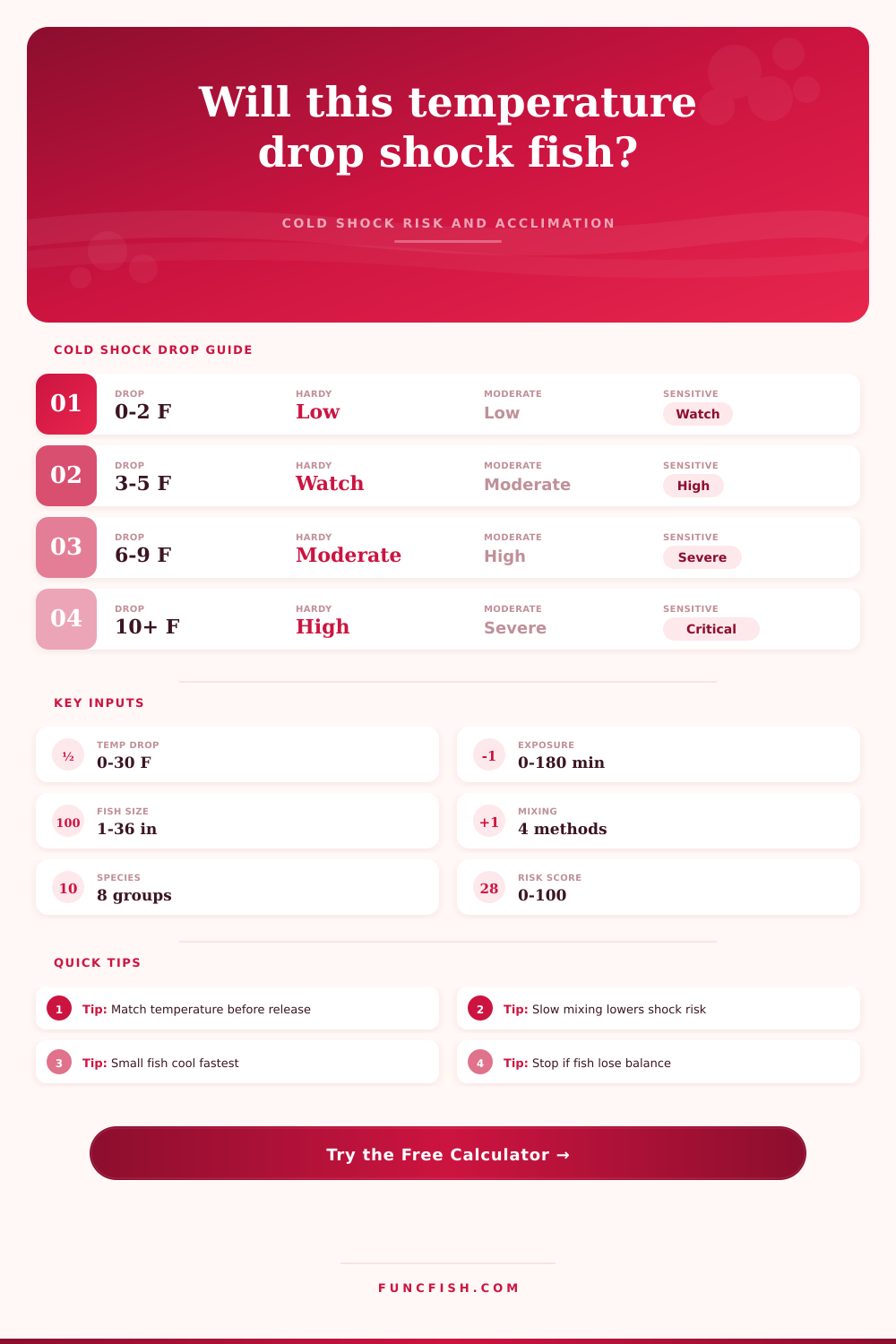
| Cold drop | Drop in C | Hardy fish response | Sensitive fish response | Calculator action |
|---|---|---|---|---|
| 0 to 2 F | 0 to 1.1 C | Usually low stress | Watch closely | Short acclimation |
| 3 to 5 F | 1.7 to 2.8 C | Moderate caution | High caution | Mix slowly |
| 6 to 9 F | 3.3 to 5.0 C | High caution | Severe risk | Extend acclimation |
| 10 to 14 F | 5.6 to 7.8 C | Severe stress | Critical risk | Delay move if possible |
| 15 F or more | 8.3 C or more | Critical risk | Critical risk | Equalize temperature first |
| Species group | Base cold tolerance | Comfort band | Size sensitivity | Notes for calculator |
|---|---|---|---|---|
| Goldfish / common carp | 6 F | Cool to temperate | Low to moderate | Hardy, but sudden drops still count |
| Koi / pond carp | 5 F | Temperate ponds | Moderate | Large fish tolerate rate better than fry |
| Bass / sunfish | 5 F | Warm to temperate | Moderate | Livewell cooldown can happen quickly |
| Catfish / bullhead | 7 F | Warm to temperate | Low | Hardy group, oxygen still matters |
| Trout / char | 4 F | Coldwater | High | Cold adapted, but abrupt shifts stress them |
| Tilapia / warmwater cichlid | 3 F | Warmwater | High | Cold drops should be kept very small |
| Tropical community fish | 3 F | Stable warm aquaria | High | Small bodies lose heat quickly |
| Marine reef fish | 2 F | Stable marine systems | Very high | Use slow drip and close observation |
| Acclimation method | Risk reduction | Estimated mixing pace | Best match | Calculator effect |
|---|---|---|---|---|
| Direct move | 0% | Immediate | Matched water only | Full temperature penalty |
| Float container only | 18% | Surface heat exchange | Small bag changes | Moderate rate reduction |
| Cup mixing | 35% | Every 5 to 10 min | Bucket transfers | Strong drop reduction |
| Slow drip acclimation | 55% | Steady drip | Sensitive aquarium fish | Largest risk reduction |
| Scenario | Main risk driver | Useful check | Typical safe drop | Suggested monitor window |
|---|---|---|---|---|
| Water change / top-off | Rapid volume replacement | Match new water temperature | 2 to 4 F | 1 to 3 hr |
| Bag or cup transfer | Small water mass cools fast | Float before mixing | 1 to 3 F | 2 to 6 hr |
| Bucket or tub move | Long unmixed exposure | Measure both containers | 3 to 5 F | 2 to 8 hr |
| Livewell or holding tank | Ice or cold inflow pockets | Measure below surface | 4 to 6 F | 1 to 4 hr |
| Pond or tank stocking | Large receiving volume | Check target depth | 2 to 5 F | 4 to 12 hr |
| Field release after capture | Air exposure plus cold water | Keep fish submerged | 2 to 4 F | 1 to 4 hr |
💡Calculation tips
Measure the water, not the room. Cold shock is driven by the actual water temperature difference at release. For ponds and livewells, check the layer where the fish will enter.
Use the score as a handling flag. If the calculator lands in severe or critical risk, reduce the temperature gap before transfer instead of relying on a longer observation period.
What does it look like? It’s okay. Cool. Clear. Fine water. Perfectly acceptable for a bucket of goldfish. Until you put those fish in the pond. Then they tilt on their sides, gasp at surface, and never manage to flip back over.
Is this some hypothetical situation I’m making up here? No. This is what always happens to people who forget that water temperatures can be different than air temperatures. Cold shock kills lots of fish. It almost always does so without warning.
How to Keep Your Fish Safe From Cold Shock
What causes cold shock? Basically, the fish is stressed because its metabolism slows as blood vessels constricts suddenly. Now it can’t get enough oxygen to function. If you suddenly move a fish from 70-degrees to 50-degrees, guess what? You’re not just cooling it down, you’re slamming its circulatory system into emergency brake mode while it’s still running at speed.
This is where the tool on this page comes in to quantify that invisible danger for you. Rather than having to guess at how much temperature drop a species can tolerate, just input the starting and ending temperature. Input what species you’re working with. Then input time that the species was exposed and which handling situation you put them in. From there, the calculator does the math for you. You don’t have to guess at someone else’s physiological tolerance limit; it calculates it for you. It converts that biological vulnerability into a risk number that lets you know if you should do something now or wait.
Why? Because a three degree change means nothing to a hardy catfish but a world of hurt for a tropical marine fish. Everything depend on context. To understand the concept of species tolerance, let’s consider how these fish evolved.
Trout and other char are coldwater fish that have evolved to stay stable in water temperatures they are used to. This means they is adapted to gradual seasonal changes rather than an immediate plunge caused by a bucket drop. In contrast, warm water species such as cichlids or tilapia has a much smaller comfort band. When the water temp drops even a few degrees, their metabolism starts slowing down, dangerously quickly. What may be a pleasant cool breeze to you will be a physiological crisis for your little tropical fish.
To avoid this mistake, we assign each group a base tolerance value based off its evolutionary history. Then, the calculator takes into account that some species can tolerates colder temps (e.g., trout) while others cannot (e.g., cichlid).
The other variable that gets folks is size. Because of their high surface-area-to-volume ratio, smaller fish are going to get hot or cold faster than larger ones. A fingerling in a small plastic cup will equalize with ambient water temp in a matter of minutes. On the flip side, a big ol’ koi in a bucket stays at its own temperature longer. That’s why I said exposure time is a critical input.
You can put a little fish into a cold bucket and within twenty minutes, he’s already shocked. It didn’t take a second for him to be messed up. The monitor window shows you an idea of how long you need to observe them after release. If they’re behaving normally by then, odds are good that the move went well. If they start gasping or darting around, then you’ve got a problem.
There are ways to save a bad situation with some adjustments. A bag floating in the tank is better than not doing anything at all, but it doesn’t affect the chemical composition of what’s happening in the tank inside the bag. It just floats there exchanging heat through the plastic. Slow dripping or cup mixing will keep the fish comfy and slowly allow for the tank water temp to come up to speed with the water in the bag.
The chart on the page explains it well with the reference table. What it shows is that using the slow drip method of acclimation, you’ll have much less risk compared to just floating something in the tank. One is a nice gradual ramp. The other is a cliff edge. You want a ramp.
By far the biggest no-no is thinking that just because the air might be cool the water must also be cool. Ponds can heat up the top layer by ten degrees over the bottom in full sun. If you pick a fish out of the warm top layer and drop it into the cold depths of the pond, then you’re giving them a nasty shock. Always take the water temperature at the spot where you plan to release the fish. Then run it through the calculator to find out whether that particular drop poses a threat to your particular fish.
If the risk score indicates danger, it’s generally an easy problem to solve. Either warm the receiving water a little or cool the holding water slowly. Don’t rush. Patience, not speed, will keep your fish healthy.
You can prevent cold shock by understanding that temperature isn’t a single number; it’s a changing factor. Acclimating is more about the process than the final result. A tool allows you to understand your acclimation speed and respect the fish’s biology. What seemed fine in the water must now be matched. Knowing that is what makes the difference between a healthy fish versus a dead one and turns what could of been a disaster into another routine move.