Fish Daily Feeding Window Calculator
Estimate today's best bite windows by combining species feeding rhythm, sunrise and sunset, water temperature, oxygen, clarity, wind, pressure, moon phase, season, forage, and angling pressure.
🏷Feeding window labels
📌Daily bite presets
⚙Daylight, water, and weather inputs
Daily feeding window results
Calculation breakdown
📊Species feeding grid
Bass
Trout
Walleye
Catfish
📘Feeding reference tables
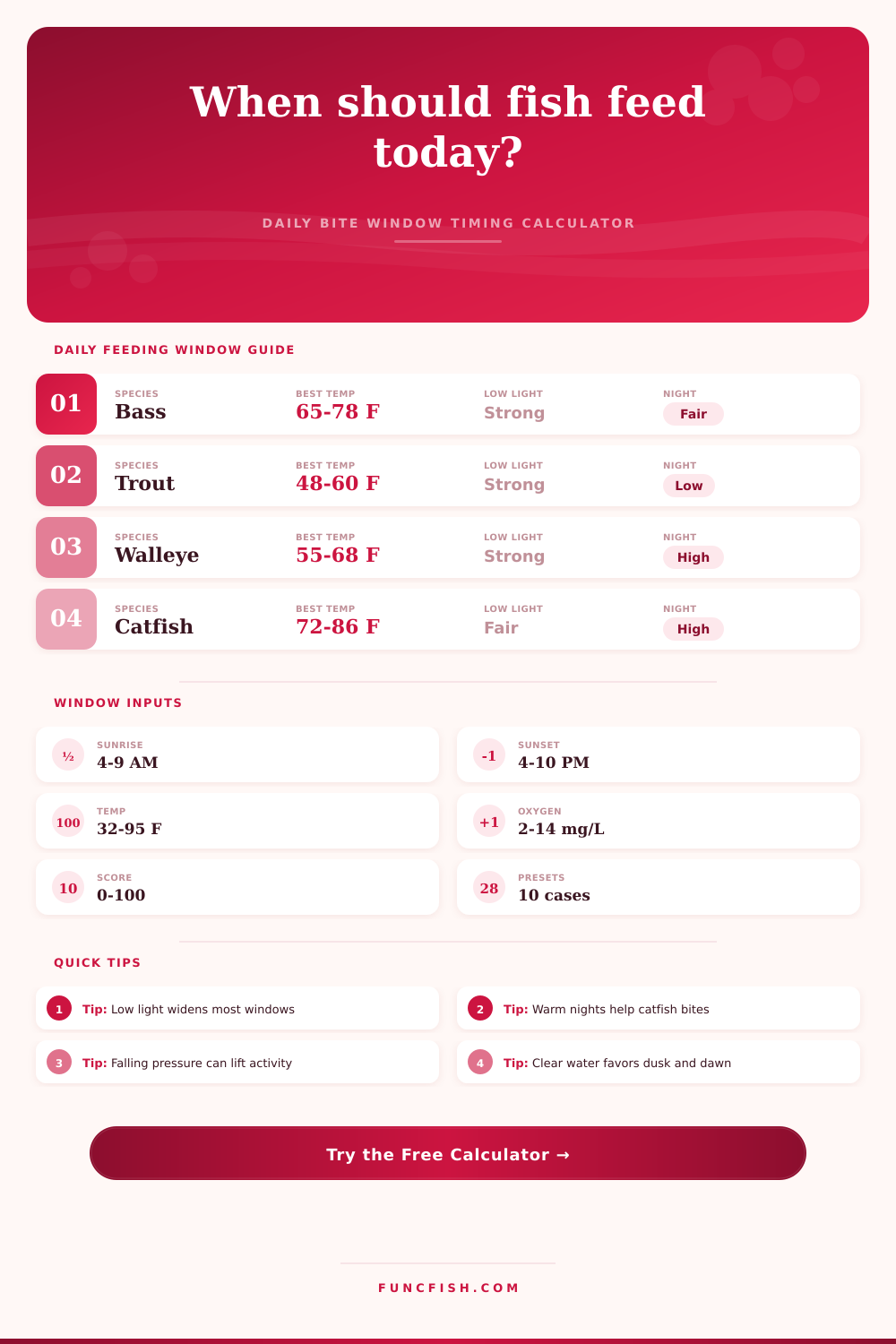
| Species group | Preferred water temperature | Primary daily window | Weak-window warning |
|---|---|---|---|
| Largemouth / smallmouth bass | 65-78°F / 18-26°C | Dawn, dusk, shade, wind edges | Bright calm midday in clear water |
| Trout | 48-60°F / 9-16°C | Morning, cloudy midday, hatch periods | Warm low-oxygen afternoons |
| Walleye / sauger | 55-68°F / 13-20°C | Dusk, night, wind-blown edges | High sun in clear water |
| Channel catfish | 72-86°F / 22-30°C | Evening through early night | Cold snaps and fast-rising pressure |
| Bluegill / panfish | 68-82°F / 20-28°C | Late morning, shade, insect activity | Predator pressure or muddy cold water |
| Pike / muskie | 50-65°F / 10-18°C | Cool morning, cloudy day, moon windows | Hot water and low oxygen |
| Striped bass | 58-72°F / 14-22°C | Low light bait movement | Midday when bait is deep and scattered |
| Redfish / inshore drum | 65-82°F / 18-28°C | Tide-influenced shallows and edges | Slack water with bright high sun |
| Condition | Calculator effect | Window shift | Typical interpretation |
|---|---|---|---|
| Overcast or light rain | Adds low-light score during daylight | Widens morning and afternoon | Fish can roam longer away from cover |
| Moderate wind | Boosts edge-feeding score | Improves wind-blown banks | Bait visibility and current improve |
| Falling pressure | Adds short-term activity score | Earlier and stronger window | Often best before disruptive weather |
| Low oxygen | Subtracts from night and dawn periods | Compresses feeding into better water | Fish may suspend or seek flow |
| Ultra clear water | Penalizes bright midday light | Moves peak to dawn or dusk | Stealth and shade matter more |
| Heavy angling pressure | Reduces noisy daytime windows | Favors first light, dusk, night | Quiet timing becomes more valuable |
| Window type | Hourly score range | Best use | Common adjustment |
|---|---|---|---|
| Prime window | 75-100 | Commit to highest-confidence spots | Fish moving bait, current, or shade |
| Good window | 60-74 | Cover water and test active fish | Rotate presentations until bites repeat |
| Maintenance window | 45-59 | Slow down near cover or depth breaks | Use precise casts and longer pauses |
| Low window | 0-44 | Scout, relocate, or wait for a trigger | Focus on oxygen, shade, or current |
| Preset scenario | Species rhythm | Main window driver | Expected window shape |
|---|---|---|---|
| Bass clear summer lake | Visual ambush predator | Low light, shade, wind | Dawn and dusk with short midday shade |
| Trout cool stream | Oxygen-sensitive drift feeder | Cool water and insect activity | Morning through cloudy midday |
| Walleye windy evening | Low-light edge feeder | Dim light and wind line | Long dusk into early night |
| Catfish warm night | Scent-oriented night feeder | Warm water and dark cover | Evening through midnight |
| Redfish tidal flat | Shallow-water cruiser | Moving water and forage | Tide-shifted shoulder window |
💡Calculation tips
Use local light times. Sunrise and sunset anchor the hourly model, so changing them can move every window even when the water inputs stay the same.
Score the water fish actually use. Temperature and oxygen at feeding depth are more useful than a hot surface reading or a marina thermometer.
The day is a flat line for most anglers. Up before daylight, fish will throw something and hope hand of fate lines up with time. It’s never that simple. Fish don’t awaken according to a timetable. They responds to an ever-changing mix of hunger, temperature, light and oxygen. To read water like weather report requires naturaly observation rather than just guesswork.
That’s a lot of variables to remember, which is why we created the daily feeding window calculator above to do all the complicated math for you. By inputting values such as dissolved oxygen levels, water temperature and sunrise time, it calculate an approximate window during which fish are most likely to bite.
How This Tool Helps You Catch Fish
You may be thinking, “I only need to know when the sun rises.” But unfortunatly it doesn’t work quite like that. While sunrise provides a starting point for light penetration, how fast the fish’s body works is also governed by water temperature. In cold water, fish metabolize their food more slow, meaning they won’t feel nearly as urgent to feed. So this tool use both the biology and environment to provide you with more than just a guess; it provides a probability score.
The light aspect is perhaps most overlooked of all. We’ve all heard about how good the bite gets in lowlight conditions at dawn and dusk. That is true, but not entirely true. On a clear water lake, fish can see you. They hides deep or in the shade when midday sun is bright. But when water is muddy or stained, that’s no longer a concern. Now the fish have confidence to move further out during middle of the day.
These reference tables shows the influence of clarity on the window. When the water is clear, it really limits things to low light hours. As water color darkens, it opens the window throughout midday. The trend in temperature is also key. In many cases a falling temperature following a frontal passage will initiate a feeding frenzy as fish adjust themselves to the change. Likewise, if it has been warming rapidly, they will be sluggish when the temperature rise. This is factored into the calculation, which takes into account not only absolute temperature but also whether it is trending warmer or colder.
Oxygen concentration becomes important with fish such as trout and walleye which requires high levels of dissolved oxygen to actively feed. When oxygen levels gets low, they concentrate their feeding time into very specific zones along wind-swept edges or other inflow areas nearest the surface.
The other variable that will alter everything is angling pressure. Remember fish are smart. Constantly presenting lures on any body of water with lots of boat traffic causes fish to wise up. They will move out deeper, wait until later in the day or simply stay off the pattern during busy times. That’s where the question of fishing pressure matters with this tool. The heavier the pressure, it is better to go early or late when there is less boat traffic. A simple time change might make the difference in your trip.
And don’t mistake this for a promise. It’s an indicator. Good anglers relies on it to cut down their time searching. Instead of fishing all over lake, they concentrate on the places that match the conditions. When the model indicates peak activity is during dusk, you get there early, an hour before, to do your recon. You keep an eye out for wind eddy spots and you watch for baitfish activity. You double-check water temp with a thermometer. Cast with intent.
Now it’s about no longer casting around blindly, but instead casting with a purpose. It’s not about waiting for a bite. But it’s setting the table for one. You should of used this earlier. Using an understanding of how pressure, temperature and light affect each other can transform a day on water from random casts to a series of calculated maneuvers. And fish have been reacting to them. Now you’re simply where you want to be when fish choose to feed.