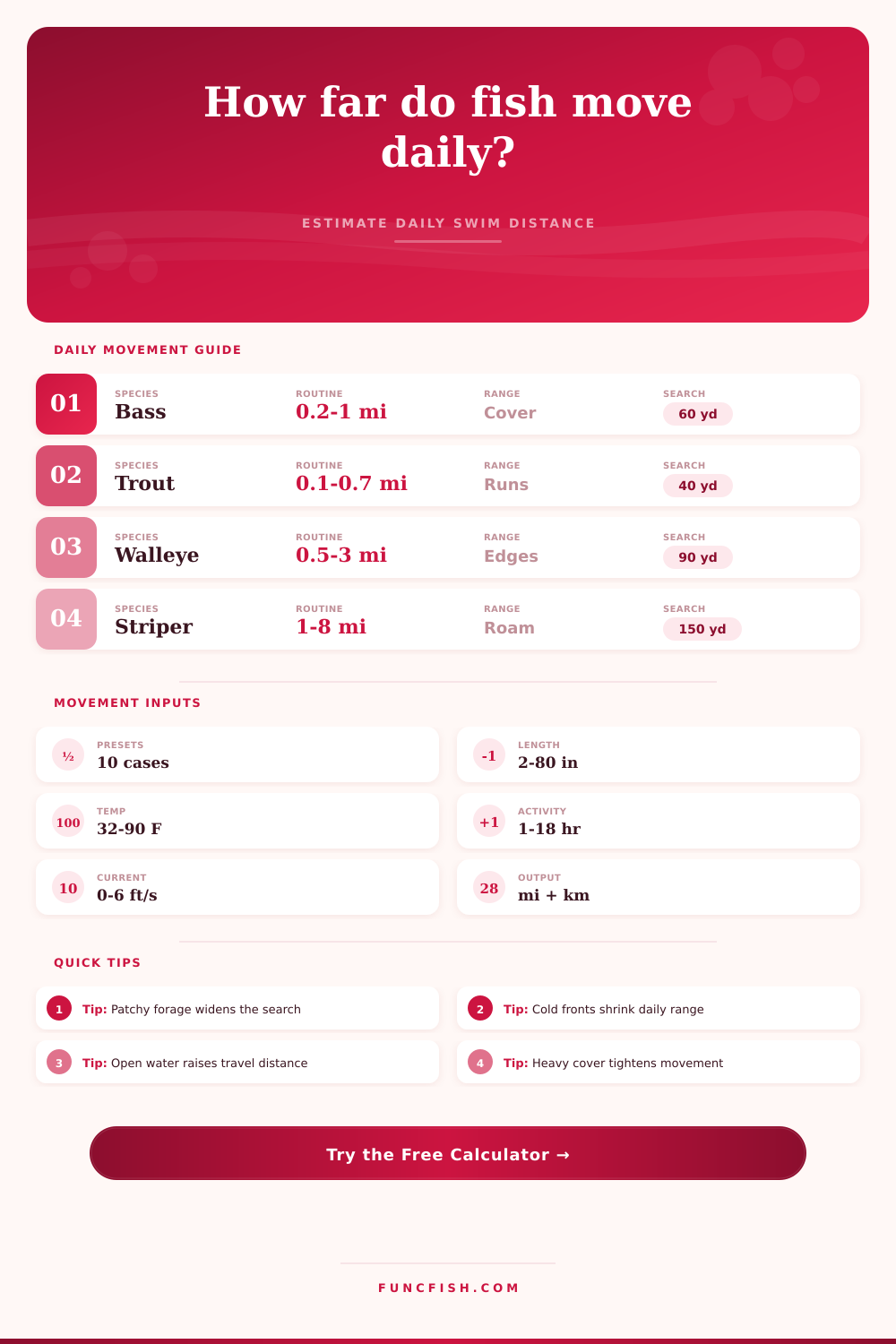
Fish Daily Movement Distance Calculator
Estimate how far a fish may travel in a day from species behavior, body length, water temperature, active feeding hours, current, habitat openness, forage spread, cover, season, and angling pressure.
🏷Movement model labels
📌Daily movement presets
⚙Species, habitat, and condition inputs
Estimated daily movement
Calculation breakdown
📊Species movement data grid
Ambush cover fish
Edge roamers
Stream movers
Open-water schools
📘Reference tables
| Species group | Routine pace | Comfort temp | Typical daily pattern |
|---|---|---|---|
| Bass | 900 body lengths/day | 64-78°F / 18-26°C | Cover to edge patrol, strongest around feeding windows. |
| Trout | 650 body lengths/day | 48-62°F / 9-17°C | Holding lies, short feeding shifts, and run-to-run repositioning. |
| Walleye | 1400 body lengths/day | 55-68°F / 13-20°C | Low-light edge travel from basin, weed, rock, or current breaks. |
| Catfish | 750 body lengths/day | 70-86°F / 21-30°C | Evening and night feeding loops across flats, seams, and scent lanes. |
| Striped bass | 2600 body lengths/day | 58-72°F / 14-22°C | Schooling travel that follows bait, wind lines, surf bars, or current. |
| Habitat factor | Multiplier range | Distance effect | Fishing interpretation |
|---|---|---|---|
| Small pond or compact cove | 0.55x | Shortens travel | Revisit key cover and shade before making big moves. |
| Weed line, brush, or dock field | 0.75x | Localizes fish | Work lanes and gaps instead of assuming long relocation. |
| Reservoir point or basin edge | 1.20x | Expands travel | Check adjacent depths and nearby bait before leaving the area. |
| Tidal flat or marsh drain | 1.35x | Expands travel | Time movement with the push, drain, and available ambush edges. |
| Offshore open water | 2.20x | Greatly expands travel | Use bird activity, bait marks, temperature breaks, and current lines. |
| Condition | Low value | High value | Movement note |
|---|---|---|---|
| Forage spread | Tight bait: 0.72x | Roaming bait: 1.55x | Fish travel farther when meals are scattered or moving. |
| Cover density | Heavy: 0.68x | Open: 1.22x | Cover lets fish feed without large daily relocation. |
| Angling pressure | Low: 1.08x | Tournament: 0.68x | Heavy traffic often compresses visible movement. |
| Season | Winter: 0.55x | Fall: 1.28x | Metabolism and forage movement drive seasonal range. |
| Flow | Slack: neutral | Strong: mixed | Mild flow helps travel; hard flow can pin fish to breaks. |
| Estimated relocation band | Boat or bank search spacing | Good technique fit | Use this when |
|---|---|---|---|
| Under 40 yd / 37 m | 10-20 yd steps | Pitching, short casts, float drifts | Fish are cover locked or temperature stressed. |
| 40-120 yd / 37-110 m | 25-50 yd steps | Fan casting, jig lanes, bank hopping | Fish patrol a defined edge or current seam. |
| 120-350 yd / 110-320 m | 60-120 yd steps | Crankbait passes, swimbaits, trolling | Bait is spread along points, flats, or basin edges. |
| 350 yd+ / 320 m+ | 150-400 yd steps | Search baits, sonar passes, bird or bait tracking | Schools are roaming open water or tide lines. |
💡Movement planning tips
If the relocation band is small, slow down and rotate angles around the same cover. If it is large, use wider search passes before returning to a spot.
A cold front, muddy inflow, stronger tide, or sudden boat pressure can change daily movement more than species alone.
As the sun rises over the lake, you’re standing on shore of a reservoir watching wind ripple across the surface. Somewhere in this stretch of water lurks hungry largemouth bass. Where is he? How far did he travel to get there? Knowing how much fish will move each day changes everything. Fishing becomes less guesswork and more of a steady search pattern.
Knowing a fish travels two hundred yards means casting randomly every ten yards aren’t efficient. Knowing a fish travels two thousand yards make spending all day in one cove a waste of time. The calculator above do the math for you. It takes water conditions and the fishs biological habits and converts them into usable search radius based off your position on the bank or in boat.
How Far Fish Move Helps You Catch Them
But where does that begin? It begins with behavior of species, as they’re not all on the same clock. For example, an ambush predator such as a bass or pike follow a tight routine. They simply sits there near some cover and wait. Maybe they move a little to chase a few random baits or switch their holding spot, but generally speaking those fish don’t move much during the day. They measure out their day in hundreds of body length.
On the other hand, compare them with school of tuna or stripers. Those are open water travelers. They constantly roam about following temperature breaks and bait balls. They swims thousands of times there own body length every day. This difference is important when knowing how far apart you should of be searching. For instance, you wouldn’t look for a smallmouth the same way you’d look for a striper. One need to make big aggressive moves, while the other needs exact slow movements around structure.
But the throttle on this engine is temperature. In cold water, metabolism slows and daily range becomes much smaller. Even though a species may travel miles during the course of a normal day, that fish in forty degree water won’t go a hundred yards all day long. When we warm up close to their comfort zone, window expands. The tool recognize that and adjusts base pace. That’s a small detail but one that prevents common mistake of using a July search pattern when fishing deep winter holes. Slow down when the fish slows down.
There are naturaly limitations too. Cover confines the fish. When they’re buried in heavy hydrilla, for example, they don’t have to go very far to eat. The estimator multiply this factor. Sparse cover or open water has reverse effect. Fish has no place to hide. To eat or be secure, they must spread out and this increases their daily range. That’s what makes fall fishing a little odd at times. When bait piles up and water temperatures cool, search area changes.
The table on that page put it all in perspective. It shows how habitat (open flats or weed lines) influence the probable distance traveled. The last layers of complexity are pressure and season. Angling pressure compress movement. Fish pull back closer to cover or deeper into it which shrinks their range of visibility. A cold front do this too. The search zone shrinks and activity shuts down. You can put those variables in with the tool.
It doesn’t give you a theoretical max; it gives you a realistic band. It’s all about managing expectations. If it says you’ve got a wide roam, fish fast using search baits covering water quick. If it says you have a tight radius, slow the boat and make precise casts. But that’s not the point; the actual number isn’t as important than the range it gives you. It will tell you if you should pick apart one rock pile or if you can scan a mile of shoreline.
It connect fishing plans with an understanding of fish behavior. Instead of throwing lines around aimlessly, you’re placing yourself in daily world of the fish. When you begin thinking about search spacing and movement bands, the water doesn’t seem so arbitrary anymore. It becomes a map of probable areas of activity. Stop looking where the fish aren’t and start looking where they usualy go, which help you find them faster. That mental switch is what transforms a great day into a realy good one.