Winter Dormancy Depth Estimator
Estimate the water depth fish need for a stable winter refuge below ice, soft sediment, and low-oxygen surface layers.
📌Winter pond presets
⚙Dormancy inputs
Winter dormancy depth forecast
Calculation breakdown
🐟Species comparison grid
Koi
Goldfish
Bass / Bluegill
Catfish
Trout
Perch / Walleye
Minnows
Tilapia
📊Reference tables
| Species group | Stable dormancy range | Depth reserve added | Winter note |
|---|---|---|---|
| Koi / ornamental carp | 36-41°F / 2.2-5°C | 1.4 ft / 0.43 m | Benefits from quiet water below ice disturbance. |
| Goldfish / comets | 35-40°F / 1.7-4.4°C | 1.0 ft / 0.30 m | Hardy, but shallow bowls and mucky ponds still fail. |
| Bass / bluegill | 37-42°F / 2.8-5.6°C | 1.2 ft / 0.37 m | Needs enough basin depth for school movement. |
| Catfish / bullhead | 36-42°F / 2.2-5.6°C | 1.1 ft / 0.34 m | Tolerates low oxygen better than most game fish. |
| Trout / char | 38-44°F / 3.3-6.7°C | 1.6 ft / 0.49 m | Oxygen demand stays high in cold water. |
| Perch / walleye | 37-42°F / 2.8-5.6°C | 1.3 ft / 0.40 m | Prefers clear water and moderate oxygen. |
| Minnows / baitfish | 35-40°F / 1.7-4.4°C | 0.8 ft / 0.24 m | Small bodies chill fast but use less oxygen. |
| Tilapia / warmwater fish | 55°F+ / 12.8°C+ | Indoor heat needed | Outdoor overwintering is usually unsuitable. |
| Climate band | Typical ice allowance | Depth buffer | Planning interpretation |
|---|---|---|---|
| Mild freeze | 0-4 in / 0-10 cm | 0.5 ft / 0.15 m | Short ice periods mainly need a small bottom refuge. |
| Cool winter | 3-8 in / 8-20 cm | 0.8 ft / 0.24 m | Plan for repeated ice and cold rain swings. |
| Cold winter | 8-18 in / 20-46 cm | 1.2 ft / 0.37 m | Stable ice and snow require deeper quiet water. |
| Severe winter | 18-30 in / 46-76 cm | 1.7 ft / 0.52 m | Long cover raises both depth and oxygen demands. |
| High elevation | 10-28 in / 25-71 cm | 1.5 ft / 0.46 m | Clear nights and altitude can extend the freeze window. |
| Pond style | Shape factor | Winter advantage | Winter concern |
|---|---|---|---|
| Garden pond | Small basin | Easy to vent | Often shallow with fast chilling. |
| Koi pond | Steep sides | Good clear depth if built deep | Large fish need oxygen reserve. |
| Farm pond | Broad bowl | More volume and wind mixing | Organic shoreline load can be high. |
| Natural pond | Irregular basin | Some spring pockets or deep holes | Muck and leaf decay reduce refuge. |
| Retention pond | Variable basin | Usually larger surface area | Runoff and plant die-off can reduce oxygen. |
| Spring-fed pond | Inflow zone | Stable temperature and oxygen | Flow path may keep fish away from best depth. |
| Winter condition | Oxygen effect | Depth effect | Estimator treatment |
|---|---|---|---|
| Clear ice | Lower risk | No added depth | Light can reach plants and algae. |
| Steady snow | Medium risk | Adds reserve | Less light, more oxygen drawdown. |
| Heavy plant decay | High risk | Adds reserve | Organic demand consumes winter oxygen. |
| Shallow shelf aeration | Risk reduction | Small depth credit | Keeps a vent without lifting deepest water. |
| Deep diffuser | Mixed result | No depth credit | Can chill the whole basin during hard freeze. |
| Spring inflow | Risk reduction | Depth credit | Usually improves temperature and dissolved oxygen. |
💡Depth planning tips
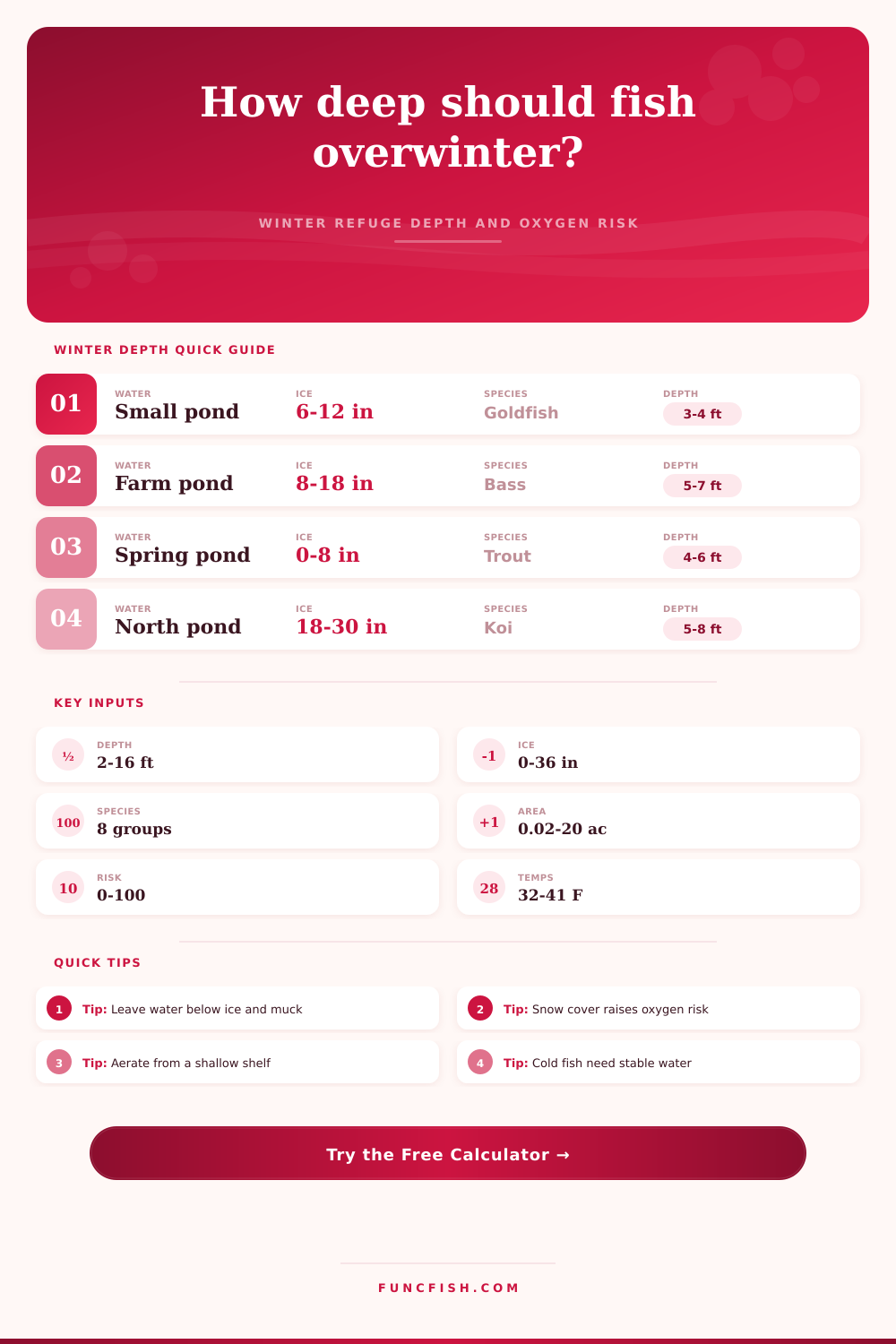
Measure usable water, not headline depth. Ice thickness and soft muck are removed before the estimator judges the real dormant fish refuge.
Keep oxygen separate from depth. A deep pond can still winterkill under heavy snow and decay, so review the oxygen score as closely as the depth result.
When the winter weather freezes the water of your pond, it doesn’t freeze all at once, but rather into layers. This means that unless you know what’s happening and take action, your goldfish or koi is at risk of suffocating before spring ever arrives. Oftentimes pond keeper fret when the pond water drops below freezing. But what they fail to recognize is that what really matters isn’t so much the lower water temperatures as it is low oxygen levels in the bottom of the pond.
To calculate how deep refuge your fish require, see the pond calculator (above). To be effective, however, you must first understand how it works. In winter, warmth is not important to fish; instead, what matter is maintaining stability. Look at those inputs Notice the distinction between usable refuge depth and total depth. On paper, maybe the pond is eight feet deep. However, heavy ice covers two feet of it, while decaying muck in another foot leave your fish to survive in five feet of water. That’s important because the soft bottom layer decomposes. Underneath the ice, bacteria break down organic matter and leaves. This consume oxygen, which your fish need.
How to Keep Your Pond Fish Safe in Winter
That’s why the tool ask about muck depth and plant load. Yes, it’s about dirt. It is also a chemical sink that pulls life support out of the water column. A heavy fall leaf load make the bottom layer hazardous.
The species matter. It matters more then most realize. Minnows behave one way in a school and bass behave another way in a school. Catfish alone will behave another way. The page have a list of these differences in the reference table. Trout require high levels of oxygen even at low temperatures. To withstand a prolonged freeze, they require a greater buffer zone of clean water. Goldfish are not indestructible, but they can be tougher. The koi depth reserve is higher on the calculator because it factors in their metabolism and size.
It’s a risk management tool. If the snow is heavy and the ice is thick, you want to make sure that there is still a pocket of oxygenated water that is deep enough to protect them. One variable we all get surprised by is snow. Aquatic plants photosynthesize even below the freezing point as long as there’s clear ice for the sun to penetrate. When they do, they’re still making oxygen beneath the ice. Heavy snow prevents the light from getting through. No more light = no more oxygen production by the plants. Instead, they keep respiring (using what oxygen remains) while also stopping production. That’s the double whammy.
Oxygen gets eaten up as things decompose on the bottom; plants no longer make it at the surface. The estimator account for this by increasing the risk score if you choose steady cover or especially heavy snow. It is not just a weather thing, but a biological switch. Pond goes from life support system to slowly leaking life out.
Doing so takes careful consideration though, as simply turning on a typical surface aerator during the middle of winter will pull that cold surface water down to the bottom and chill the whole basin, shocking the fish in the process. There are different types of aeration, such as a spring inflow or a shallow shelf diffuser, which account for this and provide oxygen without disturbing the thermal layers. Without any aeration whatsoever, the depth is even more important because you want enough volume to buffer the natural oxygen demand.
Subtraction is the name of the game in winter planning. Take away the ice, take away the muck and take away the safety margin. What’s left over is all the space that’s available for your fish to survive. The math is done by the calculator. Your job is to supply the honest numbers. How thick is that muck layer? Guess what the worst case ice will be? Is this spot well protected from wind? Enter those numbers into the equation.
Does it leave you cutting it close? Maybe it’s time to adjust your aeration strategy. Or maybe it’s time to get out there right now and get rid of some leaf litter. A fall depth issue is much easier to remedy than a frozen pond come January. Clear the water. Clean the bottom. Let the depth do the rest.