Fish Grilling Time by Thickness Calculator
Estimate fish grilling time from thickness, grill heat, cut style, fish type, surface prep, and desired internal temperature.
📌Scenario presets
⚙Grilling settings
Thickness-based grilling estimate
Full breakdown
📋Fish heat behavior grid
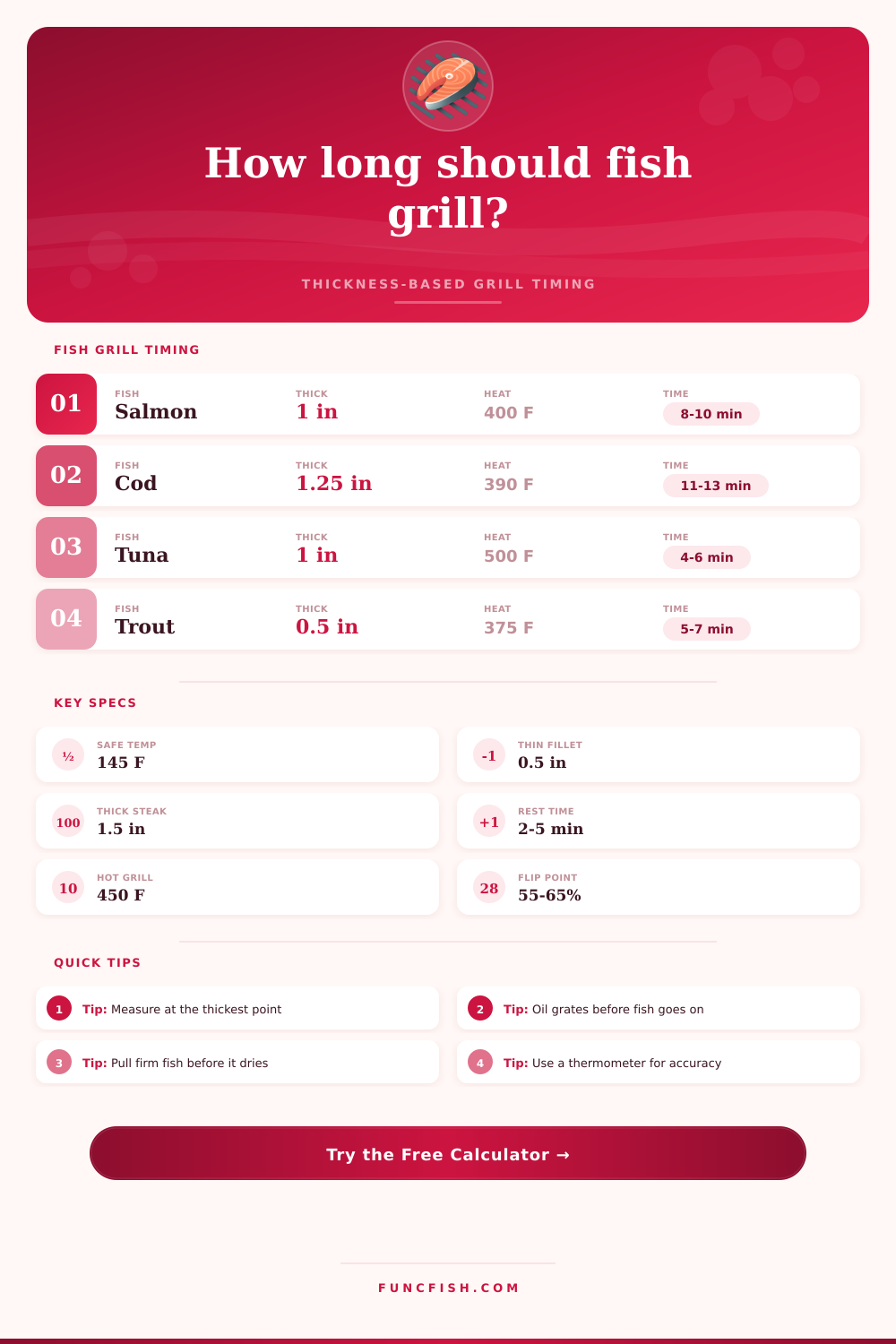
Salmon
Cod
Tuna
Trout
📐Reference tables
| Thickness | Direct heat range | Typical total time | Flip point |
|---|---|---|---|
| 0.4-0.6 in / 1.0-1.5 cm | 375-425°F / 190-220°C | 4-7 minutes | 60% through |
| 0.75-1.0 in / 1.9-2.5 cm | 390-450°F / 200-230°C | 7-11 minutes | 58% through |
| 1.1-1.5 in / 2.8-3.8 cm | 375-425°F / 190-220°C | 10-16 minutes | 55% through |
| 1.6-2.0 in / 4.1-5.1 cm | 350-400°F / 175-205°C | 15-23 minutes | Use lid or indirect zone |
| Fish type | Best grill temp | Time factor | Handling note |
|---|---|---|---|
| Salmon or arctic char | 375-425°F / 190-220°C | Medium | Skin protects the flesh |
| Cod, halibut, snapper | 375-415°F / 190-210°C | Longer | Use a clean grate or basket |
| Tuna or swordfish | 450-550°F / 230-290°C | Shorter | Steak cuts can sear hotter |
| Trout or tilapia | 350-400°F / 175-205°C | Shorter | Thin portions finish quickly |
| Cut style | Timing shift | Flip behavior | Best use |
|---|---|---|---|
| Boneless fillet | Baseline | One gentle flip | Most portioned fish |
| Skin-on fillet | +4% | Skin side longer | Salmon, char, snapper |
| Steak cut | +8% | Even split | Tuna, swordfish, halibut |
| Whole fish | +22% | Turn once with support | Trout, snapper, branzino |
| Plank portion | +28% | No flip | Gentle smoke and moisture |
| Foil packet | +18% | No flip | Very delicate fillets |
| Finish | Pull temp | Final target | Texture cue |
|---|---|---|---|
| Fully cooked / flaky | 140°F / 60°C | 145°F / 63°C | Opaque and flakes |
| Moist medium | 130°F / 54°C | 135°F / 57°C | Moist center |
| Rare tuna-style steak | 112°F / 44°C | 118°F / 48°C | Red center remains |
| Firm steak texture | 132°F / 56°C | 138°F / 59°C | Firm but not dry |
💡Practical checks
Tip: Measure the fish at its thickest point, not at the tapered tail. A thin edge may brown early while the center still needs time.
Tip: Sugar glazes and wet marinades can brown before the center reaches target temperature, so the calculator trims heat intensity and adds time.
Grilling fish require an understanding of how quickly the fish will cook and how the thickness of the fish impact the rate at which the fish will cook. If you dont take into account the thickness of the fish that you are cooking, you risk undercook or overcooking the fish. While many may believe that the time required to grill fish of any type is a fixed number, that time actualy vary with the thickness of the fish.
The thickness of the fish is one of the main variable in the grilling process, but variables like the fat content of the fish and the structure of the muscle within the fish will also impact the cooking process. In order to determine the thickness of the fish, you must take a measurement of the thickness of the thickest portion of the fish. If you take a measurement of the thin tail portion of a fillet of fish, you will take an incorrect measurement of the thickness of the fish, which will impact the cooking process.
How Fish Thickness Affects Grilling Time
In the calculator, the cook must input the thickness of the fish as a variable, as this thickness is the basis for all other calculations of the grilling process. Furthermore, the calculator must also account for whether or not the fish has skin on it or if it is a thicker cut of steak. The starting temperature of the fish is another variable that must be considered in the cooking process.
If the cook takes the fish from the refrigerator, it will be cold, and will take longer to cook than fish that was allowed to reach room temperature. The starting temperature of the fish can impact the total cooking time of the fish by as much as ten percent, especially if the fish is thick. Therefore, the calculator also ask for the starting temperature of the fish.
The type of grill that you use will also impact the cooking process. Grill flames from a gas grill will be steady, however, the heat from a charcoal grill may fluctuate, and the heat from a pellet grill may be gentler onto the fish. Therefore, the calculator will also apply a factor in relation to each type of grill.
Furthermore, the calculator will also ask if the fish has been glazed or marinated, as these ingredient can slow the browning of the fish. The calculator will provide four specific pieces of information to the cooks. First, it will calculate the total active time of the grilling process.
Second, it will provide information regarding the flip point of the fish. Third, it will calculate the pull temperature for the fish. Finally, it will calculate the rest period for the fish.
These four separate calculation provide cooks with information regarding when to act. Therefore, utilizing these four calculations will provide cooks with more reliably than attempting to use visual cues to determine when to flip the fish. The calculator will indicate that cooks should not begin to flip the fish until the fish release from the grill grates.
If the fish begins to release from the grill grates prior to the center of the fish being cook, the fish will be undercooked. Therefore cooks should use the flip point that the calculator determine rather than visually determining when to flip the fish. If the cook is cooking the fish in a foil packet or on a wood plank, it will not be flipped, and the cooking time will be adjusted accordingly in the recipe.
It is also important for cooks to allow the fish to rest after removing it from the grill. If fish is removed from the grill, the internal temperature of the fish will continue to rise, which is referred to as carryover cooking. The pull temperature that the calculator determine is lower than the target temperature for the fish; the pull temperature allow for carryover cooking to finish the cooking process of the fish.
Additionally, allowing the fish to rest permits the juices within the fish to settle. It also ensures that the texture of the cooked fish is the proper texture for the cook and the diner. Thick fish will require more time to allow the juices to settle then thin fish.