Fish Handling Stress Score Calculator
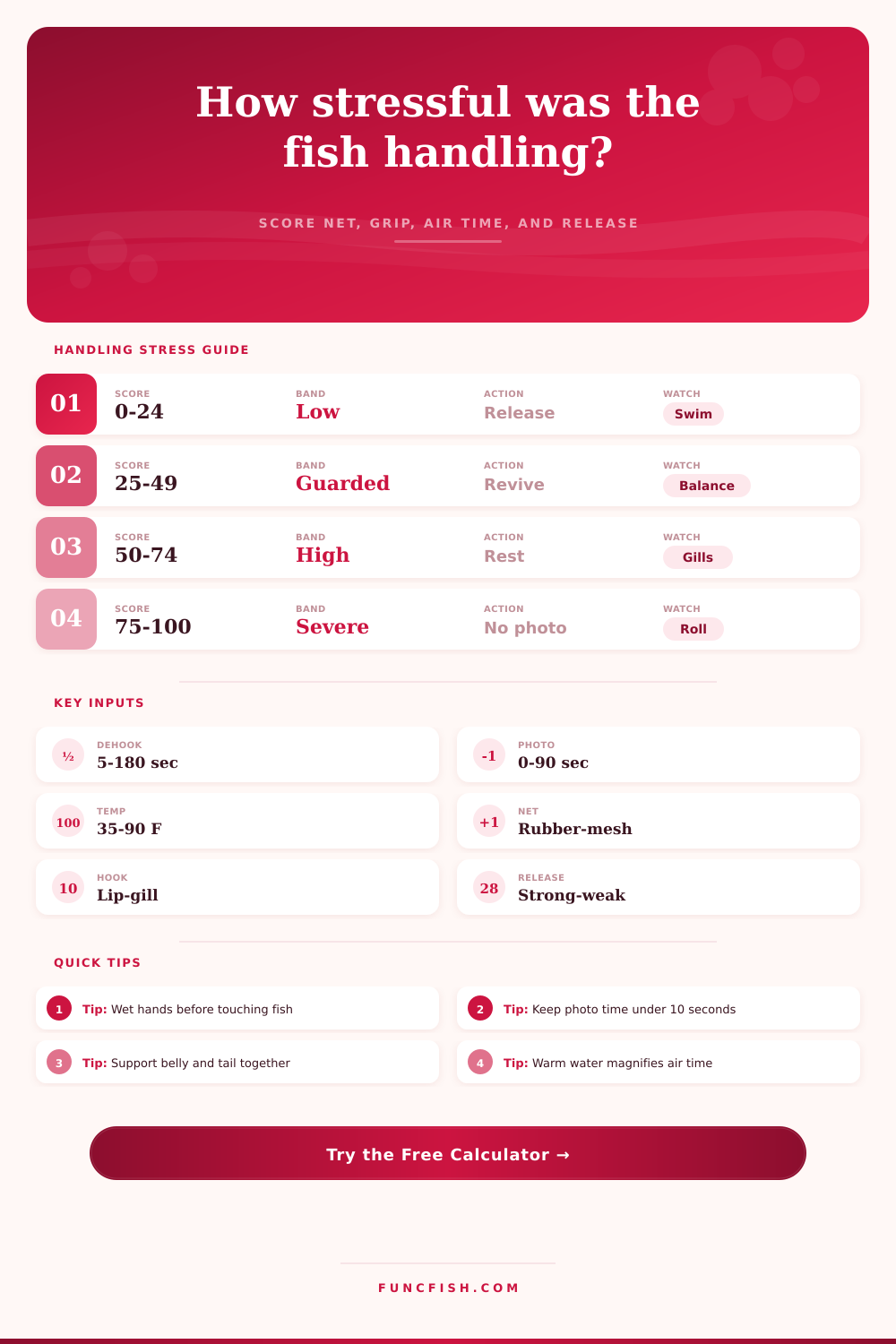
Score a catch-and-release handling sequence from net choice, hand wetness, hook location, air time, support, temperature, species tolerance, and release response.
📌Handling presets
⚙Handling inputs
Handling stress estimate
Score breakdown
📋Gear and species handling grid
Rubber Trout Net
Bass Cradle Grip
Pike Jaw Tool
Wet Sling
Fine Mesh Net
Dry Towel
Dehook Mat
Barbless Setup
📊Handling factor reference
| Factor | Low impact | High impact | Score range |
|---|---|---|---|
| Net type | Rubber mesh | Hard tool | 2 to 24 |
| Hand wetness | Wet hands | Dry towel | 0 to 22 |
| Hook location | Jaw corner | Gill or deep | 2 to 30 |
| Grip support | Cradle | Squeeze or drop | 0 to 28 |
| Air exposure | Under 10 sec | Over 90 sec | 0 to 26 |
| Release response | Bolts upright | Rolling | 0 to 34 |
| Water temp band | Temp F | Temp C | Stress modifier |
|---|---|---|---|
| Cold | 35 to 45 | 2 to 7 | +2 to +4 |
| Cool | 46 to 60 | 8 to 16 | +0 to +2 |
| Comfort | 61 to 68 | 16 to 20 | +0 |
| Warm | 69 to 78 | 21 to 26 | +4 to +12 |
| Hot | 79 to 90 | 26 to 32 | +14 to +24 |
| Species group | Tolerance | Examples | Multiplier |
|---|---|---|---|
| Hardy warmwater | High | Bass, carp | 0.88 |
| Moderate tolerance | Medium | Walleye | 1.00 |
| Sensitive coolwater | Low | Pike, muskie | 1.10 |
| Fragile coldwater | Very low | Trout, char | 1.22 |
| Pelagic or red muscle | Very low | Tuna, bonito | 1.28 |
| Small panfish | Mixed | Bluegill | 0.94 |
| Release condition | Score add | Interpretation | Next action |
|---|---|---|---|
| Bolts upright | 0 | Strong response | Observe briefly |
| Steady swim away | 4 | Normal response | Release done |
| Slow but upright | 10 | Some fatigue | Reduce air time |
| Needed revival | 18 | Stressed | Keep in flow |
| Tilting | 26 | High concern | Support longer |
| Rolling or unable | 34 | Severe concern | No photo |
💡Handling score tips
Tip: Treat warm water as a score multiplier. In high temperatures, shorten every out-of-water step before changing gear.
Tip: The largest improvement usually comes from one wet landing surface, one supported grip, and one short photo lift.
On that hot July afternoon, you hook a largemouth bass and fight her to the net. She flares her gills and thrashes about as you grab camera and hoist her from the water. For good measure, you pick her up a second time for another angle three seconds later. By the time you lower her, she’s gasping and her eyes are cloudy. Her belly is tilted sideways and she swims off, slowly sinking in the weeds.
The memory was preserved. The fish did not fare as well. That’s when your gut feeling goes awry. That’s when scoring comes in.
How the Fish Stress Calculator Works
Metabolic fatigue, air exposure, loss of slime layer, net abrasions, these all add up to stress. But stress isn’t an event, it’s cumulative. The calculator do the math for you. It translates those chaotic variables into a single number: a stress score.
Was this release survivable, or merely tolerated? Or was it survivable? Anglers tend to obsess over where hook is, but fail to account for water temp. That’s the multiplier. Because a fish has a sluggish metabolism in cool water, and because oxygen is more easily dissolved in cold water, the fish could withstand multiple seconds of being out of the water. Push that same situation into 80 degree water and you find that those seconds becomes deadly. That’s why temp modifier is built into the calculator. It acknowledges that each of your mistakes are amplified in warm water.
This isn’t just a matter of how long the fish stays out of the water. This is a matter of how hot the water is when the fish goes back in. When you’re fishing during the heat of the day, there is no room for error. What may be considered normal practice in spring… A knotless rubber net; becomes a source of friction in summer. If the fish are worn out and the fight was lengthy, even the soft mesh of a knotless net can cause pain.
For example, consider the slime coat. It’s more than just slippery; it’s the first line of defense against infection. Contact time is measured in milliseconds. In that short window, dry hands steal it from the fish. And hand wetness factor is a big one in the calculator. So if you have bare skin (not soaked) or a towel that is dry, there will be a penalty.
Here’s when those presets come into play. You pick something like trout and a rubber net, or maybe bass and a quick lip release, and the tool will put a base down. But real world is messy. Perhaps your hands were wet when you landed it but then you gripped it by the lip vertically for a few seconds. Yes gravity does apply to a fish’s internal organs and once its structure break down, no amount of gentle handling will repair it. The grip support input also accounts for this. It separates a vertical lip grip, which puts all of the fish’s weight on its jaw hinge, from a horizontal cradle that spreads that weight out evenly.
The silent killer? Air time. Eight seconds doesn’t seem like much time. You might think it’s nothing. But it matters for panfish. It’s a crisis for a coldwater trout. That’s where the calculator rolls up photo time plus dehooking time and adjusts them based off species tolerance.
Some species are hardy, such as a carp that can get beat up pretty bad. Others are not, like a sensitive trout or pelagic species like tuna. Those multipliers is presented in reference tables that make up part of this tool, and they explain why a one size fits all handling guide isn’t a great idea. What works for a sunfish fails for a musky. Respect the biology.
When the calculator give a high number, there will typically be one factor that pushed it over. In many cases, it’s the combined effect of prolonged air exposure and warm water. You watch the fish as you let it go. Does it roll? Does it bolt straight up? And then there’s the last diagnostic: the release condition input. If the fish swam off evenly, it will have a positive outlook. If it rolled or required revival, it made it through, but only just. This last data point helps calibrate the overall prediction, and it accepts that some damage occurs long before you let go.
You’re not shooting for a score of zero. That won’t happen in the real world of fishing. Instead, you want to keep that stress low enough that the fish will regain its equilibrium by the time a predator comes along. One change lowers that score. Wet your hands. Shortening the photo. Keep the head out of water when reviving. Those little changes compound fast.
Next time you’re lifting that fish out of the water, what are you thinking? Are you thinking about seconds, temperature, or slime? In some cases, it’s single digit numbers, sometimes even less, that make or break a successful release. A number calculator helps you see how those digits can add up. You should of checked the temp first.